AUGUSTO RODRIGUES
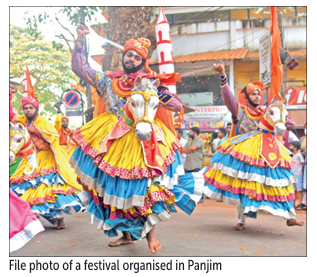
The Depart ment of Tourism spent Rs 49.2 crore on eight major festivals organised from 2022 to 2024 and on pro motion of local festivals from 2021–23, raising questions about wheth er the return on invest ment (ROI) justifies the expense. The eight festivals — Shigmo, Carnaval, Spirit of Goa Festival, San Joao, Food and Cultural Festi val, Deepotsav, Heritage Festival and Chikal Kalo — received Rs 38.77 crore over three years, leaving many locals scep tical of the spending, while government offi cials remain convinced that it is fully justified. Some believe that in vesting in festivals brings new life to Goan culture, while others argue that excessive expenditure al lows a few to profit with out ensuring broader cul tural benefit. “As someone who has spent decades preserving Goa’s tangible heritage — its agricultural tradi tions, village memory, occupational tools, and cultural landscapes — I believe festivals like Car naval, Shigmo, and others deserve both respect and thoughtful policy direc tion,” said Goan artist Victor Hugo Gomes. “These are not tourism inventions; they are vil lage traditions that long predate commercialisa tion. They were once com munity-led rather than centrally produced, rooted in satire, ritual, seasonal cycles, and local participa tion rather than large con tractors and stage-man aged spectacles,” observed Gomes, drawing the line between what was and what is happening now.

The Department of Tourism has been promoting festi vals with the aim of increasing tourist footfalls, spending Rs 10.44 crore on promotion from 2021 to 2023, accord ing to Goa Legislative Assembly records. Gomes warned that commercial scale should not overshadow cultural substance: “The concern arises when commercial scale be gins to overshadow cultural substance. If significant public funds are being allocated, the focus should be parallel — celebration and documentation; tourism promotion and cultural revival; event management and village-level em powerment.” Industry insiders add that promotion spending could be justified if reach were better targeted. “I think the Depart ment of Tourism must sell Goa through its festivals instead of casinos and parties. However, I think their reach has to be specific. I have had guests not aware that a festival is taking place,” stated Karen Rodrigues, proprietor of a bou tique hotel in North Goa. “Our festivals will attract tourists, but they need to know how to sell them. The government needs to find an ap proach that will pull people here for festivals. This is not happening. People come for reasons not linked to the festi val,” added Rodrigues. Tourism stakeholders in North Goa and South Goa, both on the same scale in terms of occupancy, think that the De partment of Tourism needs to do more to draw in guests. Pimpla Costa from South Goa said, “The footfalls would in crease if the festivals fell on long weekends.” Infrastructure investment included Rs 98.7 lakh for six Carnaval venues and Rs 3.13 crore for 18 Shigmo venues during 2023–24. Ernest Dias, CEO of Travel Corporation of India (TCI), said that “there is an increase of mid-range tourists during the festival of Carnaval and Shigmo.” Alongside these, the Directorate of Art and Culture spent Rs 15.05 crore on 18 festivals from 2022-24, including Lokotsav, Monsoon Expression, Balotsav, Natyotsav, Na tional Folk Festival, and Dhalo Fugdi Festival, reflecting Goa’s heritage, arts, and local culture. “Tourists do not come to Goa for festivals,” said Aloo Gomes Pereira, a tourism stakeholder who also organises the People’s Festival in Panjim. “Tourists now come to Goa for drugs and parties. If one sees tourists for such func tions, it is more because of inquisitiveness. The govern ment is wasting money.” Goa’s festival calendar is almost year-round. Carnaval and Shigmo dominate February–March, while San Joao co incides with the monsoon. The International Film Festival of India (IFFI) sets the international festival tone, and the state hosts at least one festival per month, sometimes three or four during the peak tourist season from November to February. Private organisations also host events reflecting the art, cuisine, dance, and way of life of Goa’s past. “Authenticity is not anti-tourism; it is Goa’s strongest tourism asset,” concluded Gomes. “Public spending on fes tivals should therefore deepen cultural roots rather than dilute them. Preservation is not nostalgia; it is continuity. Our festivals can evolve, but they must not forget where they come from.”