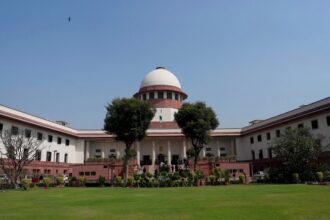
PTI, NEW DELHI: With a killer ‘pea soup fog’ blanketing the national capital for three continuous days, the Delhi High Court and the National Green Tribunal today issued a slew of directions, including implementing the odd-even scheme, to improve the air quality in the city. Hours after the High Court suggestion to bring in the car rationing scheme as was done last year, the Delhi government decided to roll it out for five days starting November 13. The High Court asked the government to consider the option of “cloud seeding” to induce rainfall artificially, as an immediate step to bring down the dust and particulate matter in the atmosphere.
The court, however, did not agree with the quadrupling of the parking fees as was ordered by the Delhi Pollution Control Committee on the recommendations of the Environment Pollution Prevention and Control Authority. The NGT banned construction and industrial activities in Delhi-NCR and ordered sprinkling of water on the roads to minimise dustcontamination.
Similar directions were also issued by the High Court.
As a “pollution emergency” prevailed in Delhi, with levels of PM 2.5 and PM 10 hovering above permissible limits, the authorities said the situation was likely to persist for another 48 hours. An irked green panel also imposed a ban on the entry of diesel trucks more than ten years old and said that no vehicle from outside or within Delhi will be permitted to transport any construction material
The tribunal told the authorities that holding meetings, writing letters and shifting responsibility from one to the other for non-performance can hardly be made an excuse for meeting “such a bad environmental emergency”.
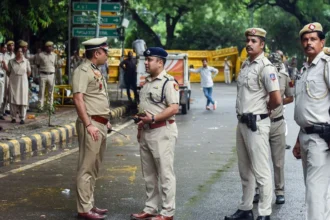
The HC also ordered the Union Environment Secretary to hold a meeting in three days of the chief secretaries of Delhi, Punjab, Haryana and Uttar Pradesh to work out a joint short-term plan to bring down air pollution. Directions were also issued by the bench to the Delhi Traffic Police to ensure there is no vehicular congestion on the roads and provide masks to the personnel on duty.
—
NHRC notices to Centre, govts of Delhi, Punjab, Haryana on ‘toxic haze’
PTI, NEW DELHI: The NHRC has sent notices to the Centre and the governments of Delhi, Punjab and Haryana in view of “life-threatening” pollution levels here and in the National Capital Region.The National Human Rights Commission today criticised authorities for not taking proper steps to tackle the “hazard”, amounting to violation of right to life and health. The rights panel sought reports within two weeks from different Union ministries and the three governments on “effective steps” being taken and proposed to tackle the situation.
“The state cannot leave its citizens to die due to the toxic haze,” it said in a statement. Notices were issued to the secretaries of the Union ministries of environment, health and highways and road transport along with the chief secretaries of the governments of the National Capital Territory of Delhi, Punjab and Haryana. The commission said it had taken a serious view of the “life-threatening” pollution in the Delhi-NCR.
“It is apparent that the authorities concerned have not taken proper steps throughout the year to tackle this hazard, which is amounting to violation of the right to life and
health of the residents in the region,” the NHRC observed. The panel said it expected the health secretary to give details about the preparedness of government hospitals and other agencies to attend to those affected by pollution and steps taken to create awareness among the public. It said there was an immediate need for effective action by agencies at the Centre and states.
Proper implementation of environmental laws was necessary, the statement said. “There is a need for an effective study by experts and proper implementation of their recommendations, including short-term and long-term measures. There is also a need for preventive medical check-ups for the people,” the panel said.
The NHRC also observed that almost every newspaper and TV channel was running stories on the subject. The toxic smog in the city had become “an annual health hazard”, particularly, at a time when the winters were about to start. Several reasons were mentioned, including pollution caused by the vehicles, particularly trucks and heavy vehicles running on diesel, dust participles due to construction work going in and around the Delhi-NCR, burning of stubble by farmers in Punjab and Haryana, the “calm wind condition” and high humidity, which were beyond human control, it said.
Proposals of alternative roads to link the highways to avoid entry of the heavy vehicles inside the cities were being contemplated but “no effective steps” in this regard were taken yet, it said.
Pollutants touched calamitous levels here yesterday, as a thick grey smog hung low across the region, prompting the government to declare closure of schools till Sunday, halt construction activities and ban entry of trucks in the city. In the NCR, Ghaziabad and Noida were the worst affected locations. As per reports, the air quality index (AQI) had slipped into alarming levels.