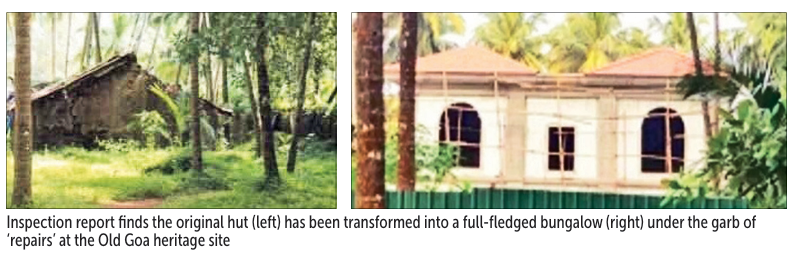
An inspection report submitted to the Supreme Court has shredded official claims that a disputed structure in Old Goa was merely ‘repaired’, concluding in stead that an entirely new build ing was constructed after de molishing the original structure — in blatant violation of heritage protection norms. The report, prepared by a com mittee headed by retired District and Additional Sessions Judge Edgar Fernandes, reveals that the permission dated February 3, 2020 — repeatedly cited by authorities — did not contain a single plan or photograph of the “residential house” purport edly allowed to be repaired at Survey No 4/1 of Village Ella, Old Goa. More damningly, records and photographs maintained by the Superintending Archaeologist, Archaeological Survey of India (ASI), Goa Circle, establish that the structure presently standing on the site is a fresh construction, erected after razing the original building. Copies of the inspection report have now been furnished to the petitioner, Save Old Goa Action Committee, and the respond ents, with the Supreme Court granting three weeks for filing their responses. The report highlights that al though the project was described on paper as “Proposed Repairs/ Re construction of the Existing House and Existing Compound Wall”, the site plan submitted to authorities depicts only a proposed structure, with no representation of the ex isting house — a direct violation ofRegulation 3.2C1(a)(iii) of the Goa Land Development and Building Construction Regulations, 2010.
During the inspection, Town Planner Vinod Kumar Chan dra stated that no photographs of the existing house were submitted while seeking a No Objection Certificate (NOC) from the Town and Country Planning (TCP) Department, despite this being mandatory under Regulation 3.2C1(g) (ii). With no reliable plans or photographs of the structure al legedly permitted for repair, the committee was compelled to rely on ASI records to reconstruct the factual position. The committee examined an 85-page ASI file bearing Inward No 2715 dated January 21, 2020, submitted by Suvarna Lotlikar. Among the documents is a letter dated October 28, 2015 from the Superintending Archaeologist, ASI, Goa Circle, to the Secretary (Archives and Archaeolo gy), Government of Goa, concerning repairs to House No 57 in Survey No 4/1. That letter is accompanied by photographs showing a small structure with a Mangalore tile roof — starkly differ ent from the building that stands today. Further, following an application by original owner Jose Maria de Goveia Pinto, the Director (Monuments-II), ASI, New Delhi, sought a site report in November 2018. The Su perintending Archaeologist responded on November 16, 2018, stating unequivocally that the only structure on the site was a small, dilapidated hut unused for many years. Photographs enclosed with the report match earlier imag es, confirming that it was the same modest structure. The inspection report further demolishes claims that the structure was a residential house. Schedule III of the Deed of Conveyance records that the structure in Plot ‘B’ was a dilapidated ‘loja’ — traditionally used for storing coconuts. Applications submitted by both Suvarna Lotlikar and Jose Maria de Goveia Pinto describe House No 57 as hav ing been repaired in 1986. However, an application dated July 20, 1986 addressed to the Old Goa Sarpanch explicitly states that the structure was used for storing coconuts and housing employees. The accompanying photographs again show a small Mangalore-tiled structure consistent with a traditional loja. The February 3, 2020 permission itself imposed a cru cial safeguard, requiring the Superintending Archaeolo gist, ASI, Goa Circle, to maintain strict supervision over the repair work and document the progress periodically. The inspection report raises serious questions about how such supervision failed to prevent demolition and fresh con struction within a protected heritage core zone. Reacting to the findings, Save Old Goa Action Committee president Fatima Pereira said, “We are happy that the in spection report has found that it was not repairs of the ex isting structure but the construction of a house with rooms. We will not keep quiet until our special leave petition is de cided by the Supreme Court.” Activist Anthony D’Silva of Assolna said, “From the in spection report, it is now very clear that a new construc tion has taken place at Old Goa. No new construction can come up in a heritage core protected zone. The findings show that this is a new construction and it has to be demol ished. The authorities should not play with the sentiments of the people and should accept the decision gracefully. There are innumerable illegalities in the construction of the structure, and a thesis can be written on it. This matter has been prolonged for long, and the authorities should not test the patience of law-abiding Goans.” Activist John Mascarenhas of Ponda said, “A loja, a tradi tional structure used exclusively for coconut storage, was granted permission only for repairs, but was illegally and fraudulently converted into a permanent building, in viola tion of applicable laws and the permissions granted. It has to be demolished.” Activist Glean Cabral of Old Goa said, “The authorities should now act fast, as the matter has been delayed for long. Henceforth, no construction licences should be given without notifying the heritage bylaws, and whatever per missions have been given without bylaws should be scruti nised and withdrawn immediately.” As the matter returns to the Supreme Court, the findings place the spotlight squarely on the institutions tasked with protecting Goa’s most sacred heritage precinct and their glaring failure to do so.