St Francis of Assisi was born in Assisi, Italy, in 1181/82, and he passed away there on October 3, 1226. He was canonized on July 16, 1228 and his feast day is October 4. The lay Third Order, the women’s Order of St. Clare (the Poor Clares), and the friars Minor (Ordo Fratrum Minorum) are all Franciscan orders founded by him. In the early 13th century, he was also a leading figure in the evangelical poverty movement.
Goa was first exposed to Latin Christianity by the Portuguese. Finding new Christians was one of Vasco da Gama’s objectives when he searched for a sea route to India. When he arrived in Calicut in 1498, he was taken aback to discover a flourishing Christian community founded by St Thomas, one of Jesus’ final apostles. Nevertheless, this did not deter the Portuguese from advancing Roman Catholicism, so much that the St Thomas Christians converted to the variant of European Christianity, they brought along.
Following the discovery of the sea route, a group of Dominican friars who arrived as fleet chaplains on Albuquerque’s ships were the first missionaries sent to India. Following the conquest, a church devoted to St Catherine was soon built commemorating their successful re-conquest of Goa on November 25, 1510, St Catherine’s Day.
The Franciscans, who came to Goa in 1517, were the next group that had greater success converting people to Christianity. They actively pursued conversions in Goa and the neighboring regions of India for the ensuing 25 years.

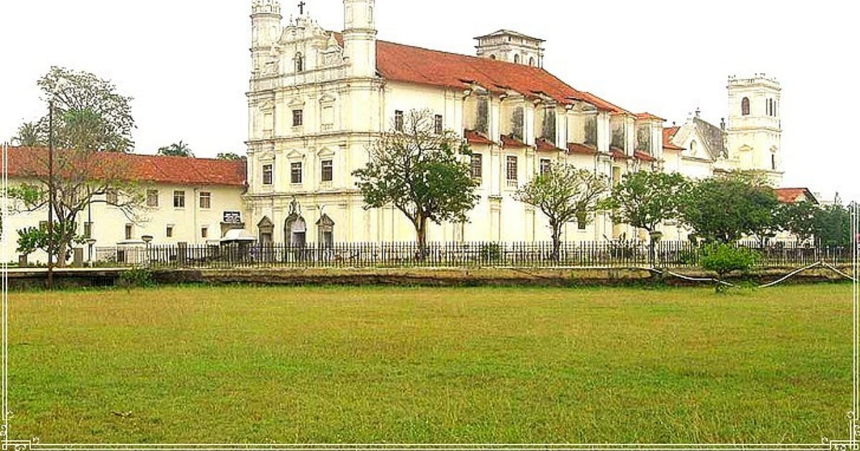
Behind the Cathedral, the Franciscans erected the first Monastery in Goa and occupied it after demolishing their temporary accommodation. The Monastery is thought to have undergone repairs in 1529. Forty friars were housed in “the great convent of the Franciscans”, as St Francis Xavier referred to it in a letter to his Society members in 1548. On the Sovereign’s order, the Government provided them with all the protection they needed and gave them a few modest houses next to their monastery.
The Monastery started to show signs of decay after 150 years, which led to the repair of many of its cells between 1762 and 1765. It was given a few upgrades to increase its elegance and neatness.
The French navigator François Pyrard de Laval did not think twice to refer to this structure as “the richest and most beautiful in the world”. The cloisters, painted in gold, blue, and other colors, with embossed walls depicting the key events in St Francis of Assisi’s life, were now run-down and deserted. Even though they are empty, the building’s enormous hallways, numerous cells, roomy refectory, and numerous other apartments are still impressive. The building’s long, black stone staircase ascends to the upper floor, from which a second staircase takes you to the highest level, known as the Ghat due to its unusual height.
Located across from the gate and with a view of the churchyard, the main corridor’s lower floor housed the monastery’s novitiate apartment. It is falsely stated that the first Mass was celebrated in the vault that this floor is built over.
Constructed adjacent to the monastery, the Church was started around the same time as the monastery and dedicated to the Holy Spirit by Dom Fr. Aleixo de Menezes, the Archbishop, in 1521. This church appears to have received no maintenance, which is why it started to deteriorate. As a result, it was demolished in 1661 and rebuilt. Thanks to the altruistic donations of the local Catholics.
Despite being rebuilt, it kept its original portico, which was used to admit St. Francis Xavier and a number of other famous people. It is likely the only surviving example of Portuguese early-16th-century architecture, other than the Church of Our Lady of Rosary, in the East. It is made of beautifully carved black stone. Rafael Moreira claims that Leonardo Vaz, who was a contractor working in the Mosteiro de Belém, Lisboa, up until 1520, completed this Manueline portico (doorway) circa 1526.