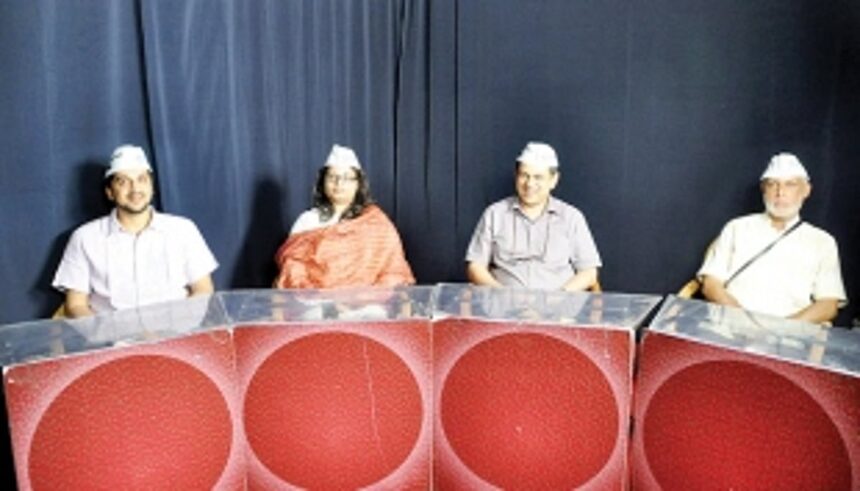
Though there may be similarities in geography between Delhi and Goa, there are many areas in which we are not similar. At the same time, the great hope for Goa is we see a blip in the horizon that may turn into a bright white light for us all. If all goes well, we’ll have a force to reckon with. AAP has the chance to be that force, they might squander it if they don’t do it right, but at least we have the space for a non-Congress, non-BJP, people’s party in the future. Today belongs to AAP. We have a full contingent of AAP senior leaders who have not seen much success in Goa but have a lot of hope. Today’s panel comprises Joao Filipe Pereira who’s been with AAP since its inception, Dr Oscar Rebello who was initially reluctant but eventually joined politics, Rajeshree Nagarsekar who is the state convenor of the AAP and Valmiki Naik co-convenor, who have just returned from a victory rally.
HERALD: The victory is huge in Delhi, but the question is what does it mean for Goa?
Joao Filipe Pereira: I must congratulate the people of Delhi. This being the largest democracy, it is a very favorable result. It goes to show the maturity of the people and in Goa we have a people with a lot of maturity who are also very aware. Taking this into consideration it’s a good place for AAP to come up. During the Lok Sabha elections people knew about us but they wanted to see what AAP could do.
Dr Oscar Rebello: It is certainly something massive for Goa for the simple reason that AAP lives in each and every citizen. The idea of AAP is almost like your alter ego. I do not believe that anybody in Goa is intrinsically Congress or BJP. I believe everyone in Goa is intrinsically AAP. Now the question was whether this could be transformed into an electoral success. We’ve become cynical with the Congress and the BJP.
Even during the parliamentary elections, let’s be honest, we gave everything that it took, everyone putting in their money and efforts trying to get the candidates in. Unfortunately we didn’t get the numbers.
The numbers would’ve showed what we were doing is right. Because for AAP, the currency is people, not muscle power or anything else. Many of us were said to have gone back into our shells etc, it was because we were not getting validation from the people. Today what is so wonderful in Delhi, is that the idea of AAP lives. It’s been historic and heroic.
HERALD: AAP worked in Delhi twice though it hasn’t worked in Goa, do you think there is validation in what Oscar is saying?
Rajeshree: I agree with what he says. After seeing the mandate, I would say that the face of politics is changing. We’ve always said Goa has a lot of scope for AAP, right from being a social movement to a political movement and a political party.
It wasn’t planned, we took the plunge because we were told to contest.
HERALD: AAP was a creation that arose from the movement against corruption. In a way people were strong in Goa, taking to the streets against corruption. But eventually the anti- corruption vote went to the BJP.
But even though BJP has come to power, corruption hasn’t reduced. And you can fight the anti-corruption battle only if people want to. In Goa people are completely connected to the powers that be, therefore in an ecosystem like that, do you think the challenges of AAP in Goa are fundamentally more than the rest of India?
Valmiki Naik: It’s interesting that in 2014, BJP rode on that anti-corruption wave. A lot of people forget that Arvind Kejriwal, Manish Sisodia and many of the main leaders were here campaigning.
That is a big reminder that people should have. Everyone is talking of a shocking verdict. I think except for Delhi, the rest of India is getting their impressions of AAP and Kejriwal from the media.
HERALD: On the contrary, the media was not overtly supportive of AAP, in fact they said the BJP was going to sweep the elections. They had written the epitaph of AAP. The issue is that AAP has won because of people and shown the media, ‘We can win inspite of you guys writing us off’. AAP can be a non-media creation.
Oscar: Fundamentally, the people of this country are very clear with what they want. They want issues of governance and corruption to be tackled, basic bread and butter issues. They were fed up with the Congress because they were self-serving. The BJP, through Modi and Parrikar, rode this anti-Congress wave and in Goa that change has not come. And this is what the people of Delhi realized. Both the BJP and the Congress were not going to address these bread and butter issues. In my mind, this was a vote against the arrogance of the BJP at the center and the sloth of the Congress.
Rajeshree: I’ve met people in Goa who were in Delhi the last time, and they were so disappointed that we resigned. But those days were the best. And then they wanted to give them a chance. This man has been so humble saying sorry to people.
Oscar: There’s a psychological thing. There were a number of people coming for Kejriwal’s meetings, slapping him, and we kept thinking it were some BJP stooges that did that. But I do think they were genuine AAP supporters who were disappointed that he brought the entire plane crashing down. He realized his mistake and went into correction. The problem with BJP and Congress is that they are incapable of corrections.
Rajeshree: All political parties should realise that negative campaigns will not work. In Delhi it worked out as a sympathy vote.
HERALD: Moving to Goa, we have the BJP and the Congress and a vast space that needs to be tapped into. At the end of the day, we realize Congress is not in a position to fill this space, and there’s a positive anti-BJP shift for a variety of reasons. There is a feeling of anger and disappointment, but there is no one to go to. Anyone who loves Goa needs to get critical of AAP. What does AAP or any other party need to do to claim that space?
Valmiki: There are two things: one is to have a direct connect with the voter and to have credibility and have the ability to solve their problems. Whatever the solutions, they have to be positive. We have to start a door-to-door campaign, because we are a little behind there. We have to go to people and set up units and get the issues and create a manifesto. The biggest problem is that all the people you see here are regular people. A lot of people criticized us after the Lok Sabha elections, but we went into campaign mode packing up our lives. Politics is a fulltime job and we need to figure out a way to do this.
HERALD: The biggest strength comes from people who are currently not politicians, like students. The leadership may guide but you need foot soldiers. Is there a plan?
Rajeshree: We are looking at structuring right now. We are working on it. The connect with the people needs to be worked on at the grassroots.
Oscar: The fence sitters who are particularly AAP from academicians, politicians, industrialists, activists, journalists, legal teams have to get into the movement, so that they become part of the thinking community. We need people to participate. My knowledge of politics is almost zero, just what I read in the papers.
So we need knowledgeable people to sell the concept of AAP. Second, we need an idea of what is the future we want for Goa and we need to stand by it. If you want Goa to be an educational hub, you need to stand by it. At the end of the day, politics for people is what’s in it for us.
Herald: The difference between Delhi and Goa is that they are very ambitious, and AAP sinks into a lot of those hopes. Here in Goa, they have it all, their homes and the local politician. They are happy in their comfort zones. In this kind of scenario, what do you do?
Joao: If you see what has happened in Delhi, it is a common man’s party. In Goa, people are looking at new faces because here it’s become a cocoon of politicians controlling power. AAP has to change and put new faces with the younger generation, from the colleges taking up issues of the villages and not take any U-turns.
Oscar: The unique selling point is that we refuse to take a U-turn. That is what the people of Goa and all over the country understand. People are not believing in Narendra Modi because of the number of promises he’s made, logically he cannot live up to them and there are a number of flip flops he’s done on his decisions. It’s better to downscale your expectations.
Herald: Should AAP project itself as a protector of Goa or look at changing itself? Does it have to do a balancing act?
Oscar: I strongly believe AAP has to focus on governance and not on individual communities. The rest will fall in place. Once you get the regional plan, you have to be water tight – this is what we can build, this is what we can’t. You cannot put one community against the other. We hope that for people simple decisions are important.
Herald: If AAP succeeds, well and good, if it doesn’t there’s still a space to be tapped. There’s a lot of hope of good young people, and not so young committed to make a change in Goa, to show that politics is not such a bad word. AAP has shown it in Delhi, will it show it in Goa? Only time will tell.