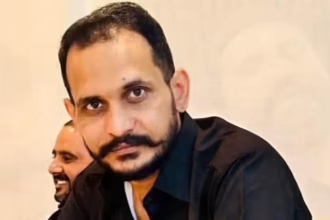
A massive turn out at the historic Lohia Maidan on Sunday evening turned into a strong show of support for Konkani, with activists, cultural fig ures and citizens backing a set of resolutions assert ing that the language must continue as Goa’s sole offi cial language while firmly opposing any move to grant Marathi similar status. The public meeting, or ganised by youth leader Vishal Nogueri and sup ported by groups includ ing the Global Romi Lipi Abhiyan (GRLA), drew a large and diverse crowd, signalling a renewed wave of mobilisation around the language issue in the State. The resolutions adopted at the meeting stated that Konkani—which is includ ed in the Eighth Schedule of the Constitution and rec ognised as an independent literary language by the Sahitya Akademi—remains central to Goa’s identity and must continue as the State’s sole official lan guage under the Goa Offi cial Language Act, 1987.
They further emphasised that Konkani defines Goa’s dis tinct identity as a State separate from Maharashtra. The resolutions warned that any political party or group supporting or promising to grant Marathi the status of a second official language would face a boycott from Konka ni-speaking voters, signalling that the issue could carry electoral consequences. They also described Konkani as the mother tongue and identity of Goans and called for unity across communities to defend its status, while cautioning against any attempt to alter its position. The mobilisation comes amid renewed demands from Marathi proponents, including Subhash Velingkar, a long time Marathi language activist and former RSS Goa chief, for official language status for Marathi—a position that speakers at the meeting opposed, maintaining that Mara thi is already permitted for official use under existing law. Speakers at the meeting included Prajal Sarkardande, Hema Sardesai, Kennedy Afonso, Wilmix, Pratima Coutin ho, Vishal Nogueri, Mariano Belekar, Iftyaz Sheikh, Fidol, Jack Sukija and others, with each reinforcing different as pects of the broader concern over the language issue. Prajal referred to the Opinion Poll and the Konkani agi tation, stating that both were crucial in safeguarding Goa’s identity and warning against any dilution of the language’s status. Hema cautioned against any attempt to alter Konkani’s position in the near future.

Wilmix called for greater youth participation in the Konkani movement, stressing that the responsibility of carrying the language forward now rests with younger generations, while Pratima criticised repeated attempts by Velingkar to revive the language issue, alleging that such moves have in the past led to communal disharmony in the State. A key theme that emerged during the meeting was what speakers described as long-standing discrimination against Romi (Roman script) Konkani. Hema and Prajal highlighted the need to address the divide between Devanagari and Romi scripts, calling for equal recognition and support to strengthen the language in all its forms. GRLA president Kennedy Afonso said a proposal had been suggested to bridge this divide, including a proposal that students learn Devanagari from Std I to VII, with flex ibility in script use from Std VIII onwards. Speakers also pointed to disparities in funding, stating that while Konkani and Marathi academies receive similar allocations, support for Romi Konkani remains significant ly lower, an issue they said must be addressed.