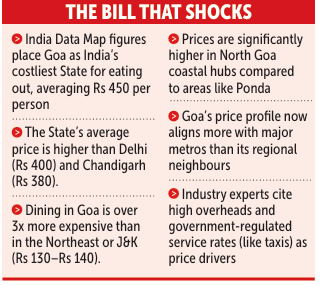
Goa has topped a national comparison of restaurant costs, emerging as the most expen sive State for eating out, with average meal prices estimated at around Rs 450 per person — Rs 50 above the next costliest region, Delhi, and higher than every other State and Union Territory in the country. The figures compiled by India Data Map and widely circulated online in recent days place Goa (Rs 450) above Delhi (Rs 400) and Chandigarh (Rs 380). Other higher-cost regions include Sik kim (Rs 350), Maharashtra (Rs 340), Karnataka (Rs 330), Telangana (Rs 320), Tamil Nadu (Rs 310) and Kerala (Rs 300), followed by Haryana (Rs 290), Punjab (Rs 280) and Gujarat (Rs 270).
In northern India, Himachal Pradesh (Rs 260) and Ut tarakhand (Rs 250) fall within the upper-mid range, while Jammu & Kashmir (Rs 140) and Ladakh (Rs 180) are posi tioned at the lower end. Across central and western India, Rajasthan (Rs 180), Madhya Pradesh (Rs 180) and Chhattisgarh (Rs 160) re flect moderate pricing. In the eastern region, West Bengal (Rs 210) and Odisha (Rs 200) fall within the mid-range, while Jharkhand (Rs 170), Bihar (Rs 150) and Uttar Pradesh (Rs 190) remain among the lower-to-mid-cost States. The southern region presents a mixed picture, with Andhra Pradesh (Rs 220) in the mid-range alongside high er-cost States such as Tamil Nadu (Rs 310) and Kerala (Rs 300). Among the most affordable regions are the northeastern States — Arunachal Pradesh (Rs 130), Nagaland (Rs 130), Manipur (Rs 130), Mizoram (Rs 130), Meghalaya (Rs 130) and Tripura (Rs 130) — along with Assam (Rs 140), all reflecting significantly lower average dining costs. These figures are broadly estimated across the cluster and may not reflect granular state-level variation. Among Union Territories, Puducherry (Rs 240), Anda man & Nicobar Islands (Rs 230), Dadra & Nagar Haveli and Daman & Diu (Rs 220) and Lakshadweep (Rs 200) are placed within the mid-range. The figures are based on average meal costs at afforda ble to mid-range restaurants, drawing on city-level cost-of living aggregates to present a broad national comparison of everyday dining expenses. The Rs 450 figure represents a State-wide average; actual costs in Goa’s coastal tourist belt — particularly in the North Goa corridors of Calan gute, Baga and Anjuna — will run considerably higher, while inland areas such as Ponda and parts of Margao will sit well below that figure. According to the dataset’s broad assessment, States with stronger urban and tourism-linked economies tend to record higher baseline dining costs, a trend reflected in Goa’s position at the top of the chart. The State’s cost profile now sits closer to India’s major metro cities than to its regional neighbours — a shift that marks a significant change from even a decade ago, and one that Goans living abroad are likely to notice on visits home. Industry stakeholders, however, maintain that pricing reflects ground realities, including operational costs and the structure of a hospitality sector that caters to a wide mix of domestic and international travellers. They point out that several cost components in the State, including taxi fares, are government-approved rates, even as percep tions around overall expenses continue to persist. The comparison, based on data compiled by India Data Map, has gained wide circulation on social media in recent days after being visualised in map form, sparking discus sion around the rising cost of eating out in tourist-driven regions.