MARCOS GONSALVES

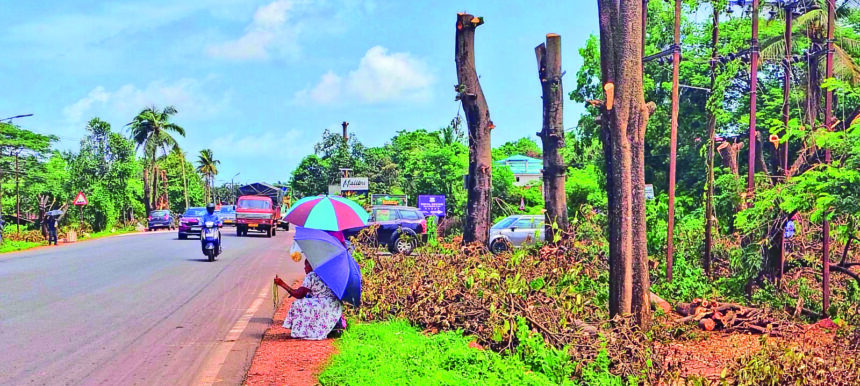
MARGAO: Development often leaves behind a quiet trail of heartbreak. For decades, the towering trees along the Verna highway were more than just green cover—they were silent companions and protectors for the local women selling fruits and flowers. Today, those majestic canopies are gone, replaced by a scorching open sky and small umbrellas. The profound personal and environmental loss felt by a community whose living heritage has been reduced to stumps.
Gazing at the empty stretch where a massive tree once stood, Francisca Fernandes, a flower vendor, said, “We spent most of our lives under these trees as they protected us from the sun during summer and sheltered us during heavy rains. We never imagined they would disappear one day.”
Minguelina Fernandes, another local fruit vendor said, “For decades, these trees formed a natural marketplace along the highway. Customers would stop not only to purchase flowers, coconuts, fruits or vegetables but also to enjoy the cool shade offered by the sprawling branches overhead. The trees created a welcoming atmosphere and became landmarks known to generations of residents.”
Several vendors recalled arriving early in the morning and spending long hours beneath the trees. During sudden monsoon showers, they would gather their baskets and goods closer to the trunks, confident that the dense foliage would provide some protection until the rain subsided.
“Now when it rains, we have nowhere to go. The umbrellas help only a little. The trees were much stronger than any umbrella. They were our shelter,” said Rosario Dias, an elderly vendor.
The tree felling has left many women emotionally affected. Some described the trees as family members that had accompanied them through different phases of life. They had watched children grow into adults, witnessed festivals and processions, and stood through countless seasons.
Environmental concerns have emerged among local residents, many of whom fear that the absence of the mature trees will lead to higher temperatures along the highway and reduce the area’s green cover. The old trees were home to numerous birds and small creatures that have now lost their habitat.
“The road may become wider, but the environment has become poorer. These trees took decades to grow. Their value cannot be measured only in terms of land or development,” remarked Remedious Dias, a resident who frequently purchases flowers from the vendors.
For the vendors, the loss is deeply personal. While they understand the need for infrastructure projects and improved roads, they feel that the disappearance of the trees represents the loss of a living heritage that connected people to nature.
As vehicles continue to speed past the newly cleared roadside, the absence of the trees is impossible to ignore. The open sky has replaced the comforting green canopy that once stretched above the vendors. What remains are memories of cool afternoons, conversations shared in the shade, and the reassuring presence of trees that asked for nothing while offering so much.
The road extension project will eventually be completed, and traffic will move more efficiently through Verna. Yet for many women who earn their livelihood by the roadside, the empty spaces where the old trees once stood serve as a reminder that development often comes with a price—one that cannot always be counted in kilometres of road or minutes saved in travel time.
For them, the trees were more than part of the landscape. They were silent guardians of a way of life, and their loss has left a void that no umbrella can ever fill.