ANIL KUMAR MISHRA
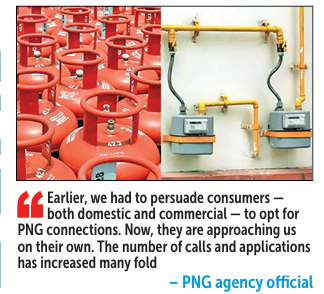
What was once a hard sell is now in high demand. Across Goa, a decisive shift is underway – con sumers who once hes itated to abandon LPG cylinders are now active ly seeking Piped Natural Gas (PNG) connections. The trigger is not policy persuasion, but disrup tion — a cascading sup ply crunch linked to the ongoing crisis in West Asia that has choked LPG availability and ex posed the fragility of cyl inder-based supply. The reversal has been swift. “Earlier, we had to persuade consumers — both domestic and com mercial — to opt for PNG connections. Now, they are approaching us on their own. The number of calls and applications has increased many fold,” a PNG agency official said. This surge in de mand is being felt most acutely in Goa’s tour ism-dependent econo my. Hotels, restaurants and beach shacks — the backbone of the hospital ity sector — have strug gled to secure steady LPG supplies in recent weeks. With kitchens running on uncertainty, many establishments are no longer waiting for supply chains to stabi lise; they are switching.

In households too, the shift is becoming visi ble. Residents who once viewed PNG as option al are now treating it as essential — a hedge against unreliable cylin der deliveries. The State government, which had been steadily promoting PNG adoption over the past few years, now finds itself respond ing to — rather than driving — demand. Offi cials have reiterated the advantages of piped gas, including uninterrupt ed supply and reduced dependence on logis tics-heavy cylinder dis tribution, while stepping up coordination with gas distribution companies to manage the surge. In areas where PNG infrastructure already exists, authorities have gone a step further — urging consumers to transition fully and, in some cases, surrender LPG connections.
There are also indications that LPG supply could be gradually curtailed in such zones to discourage parallel us age and accelerate the shift. The push has extended to the highest levels. Last month, amid mounting concerns over gas availability, Chief Secretary V Candavelou chaired a high-level meeting to fast-track PNG adoption. He called on Goa Natural Gas Pvt Ltd and Indian Oil Adani to ramp up domestic meter installations and expand pipeline networks, setting a clear target: ensure all house holds in gasified areas transition to piped gas. More recently, Chief Minister Pramod Sawant sought to reassure the public, stating that PNG supply would remain uninterrupted and urging residents to either restore inac tive connections or apply for new ones.
Yet, the transition is not without friction. PNG services remain confined to select urban centres such as Ponda, Tiswadi, Vasco and Margao, leaving several key coastal tourism belts — where demand is now peaking — outside the network. Infrastructure rollout continues to be slowed by regulatory bottlenecks, execution delays and concerns over connection timelines and costs. For industry stakeholders, the message is clear – de mand has outpaced infrastructure. The current moment, however, marks more than just a supply adjustment. It reflects a structural shift in consumer behaviour — one where crisis has succeeded where policy nudges struggled. The LPG shortage, while disruptive, has effectively compressed years of gradual transition into a matter of weeks. In doing so, it has flipped the narrative. PNG is no longer a future-ready alternative being pushed by the government. In a State grappling with uncertainty in fuel supply, it has become the present-day solution con sumers are actively chasing.