AUGUSTO RODRIGUES
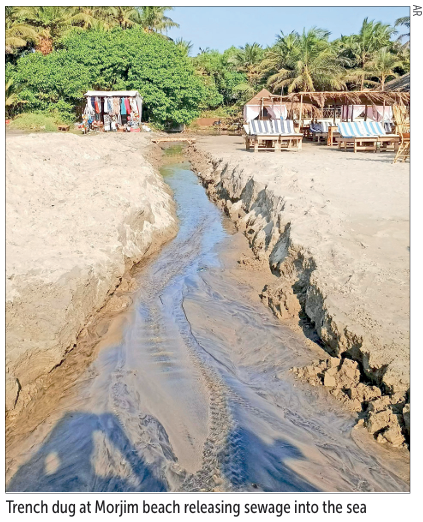
GAUREWADA, MORJIM: Tourists and locals in Mor jim were in for a shock on Sunday morning when a JCB dug a one-metre-deep trench across the beach, re leasing sewage directly into the sea and forcing many foreigners to abandon their daily swim. “I have been coming here for years to swim and it was disgusting to see sewage flowing through a trench dug this morning. How does the government expect us to swim with filth all around?” asked French actor Mari anne Borgo. “The entire place is dirty now. Apart from sewage floating in the water, empty plastic bottles are strewn all over the beach and even trees are being cut,” Borgo lamented. Several tourists lounging on sunbeds ech oed her concerns, saying that by allowing sewage and garbage to spread along the beach, the tourism de partment itself was driving visitors away. Morjim beach falls within the Coastal Regulation Zone (CRZ), where sand mining and the discharge of un treated waste are strictly prohibited under the Ga zette of India notification dated January 18, 2019. The beach is also a notified turtle nesting site, making the violations even more serious. “It is very clear from the rules laid down by the gov ernment that sand mining is prohibited even if it is not a turtle nesting beach. When turtle nesting is involved, it adds another layer of con cern if destruction takes place in these areas,” said retired Captain Gerald Fer nandes, winner of the first Goa government award for turtle conservation.

Adding to the alarm, Aaron Fernandes, member of the Sub-Committee of the Goa State Biodiversity Board Strategic Action Plan (GSBBSAP) for herpeto fauna, mammals and associated species, warned that the situation poses grave risks to marine life, particu larly the Olive Ridley sea turtle. “The Olive Ridley Sea Turtle, while globally abun dant, is still classified as vulnerable on the IUCN Red List, and its story in Goa is not a happy one,” Fer nandes said. “Sewage and other pollutants dumped into the sea from beach restaurants is a known fact and often gets exposed during the monsoons when sand shifts.” Fernandes explained that sea turtle breeding be haviour, including mating, takes place just offshore, with only females coming ashore to nest. “I am un aware of how this concentration of pollutants in the near-shore zone may affect breeding behaviour,” he said, pointing to the lack of scientific assessment de spite mounting evidence of contamination. He also cited a 2023 study by the Central Pollution Control Board (CPCB), which revealed high levels of faecal coliform bacteria in Goan waters. The Goa State Pollution Control Board later attributed this to raw, untreated sewage being discharged into the sea. “The inaction to apply this knowledge to effect change in dicates the sad state of offshore marine conservation and the level of corruption within various govern ment departments,” Fernandes observed. Residents are also disturbed by rampant noise and light pollution at the beach, particularly at night. De spite Morjim being a declared turtle nesting site, loud music and glaring lights from beachfront restaurants continue till the early hours. “I have made numerous complaints to the police about restaurants playing loud music throughout the night with disco lights falling directly on the beach, but no action has been taken,” alleged activist Mayur Shetgaonkar. “Despite clear rules prohibiting music and bright lights after sunset, trance parties go on till morning. The owners appear to be highly connected.” Morjim beach, residents say, is unrecognisable from a few years ago, with newly built beachside res taurants increasing volume as evening sets in, even when there are hardly any guests. Promising action, Mandrem police inspector Giren dre Naik said, “I will take action against all establish ments playing loud music along the Morjim stretch. I know the rules and will ensure this does not happen again.” Apart from sewage, sand extraction and noise pol lution, the absence of garbage bins along the 3.5-km stretch of the beach has worsened the problem. “I walk the entire length of the beach every morn ing collecting empty beer bottles and plastic left be hind by tourists who drink at night,” complained Kad, a French national who voluntarily cleans the beach. “Sometimes there are so many bottles that I have to bundle them and leave them at spots, hoping the cleaning staff will pick them up. Many times, they don’t.”