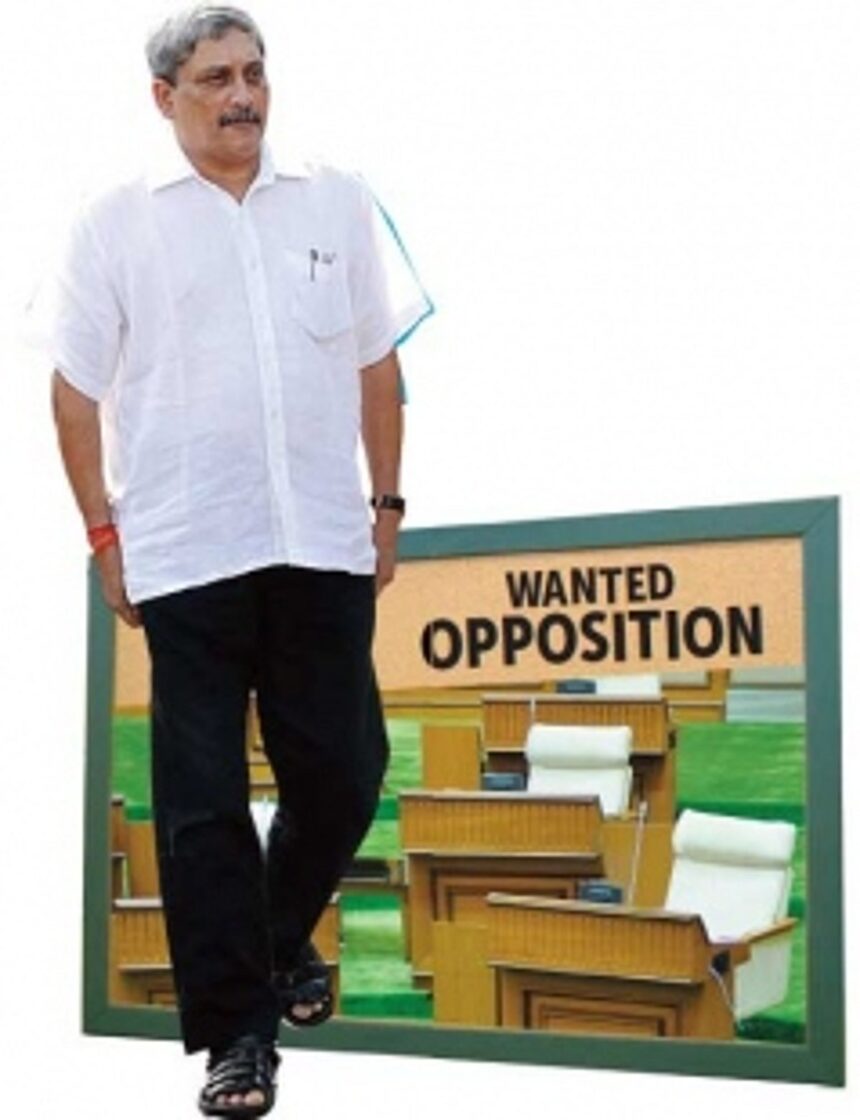
Power controls. And absolute power controls absolutely. Goa is beginning to understand the pitfalls, dangers and the difficulties of giving absolute power. The leading opposition is technically of 9 MLA’s but looks like 1. This monsoon
session was the final assertion, if ever there was needed that the checks and balance system that democracy provides through an opposition, has collapsed. There was no strategy, and co coordination as on issue after issue the government-read the Chief Minister, went through and took decisions, or postponed them at complete will. The chief minister was questioned more by the media than by opposition MLAs. The chief minister took out his ire on the media, alleging and arguing that they were unnecessarily blowing up some issues and taking others out of contest. In fact a noticeable feature was that most of the sessions he referred to the media or articles in the media that were critical of the government even as he took potshots at the Congress. The absolute non opposition and the absolute rule of the chief minister over the ruling coalition where even MGP MLA’s Sudin Dhavlikar, Deepak Dhavlikar and Lavoo Mamledar couldn’t hold their own was the hallmark of the session
Herald made an effort to bring to you an extensive coverage of the monsoon session. This package sums it all up because it is important to know how our MLA’s and have they been worthy of the job we sent them to do.
The opposition was not working as a team but as a group of individuals forced to sit together; a loose coalition. There was no floor management, no support for their colleagues during arguments and no defense even when there were open potshots taken at their previous government. The leader of opposition was more interested in taking about his farming days as well as cows and milk than to attack the government. In most cases where there were issues of importance for the State, there was only one man fighting – the person who asked the question. But this was easily handled by the Chief Minister Manohar Parrikar or some of his MLAs were let loose to hassle the questioner who was literally hounded and made to look like as if he was asking irrelevant questions. Naresh Sawal, the Bicholim MLA was made to look silly after the Health Minister
flatly refused to believe that there was a water problem at GMC. Sawal was also made to look silly on the issue of veterinary medicines not being available in veterinary hospitals at Bicholim with the minister backed by Parrikar absolutely refusing to believe him. The government kept a very firm grip on the opposition and even the outspoken independent MLAs were basically forced to get into shouting matches to get their point across and there is no unity among those sitting on the opposition benches.
Reginaldo Lourenco was literally forced to shout while raising the issue of the bridge across the Tiracol River. And then was told to tone down his voice. In fact there have been instances where the leader of opposition himself had come to the help of the chief minister – where wittingly or unwittingly is the million dollar question.One issue which comes to one’s mind
is the discussion on the Regional Plan. Lourenco managed to provoke the chief minister and if it was not for the intervention
of the Leader of Opposition Pratapsing Rane, whose took off on the ills of gram sabhas and the petty jealousies of Goans, the set and match would have surely been with Lourenco’s. Long pending issues like the Regional Plan, planned compromise withthe SEZ
promoters, traditional coastal dwellers issues and the reiteration of the chief minister that he would not auction leases
came up. But there was no concerted attack on government. If anything it was the ruling MLAs who attacked the government on issues like law and order roads, etc. Calangute legislator Michael Lobo brought to the notice of the House that crime in the coastal belt is happening on a ‘day-to-day’ basis leaving a bad impressing on tourists. “Tourists go back with bad experience in the State… There are continuing thefts with no detection…” he said, pointing out to the government machinery’s
failure to arrest major drug lords and curb rampant drugs menace as drugs, that he alleged were being largely pushed bythe Nigerians. “Drugs are common in the coastal belt. Cocaine is easily available here as Nigerians who are on student’s visa are pushing drugs in the area,” he alleged. “Nigerians are moving into every by-lane of Calangute. They are directly asking the tourists whether you want coke, which means cocaine. They have not spared the local youths too who
are consuming these drugs.” Another BJP legislator Kiran Kandolkar also took on the police department asking them to crack down on burglaries and dacoities. “The police should arrest those outsiders who commit murder and flee from the state,” he said. The House saw individual skirmishes with the Fatorda MLA Vijai Sardesai, the lone voice of the opposition. Surprisingly there were a lot of issues that the government could have been pinned on. But because the sins of omission and commission were not properly
put up, the chief ministers managed to diffuse
the situation or the speaker did not
allow it to go further.
The Leader of Opposition Pratapsing
Rane did not speak and take on the government
on issues like the really important
ones be it the RP or the SEZ. He was quiet
even when the chief minister chose to attack
the performance of the previous government
in the presence of the former
chief ministers and other ministers with no
one getting up to defend the government
or the party.
Another striking fact is that this time
BJP MLA Vishnu Wagh has been very quiet
– in stark contrast to earlier sessions – and
was mostly active in innocuous discussions
like congratulatory motions.