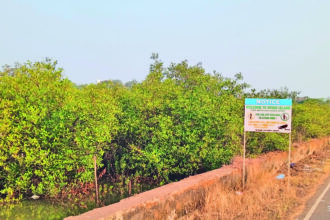
A night spent under a canopy of stars, a serenity broken only by the crashing of waves. This is the Siridao that villagers carry in their hearts. Today, the canopy has been snatched and the melody of waves has been replaced by the cacophony of loud music and fireworks.
Once a haven of traditional toddy tappers, fishermen and farmers, this village strived to maintain its identity. While other more famous seaside villages such as Calangute and Anjuna were fast losing the battle against unplanned tourism, Siridao had managed to stay out of the clutches of such “progress” till as late as 1996.
Several years ago, while some fishermen decided to welcome modernisation with mechanised fishing, the villagers opposed building a jetty in the village as it would disturb the ecosystem. Little did they know that a jetty was the least of the dangers that loomed round the corner.
From coastal regulation zone (CRZ) violations, to hill cutting, to deforestation, to damage of heritage, Siridao is slowly but surely heading towards construction doom.
Sarpanch for the last two and a half years, Anthony Afonso believes it is the Town and Country Planning (TCP) that is squarely responsible for this realty wreck in the village.
“We (the local Panchayat) are just like a post office. TCP is the one giving all the approvals (to these realty projects). Some of the residential bungalows being built in Siridao are also mega projects,” he says.
According to Afonso, the moneybags investing in Siridao approach higher authorities such as the Director of Panchayats if permissions are delayed at his level, and then he is pulled up to explain the delay. He has even been accused of delaying projects for monetary gain.
The sarpanch says the TCP should be more cautious in granting approvals and licenses. “We read media reports about villas costing Rs 7 to 9 crore, but if you see actual costing submitted to the panchayat, it is hardly Rs 40 lakh. This is what TCP should look into. The government should come up with firm policies,” says Afonso, adding that the TCP has been warned that the current infrastructural capacity of the village cannot bear the volume of construction activity.
Architect Dean D’Cruz, a member of the state-level committee on the Regional Plan (RP) 2021, says the RP 2021 is being selectively applied in Siridao. He believes corruption has much to do with this.
“There are violations on slopes in the village too. TCP was supposed to verify the marked slopes, which hasn’t been done. Ground verification is not taking place,” he says.
Over the last eighteen years, villagers have seen their little piece of heaven being shredded, bit by bit. According to one villager, in 1998-99, the bhatkars of Siridao, one of Goa’s oldest mining families, through their real estate arm submitted a development plan in the panchayat, saying they were dividing their property into plots and selling them.
“At the time, villagers were not very active in the gram sabha, only the sarpanch and members took decisions. Locals had expressed their interest in buying plots, but they were not considered,” says one of the villagers.
But the real damage started, they say, around 2005 when the bhatkars tied up with a Goan construction company, which is when all this property was sold to outsiders.
“Villagers did not know what was happening until a mega hotel project was proposed near the cemetery in 2006. People protested and the licence was revoked then. Now another project is coming up there,” says a resident, John Pinto.
On the property in question, villagers say that while the initial hotel project proposal on survey numbers 38 and 36 was stopped, the party reapplied seeking permission to build ‘residential bungalows’ in survey number 38, but with three other parties, among them an established local builder.
Incidentally, all four parties were informed by Goa Coastal Zone Management Authority that the entire survey number 36 and part of survey number 38 are earmarked as ‘no development zone (NDZ)’ owing to its proximity to the high tide line (Herald Review has a copy of the letter).
“There were natural terraces in this property which have been levelled out. Pits have been dug up for construction purposes, and our hills have been destroyed. There was also an ancient water tank, which was part of our heritage. The underground canal which filled this tank has been cut off with the construction activity. During the monsoons, there was a canal outlet which carried excess water to the fields. Once they started constructing, the stones ruined this tank completely. Now we are told the party has licences for putting up residential bungalows. The government should check if the work on this project is being carried out based on provisional or final clearances,” says Nicholas Fernandes, a resident of the village.
Local ramponkars are also upset that their traditional access on this property from where they would pull in their nets has been blocked.
“We have asked the panchayat to mark the open spaces, but they are not doing that either,” says Peter de Souza from the village.
When asked about this, sarpanch Afonso says, “This should have been taken into consideration by the party that sold this property to the developer. What can I do?”
Interestingly, despite being a No Development Zone, two names that feature in survey number 36/0 Form I&XIV, as per the Directorate of Settlement & Land Records, are Siridao Estates Pvt Ltd and MLA Rohan Khaunte’s brother, Rajesh Ashok Khaunte.
According to locals, the government departments are in cahoots with the violators.
“When we approached the land survey department for contour maps, they refused. They asked us to approach military personnel or the central land survey department in Hyderabad,” says John Pinto.
Another disputed project in Siridao is one adjoining Survey no 38.
Emgee’s project ‘Naira’ in survey number 43/1-B was launched by Bollywood wives Susanne Roshan and Gauri Khan. In June this year, Emgee Properties was served a showcause notice by the office of the Collector, North Goa. The flying squad team issued a showcause notice, stating that they observed that hill cutting was done for a length of 25 metres, breadth of 4 metres and to the height of 2.5 metres (approximately).
“We brought stop work orders from the Collector, but they continue to build. They have cut our hills, but when we approached TCP they say the cutting is required for the footing of the foundation. The plans show swimming pools. We get water for one hour a day, sometimes not even that. How is there so much water to supply to these villas? Electricity is a problem. Garbage is a bigger problem with people dumping waste in the sea,” says Peter de Souza, his lament seemingly lost in the glitz of change being forced on this coastal village.
Review Bureau