I am an oceanographer and spend a big chunk of my time at sea. I live in New York City and work at an institution that studies all aspects of our planet’s climate, its health and sustainability. Someday when I decide to hang my gloves, I hope to own a small sailboat and spend my time sailing the rivers and the coast of Goa. I am not alone in my thoughts. I foresee many Goans doing so, and in the near distant future, Goa inevitably becoming the number one destination in India for boat lovers. I am therefore completely in favor of the idea of establishing marinas in Goa, provided their impacts on the environment are minimal. Many have questioned whether this is possible. I do think so because Goa has been blessed with abundant rivers and waterways and with carefulsite selections, proper planning and minimal environmental degradation, waterfront enclaves are possible.
Two marinas have been proposed for Goa; surprisingly both close to each other; one in the village of Sancoale and the other just across, along the northern bank in the village of Nauxim. The 1,00,000 m2 Marina in Sancoale Bay is expected to provide berthing and maintenance facilities for 311 boats, while the even larger,1,50,000 m2marina proposed in Nauxim Bay, is expected to cater to over 400 boats. Even by international standards, these projects are huge and ambitious, begging the question whether the River Zuari has the carrying capacity for two such massive projects in the immediate vicinity of each other. Both projects appear to have the tacit support of the State and Central Governments who claim that the new projects and the ancillary industries that will grow around them will create much needed jobs for the locals.The proponents of the marinas argue that these projects are exactly what Goa needs to attract the high end tourists needed to take the tourism and hospitality industry in Goa to the next level.
So why is there so much opposition to thesetwo projects and for that matter, many other job creating projects such as Mopa Airport or the Def Expo that the Govt. announces? One of the biggest problems is that locals most likely to be affected are seldom consulted before a project is announced. Furthermore Environmental Impact Assessments (EIA) for these projects are rarely undertaken in a transparent manner. Most EIA studies are undertakenonly after the projects are announced and unfortunately in complete secrecy. The final EIA report is rarely placed before local bodies,and the entire process seldom encourages debate or seeks the views of the people likely to be affected.
The Goa State Bio Diversity Boardunder the chairmanship of the former Minister of Environment, Mrs Alina Saldanha argues that the entire region downstream end of the River Zuari should be declared as heritage park because of its rich biodiversity. She has gone on record to state that the two marinas would cause irreparable ecological damage to this fragile marine ecosystem, a claim that is vehemently denied by the proponent of the project in Sancoale Bay based on an EIA study commissioned by his consortium.
The EIA report for the Sancoale Bay marina project was undertaken by the National Institute of Oceanography (NIO) in 2012. The sampling and measurements cover aspects of the river flow, chemistry as well as the river’sbiology, but sadly lacks anaccount of the exceptionally rich flora and fauna within the site of the proposed marina. Instead the report is padded with undesirabledetails, bad graphics, inaccurate satellite imagesand ambiguities in support of conclusions that are disturbingly misleading.
It makes me sad, that an institution that I greatly respect and admire and where I had begun my career, could submit a report that is so deliberately disingenuous. Terming the destruction by the proposed marina to the habitat of Sancoale bay as minimal and temporary is untruthful. A visit to the Bay will immediately make you realize why the locals are up with pitchforks in protest against this project. Sancoale Bay and the bays in the vicinity are teeming with marine life, and areamong the richest and most biodiverse bays along the banks of the Zuari. Locations close to the proposed marina, like Chicalim and Nauxim Bay’s (the site of the other marina project) are also hotbeds of window pane oysters, a species declared as endangered and protected under Schedule IV or the Indian Wildlife Protection Act, 1972.
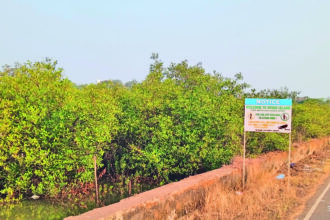
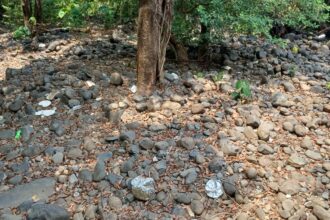
The shore-line of Sancoale Bay has mangroves but not as thick as elsewhere up the river. Thisis probably the only accurate information in the EIA report. But there is a reason for this. Unlike other clayey intertidal locations along the margins of the river and where mangroves abound, the shoreline of Sancoale Bay is made up of millions of loose calcareous shells an obvious sign of the diversity and richness of marine life within this bay. The intertidal area is hard and rocky, and low tides expose vast swaths of oyster beds that have flourished on this substratum since time immemorial. During spring tides, a narrow path of the substratum is exposed permitting the harvesting of large clams in the outer bay. Until several years ago, the remains of the shells from a thriving oyster and clam fishing industry and from the dead mollusks that wash ashore were used for making white wash used for painting of the exteriors of homes and religious edifices.Even to this day, the bay is invariably filled with people either collecting clams, picking oyster and crabs or stake net fishing.
The construction of the marina will require either dredging or blasting out of existence over 1,00,000 m2 of extremely rich and biodiverse rocky substratum to create 5 m deep berth pockets for 311 boats. Also included in the project is a deeper navigation channel to facilitate entry of boats into the marina which will be sheltered by a tall concrete breakwater. Construction in the river will alter the flow and circulation within the bay. The report states, that the currents in Sancoale Bay are only tidal and extremely weak. If this is true, the construction of a tall breakwater and the creation of 5m deep pockets, will only lead to development low oxygen zones preventing recolonization of the bay by benthic life.
The magnitude of the environmental damage likely to be caused by the project, begs the question, how did these scientistserr so badly in their assessment of Sancoale Bay? The answer is rather simple. Setting up an industry in India requires the project proponent to provide an EIA report. Invariably it is a Governmental or an accredited non-Governmental agencythat is contracted to undertake this study. The costs involved are at times huge and this arrangement invariably makes these agenciesbeholden to their sponsors and not to the environment that we rely on them to protect. A day’s worth of sampling in Sancoale Bay instead of the lakhs of rupees spent on an unnecessary EIA, should have convinced the scientists about the inaptness of this location for the marina.
The study by NIO shockingly makes no mention of the: 1) the irreparable damage it would do the window pane oyster and clam beds downstream of this site, 2) the impact the project would have on the surrounding families and their lifestyles, 3) the number of fishermen likely to be affected by the project, 4) the proximity (less than a km) to a ASI protected site, the remains of the Church of our Lady of Good Health, The report makes no mention whether any local bodies were consulted during the conception phase of the project or during the initiation of the EIA essential to the report’s conclusions
Any large project that has the potential to affect the lifestyles and incomes of the local population should have covered all these aspects. Even the Pope’s recent Encyclical “Laudato Si – On Care for Our Common Home” a document embraced by political heads of state and religious leaders of all faiths worldwide, has a special Chapter devoted to the need for dialogue and transparency in decision making processes concerning the environment. Paragraphs, 182 and 183 of this Encyclical state that EIAs should be part of the process from the beginning, and be carried out in a way which is interdisciplinary, transparent and free of all economic or political pressure. It should be linked to a study of working conditions and possible effects on peoples’ physical and mental health, on the local economy and on public safety. The Pope goes on to state that the local population should have a special place at the table; they are concerned about their own future and that of their children, and can consider goals transcending immediate economic interest.Honesty and truth are needed in scientific and political discussions; these should not be limited to the issue of whether or not a particular project is permitted by law.
(The author is a proffesor at Columbia University, New York)