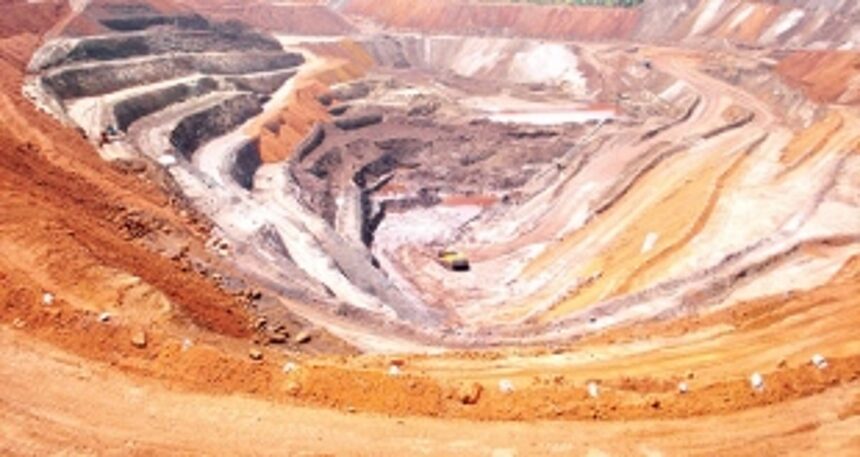
f the bells could be tolled for an economic activity that is struggling to stay alive, then they possibly could have been rung for the mining sector in Goa. Look at the current scenario: mining operations are banned, Goa Chamber of Commerce and Industry has disbanded its mining committee, the government is struggling to find an answer to the demands of the people that operations begin again. This is the picture since 2012, and the future of mining looks bleak.
Seven years ago, iron ore mining was banned in Goa due to rampant, and in some cases illegal, extraction of the ore. In fact, the then Chief Minister Late Manohar Parrikar had announced in September 2012 that all mining will be banned from the very next day of his announcement. It threw the mining sector into turmoil and the business came to a screeching halt. It has not recovered since, and the damp sentiments have also led to the Goa Chambers of Commerce and Industries (GCCI) completely disbanding its mining committee which used to look after and study exclusively on this mining sector. Certainly not a healthy sign, and it does not bode well for the mining sector as the message percolates that revival of mining in Goa looks rather bleak.
LOSS IN REVENUE
Since the State is suffering massive revenue loss due to the mining ban, various stakeholders in the sector, including the State government, has been shouting out aloud to New Delhi to help reopen the iron ore mining sector. According to the data available with the Mormugao Port Trust (MPT), during the year 2009-10 the total export of ore was to the tune of 40.32 million tonnes, which cascaded to merely 2.53 million tonnes during 2018-19 (See Chart 1).
Consultations between the State and the Centre have been going on for the past several years, ever since the ban was imposed by the Supreme Court. The result has not been favourable and many have already resigned to the fact that mining operations may not begin again. However, lately the buzz has started to build up again and the Union government has been hearing petitions by the State government on this issue.
WAY FORWARD
This issue which is now under discussion is what is the way forward if mining operations resume in Goa. The international market is very competitive and there are not many buyers left who will be willing to purchase low-grade iron ore. What is currently under consideration among mine owners is whether it will be feasible for them to do “cluster mining” which seems to be the future for maximum, safe and more economical for extraction of the ore.
When asked what should be the immediate strategy for Goa miners in case mining resumes the Chairman of the Polytechnic Mining Alumni Association of Goa (POLYMAGG), which is a core group of mining engineers from Goa Polytechnic, Joseph Coelho said that to survive in this present scenario, cluster mining is the only way forward. “We have to look into how cluster mining can be done. This is the future and in the small state of Goa which has a restricted mining vein we have to come together to survive,” Coelho said.
Retired mining engineer and mining expert in Goa, AN Joshi, who also was the CEO of Vedanta Limited said, “With fluctuating prices and huge supply routes created and Chinese economy slowing, iron ore mining and sale is bound to become low margin business once again. As such for Goa mining to be competitive, we have to mine in Goa in clusters in place of small lease mining. Such clusters will also be capable of sustainable environment friendly mining.”
Mine owner and managing committee member of Federation of Indian Mineral Industries (FIMI), Haresh Melwani said, “Firstly the government needs to form an exploration corporation just to know what minerals we have in our reserves. Secondly, the government should also form a mining corporation through which the 40 dead mines which are present in the State can be revived. As far as market for ore is concerned there is no problem and there is a plenty of domestic market. A proper analysis by the government needs to be done.”
NOT PREPARED
In fact, if mining does resume, there are many stakeholders not ready to take up the challenge. Goa Barge Owners’ Association, which has barely 20 barges, is wary about their capacity handling. The vice president and currently acting president of the Goa Barge Owners’ Association, Atul Jadhav, told Herald, “We barely have 20 barges today and in Goa there will not be more than 40 barges to help export the ore which could be produced in case the mining resumes. We are not ready as of now.”
HOPE
Whatever be the situation, there is always a glimmer of hope. Prime Minister Narendra Modi has envisaged that by 2030 India should be producing 300 million tonnes of steel. At present, it is about 104 million tonnes. If this target has to be achieved then obviously there will be rise in the demand of iron ore and certainly Goa will have its role to play.
At present, the Goan iron ore is being used in pig iron plants and it is mostly within India as exports have dipped drastically, as China has now started to import ore either from Brazil or Australia. Also, due to imposition of stricter environmental norms following growing pollution, China has cut down on import of low grade iron ore.
In Goa, the iron ore recently purchased by Vedanta Limited (Sesa Goa iron ore) through e-auction (See Chart 2) is being used in their pig iron plant at Amona. In the latest e-auction about 5.3 million tonnes were on the table and about 2 million tonnes were sold of which Vedanta got 1.4 million tonnes. According to the sources, the left over three million tonnes needs to be beneficiated for its proper usage. However, this 1.4 million tonnes of ore is being used in Vedanta’s Amona Plant which has also helped them sustain and overcome in the crises period and has enabled them not to offer pink slips to nearly 3000 of their employees.
According to the data available with the Mines Department the quantity of iron ore declared for e-auction by various companies since the implementation of iron ore e-auction was approximately 16.81 million tonnes. Till date the Department has conducted 22 e-auctions and the total quantity of mineral ore which was sold through e-auction is 13.53 million tonnes and 3.2 million tonnes balance remains unsold. By selling this 13.53 million tonnes the Department has been able to generate revenue to the tune of Rs 1292.77 crore. The government is in the process to sell the remaining 3.2 million tonnes of ore.
Even though the Mines and Geology Department of Goa government does not have data on the reserves of iron ore available with us (as the survey has not been done yet), mining industry sources have told Herald that the total reserves are to the tune of 1.4 billion tonnes of which about one billion tonnes are proved reserves. However, the Department does have data on the total production