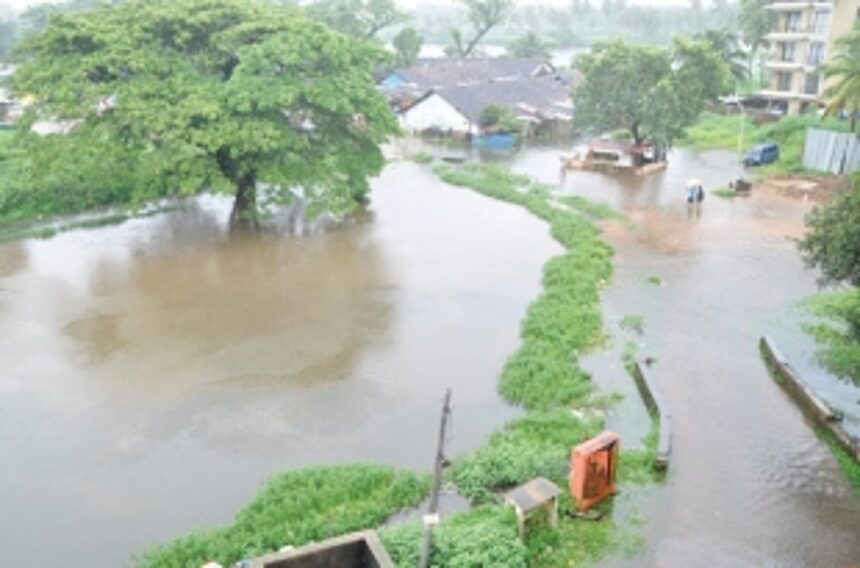
Improper drainage systems, delays in cleaning and de-silting and neglect are the root causes of heavy flooding in Panjim with areas like Mala, Tonca, 18th June Road and Don Bosco witnessing heavy floods every monsoon season. The state of Goa receives over 100 inches of rain per monsson season and the Corporation City of Panjim (CCP) hasn’t been able to clean the main drains for the last 30-odd years. These drains were installed during the Portuguese regime in Goa. This kind of weak administration worries the residents of the city, especially those residing in low lying areas. Mayor of CCP, Shubham Chodankar represents the major low lying areas in the capital.
“This year, we were short of time and were able to clean only two main drains out of 10 in Panjim. These drains are important for the city as they bear the brunt of the immediate impact of the rains. Most of the sub-drains in the low lying areas have been cleaned a few days ago,” Chodankar told Herald.
These drains, nearly one meter in height and 70 centimetres in width were not cleaned for more than (xxxxxx 9???) years and as a result, sediment collected in about 90% of them. There was thus hardly any space for rain water to pass through all these years, informed a CCP contractor.
“This year the height of the main drain at 18th June is increased by 70- 80 centimetres so that water won’t spill on to the road. By the next monsoon season, all these decade-old drains will be cleaned and de-silted so that at least 90% of the flooding in Panjim will be curbed” Chodankar said.
According to Rajendra Talaulikar Bhingui, resident of Mala, the flood is a phenomenon every year. Mala is a low lying area and even in the months of November and December, the water reaches the road. “A lot of times, the water levels rise further because the high tide coincides with the heavy rain. Besides, the de-silting and cleaning of the drainage system is poor but that is the secondary reason for the flooding,” Bhingui explained.
Presently, pre-monsoon work in Panjim is in full swing. For the first time, the CCP issued two tenders while the cleaning and de-silting work was done by CCP labourers itself. But the fact still remains that despite the work carried out by the authorities, flooding in he low lying areas still occurs.
Last year, rain water entered a lot of houses in Mala and Tonca. The same thing happened back in 2013. Water takes up the entire space in the area.
The remaining drains which carry the majority of the water during the wet season are yet to be found out by the authorities. Even the blueprints of these drains built during the colonial time in Goa aren’t with any CCP authority.
Dharmesh Rawal, a resident of Tonca said that the flood of 2013 was a man made problem. “The Public Works Department (PWD) was doing a lot of digging in the area and the other nullah which passes through Kamarabhat in Taleigao wasn’t de-silted. Besides, there are a lot of illegal hutments on the bank of the nullah as well,” said Rawal.
“Paddy fields are important during the monsoon season as they are able to retain water. This would ease a flood-like situation after a heavy downpour. However, the concretization of fields, especially in Taleigao is a cause for concern,” said Mario Fernandes, a resident of Taleigao.