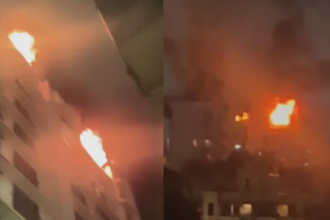
On successive days, locals took the law into their hands when they assaulted tourists and damaged their vehicles following accidents in North Goa. On Sunday, an angry mob set fire to a car with Maharashtra registration plates that was involved in an accident at the Siolim-Chopdem bridge that killed a father-son duo. Locals damaged two cars carrying tourists suspecting that the occupants were drunk. Of the two cars that were attacked, one sported a Maharashtra registration number and the other a Telangana licence plate.
A day later, 10 Indian tourists were severly injured after they were targeted by residents of the taluka of Pernem following a girl on a two-wheeler being knocked down by a vehicle with a Telangana registration. It didn’t end there, and a Maharashtra registered vehicle was stopped and the occupant beaten up. There was alcohol in both vehicles, and it led to the belief that those in the vehicles were drunk.
Is this how the Goan population should react to accidents involving tourists or involving vehicles with non-Goan registration plates? Two people died in the accident on Sunday and there may have been frayed tempers at the accident spot on account of this, but there is a legal system that needs to be followed so that the law can handle the accused in the case. What will happen if across Goa people begin to take the law into their own hands?
Rightly speaking, such incidents bring Goa a bad reputation. With the social media quick to disperse news, there are videos of the incident that have spread across the country and even beyond and this will damage the State’s tourism prospects, but more importantly, mob fury shows lack of discipline in the people, and Goa has never been known for this earlier. Goa can do without mob fury and road rage. It just doesn’t need this, not this road rage that is of a very different sort.
Chief Minister Pramod Sawant has condemned the incidents, and has said that the government will control and monitor those driving in a drunken state. That will require the police to enfore the drunken driving law more stringently. We have had drives against drunken driving, where a number of drivers are fined for driving under the influence of alcohol, but what has this achieved other than to add to the police statistics and show that they are working? There cannot be a sporadic drive against drunken driving, the police have to be on the look out for drunk drivers always. But unless the police also act against those who attacked the vehicles, such incidents could increase. Action against the local will act as a deterent to others.
The Chief Minister’s appeal to the people is that if anyone is seen to be commiting a mistake on the road then there should be a complaint to the concerned authority and people should not take the law into their own hands. This is important. There is a process to be followed, a law in place and rules to follow. But then, the police too must rush to the spot. Had the police been quick the mob fury may have been avoided. This is nothing but lawlessness and there should be space in Goa for it.
These are instances of mob fury, may be not of a large scale, but they stand as examples. The State needs to tackle all sorts of lawlessness with a strong arm so that the people will stay within the boundaries of the law. Mere statements will not suffice, but there has to be action also to be seen.