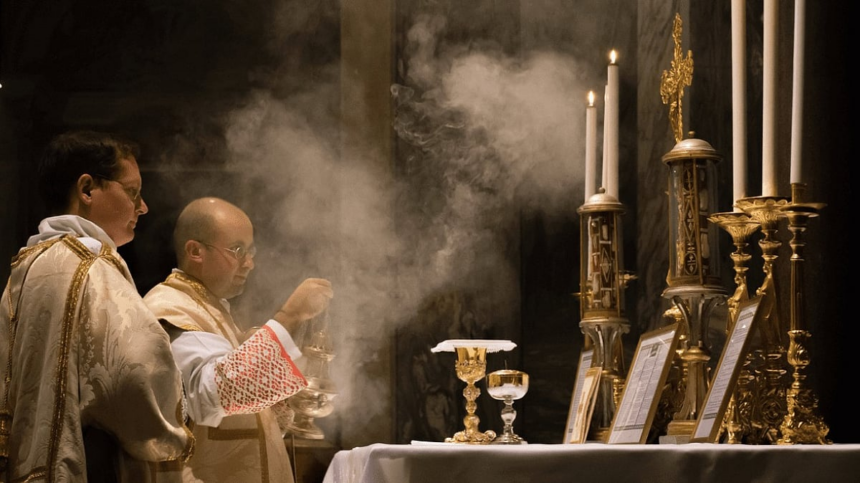
From the Middle Ages onward, the dress of clergy in the Latin Rite of the Catholic Church began to be strictly regulated. Canon law and local synods issued guidelines, with the Fourth Lateran Council (1215) mandating that clergy wear modest, front-closed garments—prohibiting flowing or extravagant styles. Around this time, the cassock (from the Early French casaque) emerged as the distinct everyday attire for clerics.
As Church discipline intensified, Pope Sixtus V (1589) imposed penalties for clergy who failed to wear the cassock (vestis talaris), and Pope Urban VIII (1624) required it be worn with a cincture and matching cloak. By 1708, under Pope Clement XI, a shorter cassock (akin to a frock coat or Nehru jacket) was permitted for travel. Later, in 1725, Pope Benedict XIII banned clergy from wearing civilian dress altogether.

Vestments of the Latin Rite and Their Prayers
The Amice
A white linen rectangle tied at the waist, worn over the shoulders and neck. Originating in the 9th century, it symbolized the “helmet of salvation” and was sometimes worn as a hood. Its use today is optional.Latin Prayer:
Impone, Domine, capiti meo galeam salutis ad expugnandos diabolicos incursus.Translation: Lord, place upon my head the helmet of salvation to combat the assaults of the devil.
The Alb
A white, full-length tunic representing purity. Worn under other vestments, it descends from the tunica alba of the Roman era. By the 10th century, decorative elements like orphreys were added, with lace becoming common by the 16th century.Latin Prayer:
De alba me Domine et munda cor meum, ut in sanguine Agni dealbatus gaudiis perfruar sempiternis.Translation: Cleanse me, O Lord, that washed in the Lamb’s blood, I may enjoy everlasting joy.
The Cincture
A cord tied around the alb at the waist, symbolizing chastity and self-restraint. Derived from cingere (to gird), it also holds practical use.Latin Prayer:
Praecinge me, Domine, cingulo puritatis, et exstingue in lumbis meis humorem libidinis, ut maneat in me virtus continentiae et castitatis.Translation: Gird me, O Lord, with the cincture of purity, and quench my worldly desires, that continence and chastity may remain in me.
The Maniple (no longer in use post-Vatican II)
Originally a cloth for wiping sweat or tears, it became symbolic of penance and the burdens of ministry.Latin Prayer:
Merear, Domine, portare manipulum fletus et doloris, ut cum exsultatione recipiam mercedem laboris.Translation: May I deserve, O Lord, to bear the maniple of sorrow, so I may joyfully receive the reward of my labor.
The Stole
A narrow, silk band worn around the neck (or over the shoulder by deacons), it signifies spiritual authority and immortality. Its use dates back to the Roman orarium or orarion, a cloth likely used to wipe the mouth or hands.Latin Prayer:
Redde mihi, Domine, stolam immortalitatis, quam perdidi in praevaricatione primi parentis: et quamvis indignus accedo ad tuum sacrum mysterium, merear tamen gaudium sempiternum.Translation: Restore to me, O Lord, the stole of immortality lost by the sin of the first parent, and though unworthy, may I attain eternal joy.
The Chasuble
The outermost vestment, reflecting charity and the “yoke of Christ.” Derived from the Roman paenula or casula, it evolved from a full bell-shaped cloak to a stylized garment worn during Mass.Latin Prayer:
Domine, qui dixisti: Jugum meum suave est, et onus meum leve: fac, ut istud portare sic valeam, quod consequar tuam gratiam.Translation: O Lord, who said, “My yoke is sweet and my burden light,” grant that I may bear it well and obtain your grace.