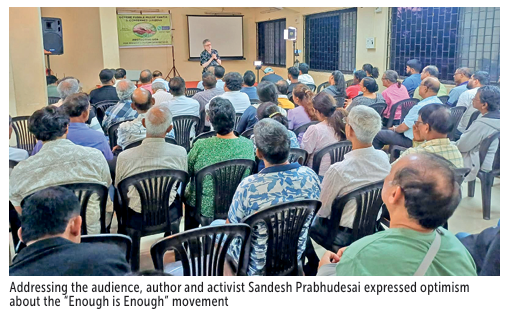
A village aware ness meeting held in Varca echoed the growing public discourse triggered by for mer Bombay High Court chief justice Ferdino Re bello’s recent meetings, with speakers referring to his 10-point charter and calling for concrete legal and constitutional meas ures to curb unregulated development in Goa. The meeting, organised by the NGO Goyche Fud dle Pillge Khatir (GFPK) with the support of Varca residents, brought togeth er citizens, activists and youth leaders to discuss what they described as the rapid erosion of Goa’s land, ecology and social fabric. Speakers said the gathering was not a rou tine NGO programme but an attempt to prepare communities for sustained civic action. Youth leader Nash Car neiro said the initiative stemmed from a refusal to remain silent while de cisions affecting land and livelihoods were taken without public accounta bility. Asking what would be left for the next gener ation, he said young Goans could not afford to be pas sive observers as large projects and policy chang es reshaped the State. GFPK president Jack Mascarenhas said Goa no longer needed politi cal “heroes” but citizens willing to take responsi bility for protecting the land. Using the metaphor of “gardeners” and “flo rists”, he said meaningful change would only come from those prepared to nurture and protect Goa’s roots rather than merely display its beauty for prof it. “We are responsible for the current state of Goa. If everyone is preoccupied with being a hero, who is left to care for the land? We need gardeners who nurture the roots, not flo rists who just display the beauty for a price,” he said. Mascarenhas stressed that every Goan, whether a farmer, fisherman, law yer or doctor, had a role to play in safeguarding the State. Emphasising collec tive wisdom over individu al credentials, he said love for the land mattered more than formal qualifications. “Not a single one of us is smarter than all of us to gether. It is not about a fancy degree or which lan guage you speak; your love for this land is your great est qualification,” he said. Journalist and author Sandesh Prabhudesai said the momentum generated by the “Enough is Enough” meetings had transformed the issue into a people’s movement because it was rooted in constitution al solutions. Referring to Justice Rebello’s 10-point charter, Prabhudesai urged citizens to press the State’s 40 legislators to adopt the proposals through the Legislative Assembly. He said the most crucial demand was an amend ment to the Land Reve nue Code to prevent the sale of cultivable land to non-residents who had not lived in Goa for the last 30 years. Prabhudesai also called for an immediate ordinance to halt hill cut ting and forest develop ment by strictly adhering to official contour maps, and demanded an end to alterations of Regional Plans through Sections 17(2) and 39(A). Policy architect and hu man rights activist Cyril A Fernandes presented a historical overview, argu ing that Goa deserved pro tections similar to those granted to certain regions in the country. He called for the introduction of an Inner Line Permit system by 2027, restoration of Goan control over Comuni dade lands and the State’s six major rivers, and pro tection of jobs exclusively for Persons of Goan Origin. Despite the concerns raised, speakers struck a note of optimism by in voking the “3.5% rule”, which suggests that a small, committed section of society can trigger wid er change. Mascarenhas said if even a fraction of citizens stepped forward with genuine community spirit, meaningful reform was possible. “Today’s benefits must not come at an undue burden to our children. This is no longer just about politics; it is for Goa’s survival, identity and future,” he said.
Varca meeting echoes Rebello’s 10-point charter, seeks legal curbs on land use