Dolcy D’Cruz
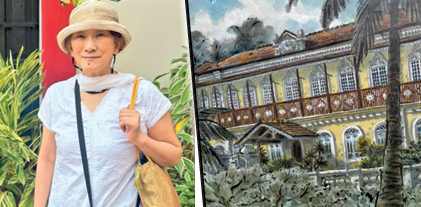
Every aspect of an ancestral Goan house has a story and emotions that speak to the heart. However, only few have the gift to portray the same image with emotion on a piece of paper. Inspired by Goa’s landscape and architecture, Akeru Barros Pereira, a writer, teacher and artist based in Japan, returns to Goa with ‘Akeru’s 20th Anniversary Exhibition’, celebrating two decades since her first show at the same venue. Married to Joao Barros Pereira, a university professor in Kyoto, who now lives in his ancestral home in Cansaulim, Akeru’s fascination with Goan homes dates back nearly forty years, beginning with a sketch of her husband’s ancestral house in South Goa. “I found those old houses very charming. Old houses have certain feelings which are not there in concrete boxes. How that house was built, what kind of people built it, what kind of emotion and the life lived in hundreds of years of history. These things are all in those walls. There’s a soul which you can feel from those houses,” explains Akeru, about her fascination for Goan houses. She further adds, “In Japan, we believe even objects can have a soul if they are used for a long time. These houses have a non-verbal communication between them and me.” The exhibition, open to the public at the open air gallery, The Flying Sari at Cansaulim, from March 25 to 29 between 3 pm and 6 pm, features a collection of prints of her paintings and sketches based on Indo-Portuguese houses. Akeru’s distinctive style combines fountain pen ink, watercolour and colour pencils on Japanese paper, “I started with my fountain pen and my son’s colour pencils. My children were very young then, and we were at home, so I began to draw. Joao, who is full of ideas, suggested turning it into an exhibition. He has a coconut property in Goa, and that’s where it all began. We bought several sarees locally and used them in the display. That was 20 years ago, in 2006, and the exhibition was called Houses of Goa,” recalls Akeru about the first exhibition in Goa at the very same venue. Before turning her focus to painting, Akeru was a well-known manga artist in Japan, having written and illustrated 14 books. However, she stepped away from the demanding profession to focus on family life. “Manga is very intense. You have to be in that world all the time. It’s not easy to switch between that and daily life, especially with children,” says Akeru. Her journey in Goa’s art scene began in 2006 with an exhibition titled ‘Houses of Goa’, followed by another show at Kala Academy in 2008. Architect and curator Gerard Da Cunha later featured 50 of her sketches in his book ‘The Indo-Portuguese House’ and supported her work through the Houses of Goa Museum. This year’s exhibition is set in an open-air space spread across a coconut grove near the beach, creating what Joao and Akeru call a “flying saree” installation. The installation will use around eighteen trees, with fabric tied around them like a belt, leaving an opening for visitors to enter. Several sarees about seven to eight, will be suspended and appear to f loat, creating a striking visual effect. The display will be carefully set up around the coconut trees, with the artworks hung and supported directly from them. A total of 32 works, including paintings and sketches, will be on display. The exhibition will be held from 3 pm to 6 pm, during daylight hours, so only prints will be exhibited. “We are promoting traditional Goa. We want to reinstate the idea that even our coconut trees can be used for development. Development doesn’t have to be concrete and steel and iron. Once the exhibition is finished, we bring it down the sarees and the coconut trees will still be there. We are not putting a single stone there,” says Joao.