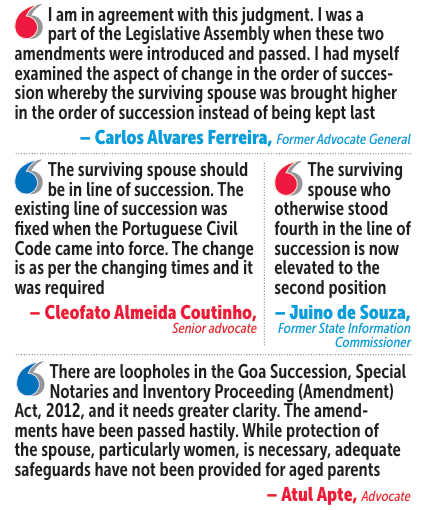
The recent judg ment of the High Court of Bombay at Goa upholding the constitutional validity of the Goa Succession, Spe cial Notaries and Inventory Proceedings (Amendment) Acts of 2022 and 2023 has triggered a mixed response. In a significant ruling, the High Court confirmed that a surviving spouse would rank second in the order of intestate succession — im mediately after descend ants and ahead of ascend ants such as parents and grandparents. The amend ments effectively altered a long-standing succes sion framework inherited from the Portuguese Civil Code of 1867, under which the surviving spouse was placed much lower in the line of succession. The judgment has been widely viewed by legal experts as a decisive shift towards recognising the economic and social reali ties of marriage in modern Goa, especially in cases in volving widows without children who were often left vulnerable under the earlier system. Former Advocate Gener al and Aldona MLA Carlos Alvares Ferreira, who was part of the Legislative As sembly when the amend ments were debated and passed, said the court had settled an issue that would have “far reaching conse quences on the succession law in Goa.” “I am in agreement with this judgment. I was a part of the Legislative Assembly when these two amend ments were introduced and passed. I had myself exam ined the aspect of change in the order of succession whereby the surviving spouse was brought higher in the order of succession instead of being kept last,” Ferreira said.
He noted that the old framework had continued from the Portuguese Civil Code into the Goa law of 2012. Ferreira said the court had considered “various im portant contentions” before upholding the amendments, thereby giving judicial backing to a major legislative de parture from colonial-era succession norms. Senior advocate Cleofato Almeida Coutinho also de scribed the ruling as a necessary adaptation to changing social realities. “The surviving spouse should be in line of succession. The existing line of succession was fixed when the Portuguese Civil Code came into force. The change is as per the changing times and it was required,” he said. Coutinho argued that the amendments corrected an im balance that disproportionately affected widows, particu larly childless spouses, who previously found themselves pushed behind ascendants in inheritance disputes. He described the older framework as “draconian or obsolete” and questioned the continued dependence on a colonial le gal structure decades after Goa’s liberation. A similar view was echoed by former State Information Commissioner and advocate Juino de Souza, who said the amendments were essential to remove the injustice faced by surviving spouses under the earlier regime. “The surviving spouse who otherwise stood fourth in the line of succession is now elevated to the second po sition,” de Souza said, while raising a broader ideological question over the continued operation of the Portuguese Civil Code in Goa despite its repeal in Portugal itself. He pointed out that Goa’s matrimonial property re gime — particularly the concept of communion of assets between spouses — remains markedly different from the system followed in Portugal today, where separation of assets is generally the default arrangement. According to de Souza, the contradiction highlights the unusual position Goa occupies in continuing to operate portions of a colonial legal framework long discarded in its country of origin. Yet the judgment has also exposed concerns about the possible unintended consequences of the amendments. Advocate Atul Apte cautioned that while the protection of spouses was necessary, the amended law may not suffi ciently safeguard aged parents and other vulnerable family members. “There are loopholes in the Goa Suc cession, Special Notaries and Inventory Proceeding (Amendment) Act, 2012, and it needs greater clarity. The amendments have been passed hastily. While protec tion of the spouse, particularly women, is necessary, adequate safeguards have not been provided for aged parents,” Apte said. His concerns underline a growing legal debate over whether the reforms, though progressive in intent, may create fresh conflicts in family property disputes in volving dependent parents. The ruling is therefore likely to have implications extending far beyond inher itance litigation. It has reopened larger questions surrounding the future of Goa’s distinctive civil code framework — often celebrated politically as a symbol of uni form civil law — while simultaneously exposing tensions between inherited co lonial structures, evolving family realities and competing claims of social justice. By upholding the amendments, the High Court has effectively endorsed the legisla ture’s attempt to modernise succession rights in favour of surviving spouses. Adv Albertina Almeida said, “The High Court’s observation that placing the wid ow second in the order of Succession is not arbitrary. From the judgement it can be inferred that Goa which has a near Uniform Civil Code, did not necessarily have a totally just Civil Code, despite near uniformity, and it needed amend ments to the law to make it more just, where the judge ment has drawn on provisions of the various Indian laws to suggest why upping the widow without descendants in the order of Succession is tenable. Therefore, there can be just provisions in personal laws and not so just provisions in uniform laws and vice versa, and the lesson is that uniformity is not necessarily synony mous with equality.”