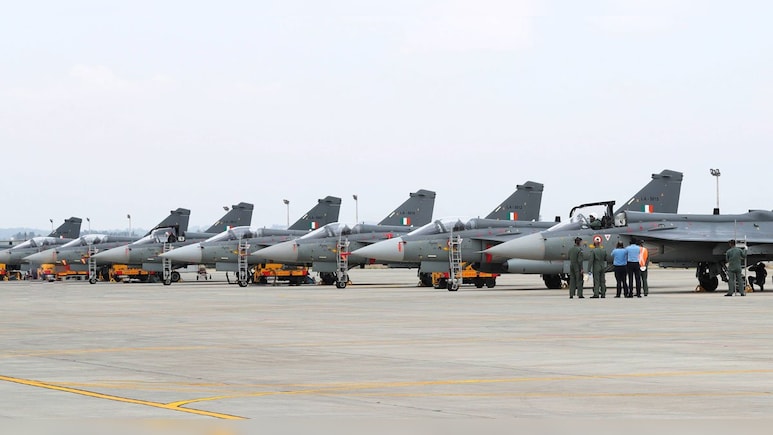
Former Indian Air Force Vice Chief Air Marshal Nagesh Kapoor has raised serious questions over the operational relevance of India’s Tejas Mk-2 fighter, saying the aircraft may not be suitable for a frontline role when it begins entering service in significant numbers in the mid-2030s.
Asked whether India should induct a fourth-generation fighter around 2035 when China is moving towards sixth-generation platforms and Pakistan is considering fifth-generation aircraft, Kapoor was categorical: “No, operationally, definitely no.”

Fifth-generation fighters such as the US F-22 and China’s J-20 combine stealth, sensor fusion and internal weapons carriage. Sixth-generation platforms are expected to add greater use of artificial intelligence, autonomous systems, drone wingmen and networked “system of systems” capabilities.
India currently has neither fifth- nor sixth-generation fighters in service. China, meanwhile, is expanding its fleet of J-20 fifth-generation fighters, with some estimates suggesting it could have around 500 by 2030.
However, Kapoor said fourth-generation fighters such as the Tejas Mk-2 could still have a role outside the most demanding frontline missions.
“You can have a certain number of those 5th generation & 6th generation fighters, but given the size of the country, you won’t be able to deploy them everywhere. So those gaps which continue to remain to be filled will have to be filled by this class of aircraft,” he said.
Kapoor also criticised Hindustan Aeronautics Limited (HAL) over delays in delivering the Tejas Mk-1A. He described the absence of the aircraft in significant numbers as a “huge” concern and questioned why promised capabilities had not been delivered on schedule.
“Why must we be hamstrung because someone somewhere has not been able to keep their promises?” he said.
While backing indigenous fighter development, Kapoor stressed that India could not afford prolonged delays.
“Indigenous is the way to go without a doubt but how long do we keep waiting?” he said.
The Tejas prototype first flew in 2001, while the IAF initially ordered 40 Tejas Mk-1 aircraft. In 2021, it placed an order for 83 Tejas Mk-1A fighters in a deal worth around Rs 46,000 crore. A further order for 97 Mk-1A aircraft was announced in September 2025 for Rs 62,370 crore.
The Tejas programme has faced delays, including issues related to the supply of General Electric F404 engines and the integration of radar, avionics and weapons systems.
The more advanced Tejas Mk-2 has also faced repeated delays. Its first flight was originally expected in 2022, but the timeline has since slipped several times. HAL’s latest update in July 2026 indicated that the aircraft’s first flight is expected between March and July 2027.
“Their (HAL’s) sense of urgency is not equal to the sense of urgency of the Indian Air Force,” Kapoor said.
Kapoor also expressed concerns about India’s Advanced Medium Combat Aircraft (AMCA), the country’s planned indigenous stealth fighter. He argued that India should consider joining international sixth-generation programmes rather than progressing through successive generations at a slower pace.
“Why not FCAS? Why not GCAP?” he asked, referring to the Future Combat Air System being developed by France, Germany and Spain, and the Global Combat Air Programme involving the UK, Italy and Japan.
FCAS is targeting a next-generation combat aircraft around 2040, while GCAP aims to develop a new-generation fighter around 2035.