Dolcy D‘Cruz
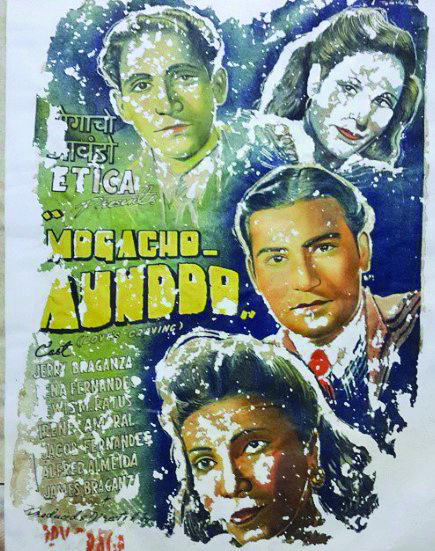
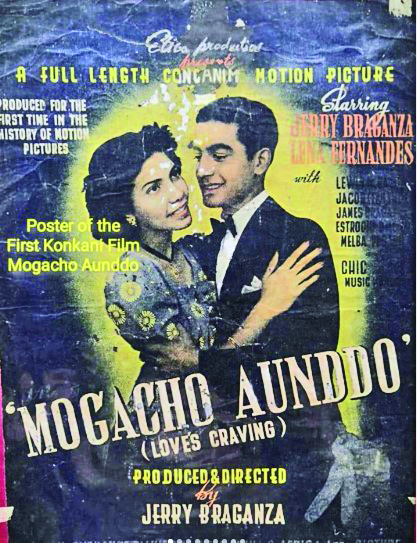
April 24 is celebrated as Konkani Cinema Day as it marks the day in 1950 when the first Konkani film ‘Mogacho Anvddo’, produced by ETICA Films Pvt Ltd was screened. A L Jerry Braganza from Mapusa was the writer, director and actor of the first Konkani film ‘Mogacho Anvddo’. Unfortunately only ten minutes of the first Konkani film could be restored, highlighting the need for preservation.

Noted for his interest in Konkani films and as an lexicographer for his work in the Konkani language, Isidore Dantas was gifted a reel of the film when he released his first book in Roman Konkani, ‘Konkani Cholchitra’, in 2010. At the time, Agnelo Braganza, the nephew of Jerry Braganza, attended the function, as he had a strong interest in films. “He brought along a film reel which was in very poor condition. I had initially taken the reel to the National Film Archive of India in Pune, but I was told that restoration was not possible. I was informed by filmmaker Bardroy Barretto about Shivendra Singh Dungarpur, and things finally began to move forward. Today, the surviving material is with him, as it requires specialized care due to its fragile state. Ideally, such reels should be stored at temperatures as low as minus 20 degrees, informs Isidore.
At first, he received a trailer from the material, which he managed to develop, but only one photograph could be recovered. “Many other films, such as ‘Amche Noxib’ and ‘Nirmonn’, have also been lost. The producers, facing financial difficulties, had sold their prints to distributors, who unfortunately did not preserve them properly,” says Isidore.
Isidore’s new English-language book on Konkani cinema is now ready for publication. It contains detailed information on 123 Konkani films, along with photographs and posters. The book covers films made in Goa, Mangalore, and Kerala, and for each film, he has tried to include at least four stills. The films are organized according to their censor certification dates, with the latest entry being the Konkani film, ‘Umesh’.
Director of Konkani film ‘Nachom-ia Kumpasar’, Bardroy Barretto has known Shivendra for the past 20–30 years. “For Shivendra, this work is truly a mission and a passion. He has restored many films, and several families have entrusted their material to him. I can say he’s done phenomenal work in film preservation. They had retrieved some material of ‘Mogacho Anvddo’, which I’ve also seen. It was only a small part of a reel about 3 or 4 minutes. It is now handled by the Film Heritage Foundation. The reel was in very poor condition. The first reel, in fact, was like a brick. I was quite surprised that they were eventually able to open it at all. As for the other reels that were found later, I’m not sure what condition they were in. Unfortunately, many films like ‘Amche Noxib’ and ‘Nirmonn’ have gone completely missing, not a single print is available. ‘Nachom-ia Kumpasar’ does have a normal print; we’ve preserved it in DPX format. Eventually, I plan to hand it over to Shivendra for archiving with the Film Heritage Foundation, because their work is to restore and preserve films, almost like a museum. People often misunderstand and think they restore films to make money, but that’s not the case. It’s a non-profit organization led by Shivendra Singh Dungarpur.
He further adds, “If families still have any material, they should at least consider giving it to them. Film reels were quite large and took up a lot of space in homes. A single reel could hold about 20 minutes, these were called jumbo reels. It should be kept in metal containers, not wooden ones, because wood absorbs moisture. Now everything is digital, and we have plenty of storage options.”
Shivendra Singh Dungarpur is an Indian filmmaker, producer, film archivist and restorer. He is the founder Director of Film Heritage Foundation, a non-profit organization dedicated to the preservation and restoration of India’s film heritage. “I think there was only one reel that survived. Just a single reel, which we’ve digitized, and that process is complete. That’s the only material representing the film that people are aware of. Ten minutes of the film can be viewed. We don’t know which part of the film it is. The film is now with the Film Heritage Foundation in Mumbai. People usually contact us if someone wants to show a clip, maybe while discussing the film. It is the only surviving material from the film. I’m planning to do something with it, Bardroy suggested it, so hopefully we’ll work on that soon, sometime in the future,” informs Shivendra.
Capt Dr Sam Braganza is the third generation of the Braganza family from Mapusa who holds the archival material of the first Konkani film. “Initially, only a portion of the material was available. Later, I handed the reels over to Shivendra. My grandfather, James Braganza, was based in Goa, while his brother, Jerry Braganza, was in Bombay and had the reels there. After Jerry passed away, my uncle, who is also my godfather, Agnelo Braganza,brought the reels back to Goa. Because they were exposed to rain, moisture, and the humid Goan climate, the reels deteriorated badly. They stuck together and could not be separated. I had no idea about their condition until after Agnelo passed away. As part of the third generation, I’m the one who developed an interest in theatre and the performing arts. So I went looking for them and eventually found the reels, along with his wife, in Mapusa itself,” says Sam.
As a grand-nephew, Sam hadn’t heard much about the film. His father, Sergio Braganza, was just born when the film was released, so he never really experienced it either. It was screened only once, at the time of its release. It was shown during the Milagres Feast in Mapusa at Dasharata Cinema on April 24, 1950. “My grandfather had written many songs for the film. He used to sing those lullabies to my father, and my father sang them to me and now I’ve sung them to my own children. These songs are something I’ve never heard anywhere else, and most Goans haven’t heard them for the past 30 or 40 years. Some of the lullabies include ‘Mogall Bai,’ ‘Mogacho Aundo,’ and ‘Dog Amig.’ We know them only because they’ve been passed down within the family,” says Sam.
The story of ‘Mogacho Anvddo’ is not just about what has been lost, but also about what can still be saved. As memories fade and physical reels deteriorate, a handful of photographs, or songs passed down through generations become invaluable. Konkani Cinema Day, therefore, serves not only as a celebration of a historic beginning but also as a call to action to safeguard Goa’s film heritage before more of it disappears forever.