A Goan Catholic wedding has a vibrant series of unique pre- and post-marriage rituals, steeped in both tradition and symbolism, often shaped by region and family customs. These events historically never occured during Lent or Advent, periods reserved for repentance and not celebration (with the exception of modern Advent weddings). Below is a paraphrase that preserves every detail from the original text, organized by each main event:
Wedding Season Restrictions

Catholic weddings were traditionally never held during Lent or Advent, as these are periods of penitence and self-denial, and therefore considered inauspicious for grand personal celebrations. However, in recent times, Advent has become a popular wedding season.
Typical Goan Catholic Wedding Events
The sequence of events in a Goan Catholic wedding is generally as follows:
- Chuddo
- Bhikarianchem jevonn ani Dhennem/Doth/Zoth
- Roçe
- Kazaar
- Portonnem
- Apovnnem
For arranged marriages, once the bride and groom agree to marry, the groom traditionally presents the bride with a gold ornament as a sign of love and commitment.
Chuddo
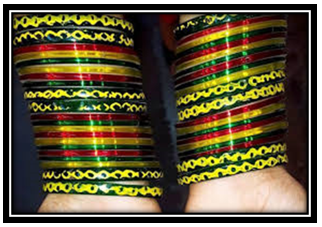
About a month before the wedding, on the day the first wedding bann is announced in the church (a bann is a public proclamation of the couple’s upcoming marriage in both parishes), the bride’s maternal uncle invites her to his home for a final lunch as a single woman. During this lunch, the local bangle seller is present for the Chuddo ceremony, which is preceded by a short prayer at the family oratory. The uncle gifts the bride an odd-numbered set of glass bangles, signifying her forthcoming marriage.
Glass bangles are also purchased for other female family members and neighbors who participate. The bride drinks water from her uncle’s well, a symbolic act, and wears the Chuddo until the wedding day. Accidentally breaking these bangles before the wedding is viewed as a bad sign.
Each bangle color represents something:
- Red: love/romance
- Green: fertility
- Yellow: middle age
- White: old age
The choice of bangle colors varies according to caste and locality. For instance, Kshatriyas from Thivim wear only green; some from Carmona wear either maroon/red or maroon/red with white; Shudras from Canacona and certain occupational groups wear all four colors. The quantity of bangles, always odd, varies by region (e.g., 13–15 in Moira).
After lunch, red flowers are placed in the bride’s hair, and the bangles are put on by the seller who prays for the couple. Neighbors and friends sing traditional songs, and firecrackers are lit. Offerings of money are also given to the bangle seller in addition to payment for his services.
The uncle also gives the bride red cloth for a new dress, called a ‘Saddo’, which the bride will later wear on the day after the wedding. Also for up to a month after her wedding, she wears shades or red or pink signifying her new marital status. The family tailor was invited to sew this dress alongside the wedding gown, and neighbors would join in celebration with song.
Upon completion of the Chuddo, the uncle sends the bride home with a ‘Vojem’—a basket containing sweets, bananas, and bread (twelve of each). These are shared among villagers. In certain regions, special sweets like ‘Kholle’ and a basket of flowers are also sent.
Once the first bann is read, until the wedding, neither bride nor groom may travel far. This precaution, strictly observed, is believed to protect them from negative energies.
On the wedding day, after the “Portonnem” (the bride’s family’s return from the groom’s village), the Chuddo is traded for red bangles, which the wife wears until her husband’s death. On his funeral day, she breaks her Chuddo on his grave, indicating the end of marital vows, and then, wearing a red dress and a red flower in her hair, she switches to black bangles and only wears somber clothing for the rest of her life. The Chuddo is kept safely in the trousseau cupboard.
- Green bangles signal a woman’s first pregnancy.
- Black bangles are worn during mourning.
Bhikarianchem Jevonn Ani Dhennem/Doth/Zoth
Roughly two days before the Bhikarianchem jevonn, temporary outdoor kitchens are built with stone stoves and palm thatch. Called ‘Rossoi/Reshi’, the kitchen is blessed with a palm-leaf cross before being used to prepare a sweet dish, ‘Aatol’. This is distributed in the village after firecrackers are set off.
The Bhikarianchem jevonn occurs about five days before the wedding, usually only for the wedding of the eldest child. An odd number of beggars, chosen to resemble deceased family members are invited for lunch at both the bride’s and groom’s homes. Seated on the floor in the entrance, they are served a traditional meal on leaf plates, after prayers. A special pumpkin is blessed at the oratory and is later cooked for further wedding celebrations.
On this day, the bride’s family sends her wedding trousseau (Dhennem) to the groom’s house, where both families dine together. The trousseau and bride are blessed by the beggars at both venues. The trousseau consists of a cupboard, clothing, jewelry, linens, and a statue of the bride’s parish patron, or, among elite Brahmin and Kshatriyas, a statue of the Infant Jesus or Our Lady of Good Delivery as wishes for progeny. At times, the bride was expected to bring a handmade wall hanging, often depicting a religious image crafted through embroidery or other needlework techniques, as a way to demonstrate her talent and skill in the art.
Trousseau items (Doçe, bread, bananas, and a patron saint) are sent in a basket, covered with a crochet cloth to the groom’s house. The quantity of Doçe is determined by the groom’s family. In northern Goa, instead of Doçe, a sweet cake (Soiecho Bolo) may be prepared. These treats are distributed in the groom’s village.
Another sweet dish, Sojhi, is made and distributed, often by a hired tribal woman who received a tip as she makes her rounds.
Dowry (gold, copper, cash) was also historically common, though it is far less prevalent today, remaining in some areas. All of the dowry on arriving the grooms home, was displayed for public viewing.
Roçe Ceremony
The ‘Roçe/Ross’ ceremony traditionally would be held on the evening of the day prior to the wedding (Unlike the recent practice of having it two or three days before the wedding day).
The ceremony involved application of a fist full of coconut milk by the family members, neighbors and friends, to the bride/groom. This ceremony of coconut milk application would be performed in the ‘Entrada’ of the house where the family oratory would be placed (Unlike todays times where this ceremony is carried out outdoors), after a short prayer. This ceremony involved application of coconut milk to the bride/groom, a night prior to the wedding and hence served as a skin softener/moisturizer for the couple which would enhance their skin glow on the wedding day.
Unfortunately, the actual essence of the ‘Ross’ is being gradually lost today. It is not uncommon to find application of literally “anything available in the kitchen”. Apart from the traditional coconut milk, curries, liquors, ketchup, noodles etc. etc. etc. have been sadly applied to the couple, especially by the youth, thus destroying the true meaning/essence of this amazing Indic tradition.
Once the ‘Ross’ was applied, the bride/groom was not permitted to leave her/his house before leaving the house for their nuptial. It was believed that if this rule was broken, a sequence of twelve bad events would follow in the newly married couple’s life.
As people stood in a queue, waiting for their turn of ‘Ross’ application, they would drop a coin or two into the earthen vessel (Khoddem), which contained the warm coconut milk. This amount served as a token of love, and was meant for the person who extracted the coconut milk, which was in addition to the amount due to person for his/her job.
During the entire ceremony, men and young boys from the neighborhood and family would sing ‘Verso’, ‘Mande’ and ‘Dulpods’ (Traditional Goan folk songs).
Unlike today’s times, no elaborate meals were served during the evening of the ‘Ross’, just a cup of coffee and a slice of Doçe was served to everyone attending the ceremony.
Kazaar – The Wedding Day

On the wedding morning, the groom’s family visits the bride’s home with her gown, accessories, and a perfume from the groom, helping her prepare. At the groom’s house, his best men assist him. Both homes welcome friends and family bringing blessings and cash gifts, given at the family oratory during the ‘Benção’. In some areas, the groom personally visits elders’ homes for blessings, escorted by a red umbrella.
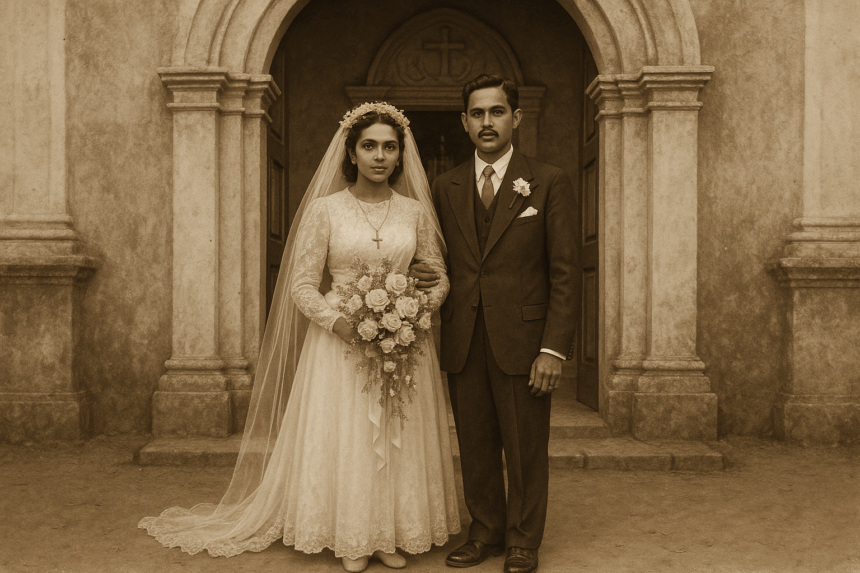
The ceremony generally takes place in the morning at the groom’s parish church. At the entrance, the main best man lifts the veil, kisses the bride’s cheek, and gives her a bouquet. The bride enters with her father, the groom with his mother.
After the service, the couple proceeds to the groom’s home, where the groom’s parents incense them at the entrance, adorn the bride with a gold necklace, and host a brief Latin prayer (Laudate Dominum) sung by the men. The groom leaves a cash token under a kneeling cushion for the person arranging it. After prayers, the reception follows.
The reception features a brass band, Konkani and Portuguese songs, ballroom dancing, and a wedding march. Food was a simple plate service of stew, bread, pulao, and Caldo. A toast (saúde) and song (saúdichem cantar) are offered, vinho do Porto toasts and the cutting of the cake follow. As guests leave, everyone received cocada/gons, or a Doçe slice. Receptions were typically outdoors (pedal/maatov).
Following the reception, both families walk to the boundary of the groom’s village. A bottle of liquor was poured along the border for village spirits after a prayer, then the bride’s family performs a symbolic tug with a reed to represent breaking family ties, after which they leave without looking back. This spirit-offering is called ‘xhim’.
Portonnem
The term ‘Portonnem’ refers to the bride’s family returning from the groom’s village border, a symbolic conclusion of their accompaniment.
Apovnnem
The morning after the wedding, the couple is hosted overnight at the bride’s family home the Apovnnem. They are incensed outside the house, and the groom receives a gift (traditionally a gold tiepin/cufflinks). He places cash under the pillow for the person who made their bed, a coveted job for children because of the reward.
Traditionally, there were several Apovnnems (3–5), unlike today’s single visit. The couple has meals at the bride’s home, returning to the groom’s each evening. Only the first Apovnnem included an overnight stay, serving to help the bride adjust gradually to her new life after a sudden and significant transition.
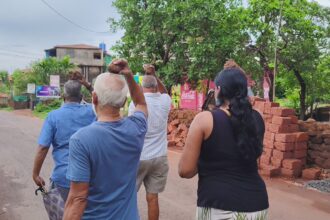
In villages such as Curtorim, the Gavda community observes a custom of setting up a palm arch at the entrance of the bride’s house. As the couple departs for the groom’s home, they are required to pull down this arch a symbolic gesture marking the conclusion of the wedding festivities.