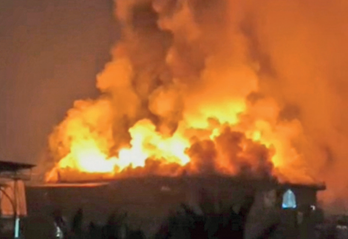
The Magisteri al Inquiry Report into the tragic fire at the Birch by Romeo Lane nightclub in Arpora has merely put an official stamp on what residents, activists and whistle-blowers have long alleged — that governance in coastal Goa has hol lowed out, reduced to se lective enforcement, willful blindness and institutional complicity. Far from being an iso lated administrative lapse, the inquiry lays bare a sys temic breakdown where laws existed only on paper, authorities abdicated stat utory duties, and illegality flourished under official protection. The report documents how unauthor ised construction, forged documents and expired licences were allowed to persist openly, culminating in a disaster that claimed 25 lives. At the centre of the scan dal is the Arpora–Nagoa village panchayat, which issued a trade licence to Birch by Romeo Lane on December 16, 2023, valid only until March 31, 2024. Despite the licence expir ing, the nightclub contin ued operations without interruption. The panchayat, empowered under Section 72-A of the Goa Panchayat Raj Act to seal establish ments operating without a valid licence, took no action whatsoever. The inquiry makes it clear that this inaction cannot be dismissed as an oversight. Statements by both the then panchayat secretary, Ra ghuvir Bagkar, and the sar panch, Roshan Redkar, con firm that no sealing orders were issued even after the licence expired and demo lition orders were passed. The four-member inquiry committee concluded that such conduct “cannot be attributed to negligence”, but instead points to collusion with the property owners and violations of statutory duties and conduct rules.
Bagkar has since been dismissed from service, while Redkar has been disqualified and barred from contesting elections for five years. However, demands are growing for stronger action, including dissolution of the entire panchayat and suspension of all officials found complicit. The report further exposes serious documentary fraud in the trade licence application itself. Mandatory docu ments — approved building plans, Form I & XIV, and occu pancy certificates — were missing. A house number cited in the application, 502/1-RT8, was found to be fictitious and untraceable on site, indicating deliberate falsification to obtain approvals. Shockingly, the licence was processed and approved within just five days, without basic scrutiny. The panchayat secretary admitted before the inquiry committee that house numbers and documents were never verified. The sarpanch, in turn, attempted to shift responsibility onto the secretary, exposing a complete collapse of oversight and accountability within the panchayat’s decision-making structure. At the grassroots level, anger is palpable. Arpora-based activist Peter de Souza demanded immediate dissolu tion of the panchayat, saying, “The Arpora-Nagoa village panchayat body should be dissolved immediately. The lo cal MLA should take moral responsibility and resign.” Drawing a sharp comparison, he added, “Whenever a railway accident takes place, the concerned Union Minis ter steps down, owning moral responsibility despite not being directly involved in railway operations.” But Birch by Romeo Lane, the report makes clear, was not an aberration — it was symptomatic of a larger rot. The inquiry uncovered widespread illegal development at Maizon Lake View Resort, where trade licences, house numbers, and water and electricity NOCs were issued for 13 shops constructed on land recorded as salt pan, paddy field and water body. These constructions were declared illegal ab initio, violating the Land Revenue Code and Coastal Regulation Zone norms. AITC national spokesman Trajano D’Mello flagged what he described as a glaring omission in the inquiry, saying, “Though the magisterial inquiry into the fire incident at Birch by Romeo Lane nightclub was conducted within a reasonable time, it glaringly avoided any comment on — or inquiry into — the role of the Goa Coastal Zone Man agement Authority (GCZMA).” He added, “This authority was not questioned by the magisterial inquiry committee. The land where the fire broke out, killing 25 persons, was contested before the GCZMA, which was headed by an IAS officer.” Disturbingly, the inquiry traces the origins of illegality at the site back to 1998-99, underlining decades of reg ulatory failure across successive administrations. Most NOCs over the years, the report notes, were signed by the sarpanch without adherence to due process — pointing not to clerical errors, but to systemic misuse of authority. Even repeated complaints about noise pollution and parking violations in 2024-25 were routinely brushed aside. Police investigations were consistently closed with findings of “nothing found”, despite blatant violations. The inquiry also records non-compliance with specific directives of the High Court of Bombay at Goa on inspec tions and night patrolling, raising serious questions about enforcement credibility and institutional integrity. Reacting to the report, Chief Minister Pramod Sawant has recommended disciplinary and criminal action against multiple officials, including the panchayat secre tary and sarpanch, and ordered inquiries into the alter ation of water body status during preparation of the Goa CZMP plan. Suspension has been proposed for Goa State Pollution Control Board officials who issued NOCs based on misleading facts, while show-cause notices are to be issued to officers from the Fire and Emergency Services, Police, Excise, Electricity Department, Food & Drugs Ad ministration, Commercial Tax Department and Tourism Department. The Labour and Employment Department has been di rected to initiate action for loss of life and award compen sation, with further steps contingent on the outcome of the police investigation. However, critics say the government’s response still stops short of addressing the full chain of accountability. Former Calangute MLA Agnelo Fernandes questioned the selective targeting of officials, stating, “By this logic, every government officer on duty or posting during that period should have been dismissed — including the ta lathi, mamlatdar, deputy collector, police, Director of Panchayats, Goa State Pollution Control Board and the Goa Coastal Zone Management Authority. If the govern ment believes only the sarpanch and the panchayat sec retary are responsible, then equally other officers are re sponsible because they too violated rules.” Fernandes also pointed to the role of higher authori ties, adding, “The demolition order issued by the village panchayat was stayed by the Director of Panchayats. What powers does the village panchayat have once a stay is granted? The main culprit is the Director of Panchayats for holding the appeal for so long.” RTI activist Rajan Ghate warned that the dismissals may only scratch the surface of a much deeper nexus. “The dismissal of the then panchayat secretary of Arpo ra-Nagoa shows the involvement of government officials,” he said, adding, “Despite the demolition order, the matter was stayed and illegalities were allowed to continue.” Ghate further cautioned, “There are many nightclubs running illegally in coastal areas. If government officers are dismissed from service, they will expose politicians who pressured them to protect illegal nightclubs.” For many in Goa, the report has not revealed a hidden truth, but merely formalised an open secret — that the system failed long before the fire, and continues to do so even after it.