SHASHWAT GUPTA RAY

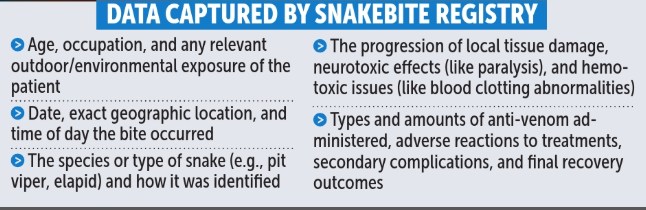
PANJIM: The untimely death of a prominent local physiotherapist, Dr Ketan Bhatikar, due to a snake bite has cast a sharp spotlight on Goa’s rising snake-human conflicts, prompting urgent calls for systemic medical reform. To prevent future tragedies, top medical experts have called for launching a systematic and centralised database, the Snakebite Registry, which will track and analyse snake bite cases to help save lives.
“It is a critical public health tool used to quantify incident rates, identify vulnerable demographics, monitor anti-venom efficacy, and guide targeted medical interventions and preventive education,” Dr R G Wiseman Pinto, former Professor of Pathology and former Head of Pathology Department, Goa Medical College (GMC) told O Heraldo.
Dr Pinto, who was instrumental in launching the Diabetes Registry and Cancer registry in Goa in 2008, said that globally there are 5.4 million snake bites per year. Of these, 3 to 4 million are seen in India.
“Goa sees around 500 to 600 snake bites annually, i.e. two snake bites a day during the monsoons. A study published in the International Journal of Multi-disciplinary Research in June 2025 by Dr Chetan Karekar and Dr Purvi Mishal of the Forensic Medicine Department Goa Medical College, from 2020 to 2024 there were 1,663 snake bite cases in Goa, and 30 deaths in five years, most during the monsoon,” Dr Pinto said.
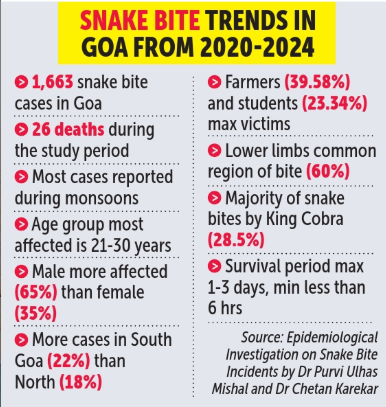
The study also depicts the common age distribution (21 to 30 years), the male-to-female ratio, the sites on the body of the bites and the geographical distribution in North Goa, South Goa and adjoining Maharashtra and Karnataka.
“The areas commonly involved are rural areas – forests, agricultural areas. Even in urban areas due to widespread deforestation and construction activity the towns are also not spared of snakes. In this situation, it is extremely necessary to have a Snakebite Registry,” he said.
Dr Silvano Dias Sapeco, former Professor and Head of Forensic Medicine, GMC said that the Snakebite Registry can operate in tandem with the Poisons Information Centre (PIC).
“The PIC is a specialised unit providing information on prevention, early diagnosis and treatment of poisoning and hazard management. The objective of the Poison Information Centre is to improve the health of the public by minimising or preventing illness and death due to poisoning,” Dr Sapeco said.
The well-trained staff will provide appropriate information regarding management and first aid measures for various poisoning substances.
Former senior physician at South Goa District Hospital (Hospicio Hospital) Margao, Dr Edward D’Mello said a registry will help identify high-incidence areas to improve facilities and resource allocation, particularly in peripheral health centres.
“A snakebite registry standardises treatment by tracking bite incidents, treatment responses, and snake species. This data-driven approach establishes region-specific clinical guidelines, ensures consistent Anti-Snake Venom (ASV) distribution across Primary Health Centres (PHCs), and prevents delays in referring complex envenomation cases,” Dr D’Mello said.
When asked about the Registry, a senior official at the Directorate of Health Services (DHS) said that a proposal has been forwarded to the government in this regard and approval is awaited.
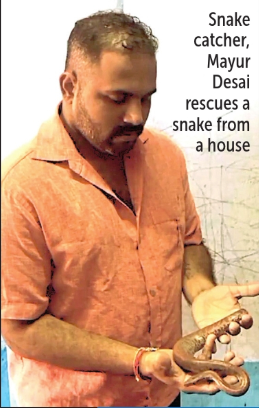
Meanwhile, a Panjim-based snake catcher, Mayur Desai said that if a snake enters your home, stay calm, keep a safe distance, and immediately relocate children and pets away from the area.
“Isolate the snake by closing the door to the room and blocking the gap at the bottom with a towel, then call a local wildlife rescue or forest department. Do not try to kill or attack it. Striking or agitating the snake will make it defensive and aggressive. Also, never attempt to pick up a snake with your bare hands or a regular broom,” Desai said.