Cuncolim is a little village in South Goa, blessed with fertile soil and is bound by deep rivers, which led to traders and artisans settling here. Historian Teotónio Rosário de Souza, in his writings mentions that the metal industry in this village, which made guns, was of extremely good quality. Afonso de Albuquerque mentions that they were comparable in quality to the arms manufactured in Germany at that time. However, in the 17th century, the manufacturing of arms in Cuncolim was banned by viceroy Dom Jerónimo de Azevedo.
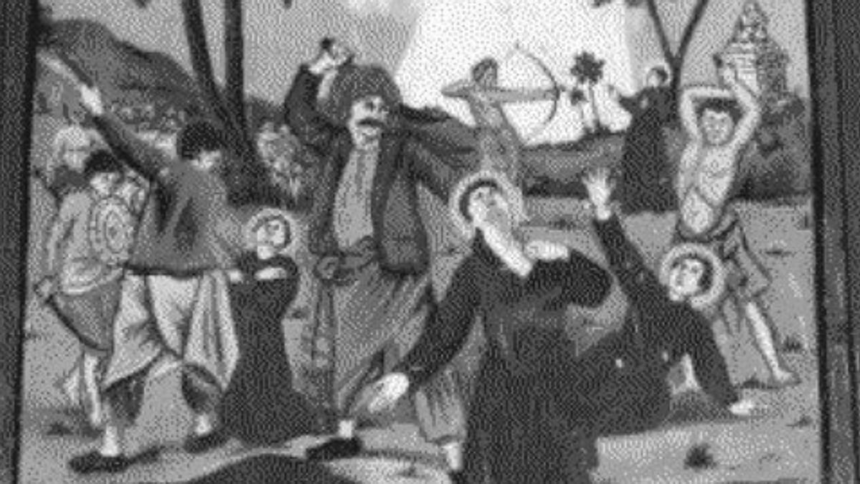
It is the month of July. The anniversary of the Cuncolim incident (15th July 1583) has just been a few days ago. One may come across many, demanding the need for the state to commemorate the chieftains (gãonkars) who were executed by the Estado da índia for killing five Jesuit missionaries and several native Catholics, as the first ever revolt against the Portuguese. This is certainly a great example of the prevailing amnesia about Goa’s past. This amnesia is not wholly but at least partially induced on purpose. This is clearly seen from how the well-known Cuncolim incident has been woven to satisfy as many nationalist tropes as possible. The Portuguese are regarded as continuous oppressors, Goa as a land of the Hindus, religious conversions as forced and violent, natives as Hindus alone and as united against foreign rulers with no mention of castes. All of this, makes the Cuncolim revolt, the first war of independence.

It is a fact that although nationalists insist that Goa was Hindu before the arrival of the Portuguese, many Goans of the time were actually Muslim while several others were part of indigenous communities with their own set of distinct beliefs and traditions.
For Nationalists it is truly a matter of pride, since they believe that the first ever revolt against the Portuguese (foreign) rule, in India (did India exist in 1583?) took place in our beloved state of Goa, in Cuncolim on the 15th day of July in 1583. However, one needs to understand that when the Portuguese (Afonso de Albuuerque) attempted to conquer Goa on February 17, 1510, he was welcomed by some Goans but opposed by others. The opposition was led by the Sultan of Bijapur and succeeded in driving away the Portuguese by the end of May. It was in November that Afonso conquered Goa for the second time. Thousands of soldiers and laymen lost their lives in the battle and the turmoil that followed. Shouldn’t these individuals who lost their lives (many of whom were Goans or residants of Goa) during this period be considered as martyrs for the cause of seeking independence?
During the initial years of the first half of the 16th Century, the southern parts of Goa were mainly ruled by Adilshah. During this time, it was only three talukas i.e Tiswadi, Bardez and parts of Salcéte which was inclusive of today’s Mormugão, that were under Portuguese governance. Cuncolim was still under the control of the local ‘Sanātana’ Chieftains. Salcéte came under the Portuguese rule in 1543.