AUGUSTO RODRIGUES
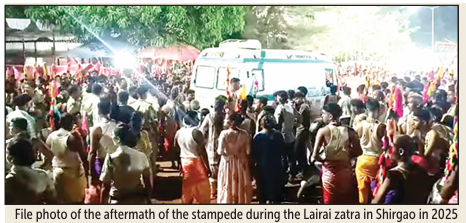
With a little over a month to go for this year’s Lairai za tra on April 21, 2026, pain ful memories of last year’s tragedy, in which six people lost their lives and over 100 were injured, continue to haunt residents of Shirgao. Villagers are questioning whether the government has taken steps to imple ment the recommendations of the Fact-Finding Inquiry Committee (FFIC) consti tuted after the tragedy. The simple answer is, ‘NO’. The committee had criti cised the role of the temple management committee, raising doubts among locals about whether the organis ers are capable of ensuring safety this year. Apart from recommend ing a detailed inquiry and fixing accountability — which villagers say the gov ernment has not undertak en so far — the FFIC had also recommended that “the government should explore the possibility of dissolving the Temple Management Committee and appointing an administrator after fol lowing the due process of law”. The recommendation, however, was not consid ered or implemented. “The deaths happened during the first year of the new committee. There were problems earlier but never this severe. If the committee continues to overlook the recommendations like it did last year, the future is un predictable,” said a villager requesting anonymity.

The wounds of the 2025 tragedy remain fresh in the minds of the villagers of Shirgao and the Dhonds who form an integral part of the festival. Many say the committee’s observation that “the stampede was precipitated by a con fluence of preventable lapses and oversights” continues to weigh heavily on them. The FFIC report released through Unstarred LAQ No 158 tabled by Vijai Sardessai in the assembly states that some in jured victims informed the committee that the previous year “a woman allegedly died due to suffocation at the sloped section of the pathway”. However, the report notes that the committee did not find any official record to substantiate such an incident. “Not withstanding the absence of official records, the com mittee is of the view that the key stakeholders, including the organisers, district administration and the police, should have reviewed past occurrences and undertaken adequate precautionary measures to prevent such untoward inci dents,” the report stated. In its specific findings under the section on crowd behav iour, the report states that “this unruly and irresponsible be haviour of a section of Dhonds significantly contributed to the overcrowding that precipitated the stampede”. The observation has not gone down well with many Dhonds, most of whom believe that the journey from the Tali to the Homkhand — the place where the incident occurred — represents the spiritual peak of the festival. “Apart from observing a vegetarian diet for a month and living in seclusion for a week before the final night, the sa cred bath, lighting of the ritual bonfire and walking on the embers are extremely important for us. We do not expect to be pushed around or have our way blocked by people who come merely as spectators,” said a Dhond. “I hope the organisers understand that our cleansing be fore the final ritual should not be disturbed by being jostled by people for whom the zatra is just a spectacle,” he added. The FFIC report also found fault with the manner in which the management committee of Shree Lairai Saunsthan func tioned. According to the report, the committee “did not pro vide critical information regarding the expected number of visitors, potential risks based on past incidents, or options for alternative circulation routes”. “On the contrary, the committee found that the organisers appear to have disregarded specific instructions issued by the revenue and police authorities concerning crowd man agement, instead focusing solely on the conduct of religious activities,” the report stated. The report also brought the police into the ambit of re sponsibility, noting that “records of pre-event meetings in dicate that no risk assessment or suggestions for the use of alternate routes to prevent overcrowding were proposed by the police”. It also pointed to ambiguity in command and control dur ing the festival. “Although the police had deployed a drone for surveillance purposes, the committee found that it was not utilised during the critical period. The reason for this could not be established,” the report noted. The village panchayat too came in for criticism for alleg edly ignoring directions regarding stalls. “By issuing these NOCs, the panchayat indirectly permitted and facilitated the setting up of stalls in utter disregard of the directions giv en by the police and revenue officials. This eventually con tributed to the further narrowing of the pathway and the resultant overcrowding on the sloped section of the path way,” the report stated. The FFIC concluded that the tragedy resulted from a chain of preventable failures. “This critical incident was precipitated by a chain of preventable failures arising from inadequate crowd risk assessment, absence of unidirectional circulation planning, non-implementation of safety directives, ambiguity regarding sectoral responsibil ities, failure to utilise surveillance tools, unregulated road side vending and the lack of pre-emptive crowd behaviour management,” the report said, adding that these pointed to institutional and procedural shortcomings among the or ganisers, district administration, police and the local body. With 38 days left for the Lairai zatra to begin, the Dhonds are preparing themselves spiritually for the festival night, while members of the managing committee attempt to move past the memories of 2025. For many villagers, however, concerns over safety remain.