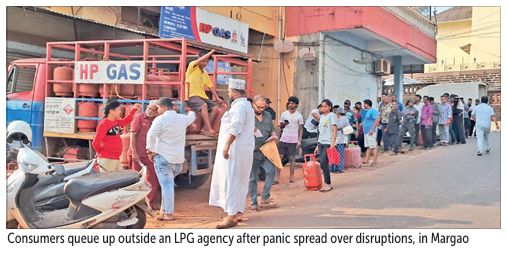
The widening West Asia conflict has begun spilling into kitchens across Goa, triggering panic among res taurants, eateries and ho tels as a sudden shortage of commercial LPG cylinders disrupts cooking opera tions and forces several es tablishments to shut down. IRAN WAR FALLOUT With global fuel supply chains under strain, the government has prioritised domestic LPG supply for households, leaving busi nesses dependent on com mercial cylinders scram bling for stock. Across the State, hotel owners say kitchens are running on dwindling supplies, men us are being cut down and some eateries are preparing to temporarily close if fresh cylinders do not arrive soon. Restaurant operators said commercial cylinders have become increasingly difficult to procure over the past few days, severely affecting food service
Bhaichandra Kamath, a hotel owner in Panjim, said his establishment usually requires two commercial cylinders every week but has been unable to procure fresh stock. “There is no cylinder available. If the situation continues, I may have to close my hotel in two days,” Kamath said, adding that the price of commercial cylinders has also in creased by around Rs 100 to Rs 160. Kamath said he recently visited a distributor to purchase a cylinder but was informed that there was no stock avail able. “They asked me to come next week, but without gas what can we do?” he said. Another restaurateur said the crisis has already led to shutting down of eateries in several parts of the State. “There is a huge crisis with regard to commercial gas availability. Several eateries have shut shop in Panjim, Baga and other places. Indane is out of stock while Bharat Gas is still supplying. I am forced to buy in the black market. Yes terday it was Rs 2200 per cylinder, while today they are de manding Rs 4,000. I have cut down my menu and stopped serving tea today. In another day or two I’ll be forced to down my shutters,” he said. Small establishments say the disruption is hitting them the hardest. Ramesh Naik, who runs a small family restaurant near the market area in Margao, said the situation is becoming increasingly difficult. “We depend completely on commercial LPG cylinders. Earlier we used to get deliveries within a day or two of booking. Now we are waiting for almost a week,” Naik said. “If this continues, small restaurants like ours may have to shut down temporarily because we simply cannot run the kitchen.” The crisis has also triggered panic among consumers in some towns. In Ponda, chaos erupted as residents rushed to the Goa Marketing Federation office to manually book cylinders af ter the online booking and OTP systems failed to generate home deliveries. Commercial bookings were halted while online booking for domestic consumers was also tempo rarily stopped to prevent black marketing. Many eateries and hotels in Ponda were forced to shut shop following the supply disruption. However, officials of the Goa Marketing Federation re jected claims of an LPG shortage, saying there was suffi cient stock and that the problem arose due to a non-func tional booking number. Consumers were asked to manually book cylinders at the office and collect them directly. Following grievances raised by social worker Dr Ketan Bhatikar, officials rushed to the office. He said, “One woman was in tears after not getting her LPG cylinder despite making an online booking. I urge the government to streamline the gas supply. If the situation continues in this manner for a few more days, people will have to fell trees for cooking.” Restaurant operators across the State say the shortage has already forced them to scale back services. Ramesh Shetty, who runs a hotel, said the shortage has forced him to reduce menu items. “Service is getting reduced because gas is not available. We have switched off two to three items from the menu be cause we cannot cook everything,” he said. Some establishments have even begun adjusting their operating schedules. “We are opening once in two to three days depending on gas availability,” Shetty added. Suppliers themselves say they are struggling to maintain stock. A gas dealer in Panjim, speaking on condition of anonym ity, said the shortage has left distributors without supplies. “I have no stock with me now and I don’t know when the next stock will arrive. This is not the fault of the company or the dealership. The situation is bad and there is nothing we can do. Everyone is suffering,” the dealer said. Meanwhile, an LPG distributor based in Margao acknowl edged the supply challenges but said efforts are underway to stabilise the situation. He said the supply chain has been experiencing tempo rary disruptions. “There has been a sudden rise in demand for commercial cylinders, and at the same time there have been delays in replenishment from higher supply points,” he explained. “We are trying our best to ensure that hotels and restau rants receive cylinders, but the supply is currently limited.” He added that distributors are coordinating with oil companies to improve supply in the coming days. “We expect the situation to improve once additional stock reaches the region,” he said. Hotel owners say the shortage is already affecting opera tions and customer service. Pankaj, a restaurant operator, said his establishment typ ically uses two to three cylinders every day. “Till yesterday the supplier was delivering, but today he said he doesn’t have backup stock,” Pankaj said. “If the supply stops completely, we may have to shift to other options like electricity,” he added. Anthony Fernandes, another Margao-based hotel owner, said the shortage has made it difficult to maintain normal operations. “We have regular customers who come here every day. But without LPG we cannot cook food. Some days we have to reduce the menu or stop service early. It is worrying be cause our employees depend on this income,” Fernandes said. Industry representatives warn that the shortage could soon affect Goa’s tourism-driven economy if supplies are not restored quickly. Goa Hotel and Restaurant Association (GHRA) President Gaurish Dhond said the shortage is likely to affect both small eateries and large restaurants. “All bigger restaurants as well as smaller ones will be af fected, which is a major issue. Goa is a tourist destination, and any disruption like this can create difficulties for the hospitality sector,” Dhond said. Dhond said some establishments are exploring alterna tives such as induction cookers and other electric equip ment to keep kitchens functioning. He added that busi nesses may also resort to using domestic LPG cylinders to maintain at least a basic menu. “It is a critical situation, and the earlier it is resolved, the better,” he said. According to Dhond, the shortage has already begun dis rupting events and large gatherings. “At the moment, around five to ten per cent of hotels and restaurants have already been affected,” he said, adding that some parties and events scheduled at hotels and res taurants have already been postponed or cancelled. The growing crisis has prompted the Travel and Tour ism Association of Goa (TTAG) to seek urgent government intervention to prevent disruption to the State’s tourism sector. In a letter sent on Wednesday to Chief Minister Dr Pra mod Sawant, TTAG Executive Secretary Amey Naik warned that restaurants, hotels, beach shacks and catering services across Goa rely heavily on LPG for daily operations. “This could lead to the closing down of many food and beverage establishments and hotels around Goa, which will lead to a crisis and affect tourism in Goa. A lot of ancillary businesses will also be severely affected,” Naik said in the representation. The letter was also marked to Tourism Minister and Cal angute MLA Michael Lobo. “We urgently request you to ensure that commercial LPG is continuously available for all establishments throughout this period,” Naik said. “The majority of restaurants, beach shacks and catering services rely on LPG for their businesses,” the letter stated. The association has urged the State government to ini tiate discussions with the Union government and coordi nate with suppliers and distributors to anticipate possible shortages. Michael Lobo said the crisis could escalate if the supply chain is not stabilised soon. “India needs to import from other countries. Fifty per cent of the hotels will close if commercial gas cylinders are not supplied. Other States have also been affected similar ly. India will have to look at other alternatives,” Lobo told reporters. While restaurant owners struggle to keep their kitchens running, residents who depend on eateries for daily meals fear the shortage could disrupt their routine. Sarto Fernandes, who relies on restaurants for lunch, said he may have to change his eating habits if the crisis deepens. “Well, we have to manage in these times. I have my break fast and dinner at home, but lunch is always outside. If the situation gets worse, I suppose I will have to change my diet. I usually have a thali, and now I will have to go in for a complete change. I may even have to survive on biscuits for lunch,” Fernandes said. Conal Lobo, another resident who depends on hotels for most of his meals, said the shortage could also drive up food prices. “I survive on hotels for all my food intake. I suppose I will have to change my diet. The pricing will certainly increase if this continues longer. I may have to survive on a diet that is full of vegetables and fruits. I know it sounds a little cra zy, but that is what I foresee happening,” he said. Tourists visiting Goa have also begun expressing con cern. Ankita Sharma, a tourist from Delhi staying at a hotel in Panjim, said she had hoped to explore Goan cuisine during her visit. “I just came in today and I have another five days here. It is unfortunate. I wanted to try some Goan cuisine, espe cially the seafood, but it looks like that may not happen if restaurants shut down or reduce their menu,” Sharma said. Adrian D’Souza, a bachelor living in Porvorim and work ing in Panjim, said the disruption could affect people who rely heavily on restaurants. “I am literally at a loss for words. I start the day with idlis or dosas for breakfast. Now that may not happen. I have a budget set aside for food, and now that will go for a toss. The alternative may be expensive and not healthy,” he said. “My lunch and dinner will also be affected. I may have to live on biscuits, pizzas or other quick food options if restau rants stop serving regular meals,” he added.