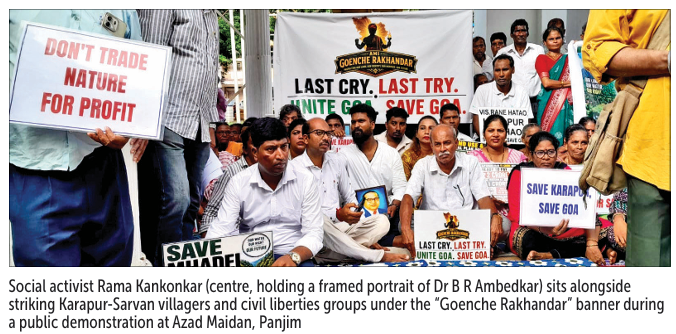
A major politi cal show of solidarity at Azad Maidan on Sunday turned into a direct testing ground for Opposition uni ty, as top leaders from the Goa Forward Party (GFP) and Congress backed striking activist Rama Kankonkar and villagers protesting against the proposed development at Karapur-Sarvan, while several citizens warned them to put personal egos aside to secure Goa’s future. Goa Forward Party (GFP) president and Fator da MLA Vijai Sardesai said the Opposition needed to overcome its differences and present a clear polit ical alternative to the BJP. Speaking in support of the agitation, Sardesai said the Opposition could not afford to remain divid ed if it wanted to prevent the BJP from returning to power. “There has to be a clear cut step.
If the Opposition is not united and the BJP comes to power, those who have the habit of speaking against the government will continue to do so. So cial activists will carry ontheir work,” he said. Sardesai pointed to political developments in Bihar, saying the BJP had been defeated de spite its long-standing elec toral strength and questioned why a similar political change could not take place in Goa. “If it can happen in Bihar, then why not in Goa?” he asked, while stressing that de cisions concerning the State should be taken by Goans. “I think the decision-mak ers should be from Goa. I am completely with the activists. We have to remain united,” Sardesai said. He warned against projects that, according to him, were threatening Goa’s identity and environment, and said the in terests of Goans and Goenkar ponn should take precedence over outside interests. “There are projects which are destroying Goenkarponn. The encouragement of sec ond homes should be stopped. Goans and Goenkarponn should be the priority. We will have to protect Goa, not those who are in Delhi,” he said. The Goa Congress also extended solidarity to Kankonkar and the Kara pur-Sarvan protesters at Azad Maidan. Congress Working President and Aldona MLA Carlos Alvares Ferreira, chief spokesperson Amarnath Pan jikar, Youth Congress pres ident Archit Naik, OBC Cell chairman Sharad Chopdekar and Civil and Social Outreach chairman Seby Menezes were among the party leaders who joined the protest.

Ferreira said people needed to remain vigilant about their rights and assured protesters of Congress support. “People have to be alert. We know that they have their rights. They can go to court and we will help them,” Fer reira said. He also reiterated the Con gress’ assurance that, if voted to power, it would scrap Sec tion 39A and take steps to re verse decisions that the party believes are against the inter ests of Goans. The agitation also drew support from citizens from out side the immediate affected area. A senior citizen from Siolim, identified as Mrs Marlanie, joined the protesters and raised concerns over the impact of large-scale development on Goa’s land, water resources and way of life. Meanwhile, social activist Devidas Amonkar used the platform to place before the government a broader set of demands covering tribal rights, employment, taxation, women’s representation, governance and protection of Goa’s natural resources.
Among the demands were implementation of the Forest Rights Act, filling the backlog of Scheduled Tribe vacancies, ensuring ST political representation and protecting tribal land and constitutional rights. Amonkar demanded that eligible contract employees be regularised through a transparent, merit-based process and called for job security and equal service benefits. On the economic front, he sought measures to ensure that wages and amenities keep pace with the rising cost of living, while calling for fair and proportionate taxation and public charges. He also demanded stronger measures for women’s safe ty and justice and called for 50 per cent representation for women in the Goa Legislative Assembly, including 50 per cent tickets for women. Among his other demands were electoral and governance reforms, strengthening anti-defection provisions, transpar ent recruitment, measures against paper leaks and reforms in government education with greater emphasis on digital, AI, skill-based and employment-oriented learning.
Amonkar called for a halt to business and official engage ments with the Karnataka government until Goa’s rights over the Mhadei are secured. He gave the government 10 days to announce and begin implementing a time-bound action plan on the demands, warning that failure to act should invite political account ability. A major thrust of his demands, however, was directed at the Opposition itself. Amonkar called for the 67 per cent anti-BJP vote to be united under a common minimum pro gramme, urging opposition parties not to field defectors or candidates associated with the BJP. He called for candidates to be selected on the basis of merit, integrity, clean public service and grassroots credi bility, while ensuring representation for women, Scheduled Tribes and other communities. Amonkar urged opposition leaders to put Goa above personal ambitions and work towards a stable alternative government. However, the Opposition’s show of solidarity was accom panied by criticism from some citizens over the continued lack of unity among opposition parties.
A concerned citizen at Azad Maidan said the Opposition needed to set aside personal egos and come together if it genuinely wanted to challenge the ruling establishment. “The Opposition should come together. We know that the current government has finished us and will do the same in the future. I am asking the Opposition to keep their egos aside and come together,” the citizen said. The developments at Azad Maidan thus brought togeth er two parallel messages — support for grassroots move ments against contentious development projects and a growing demand for opposition unity ahead of the next electoral battle.