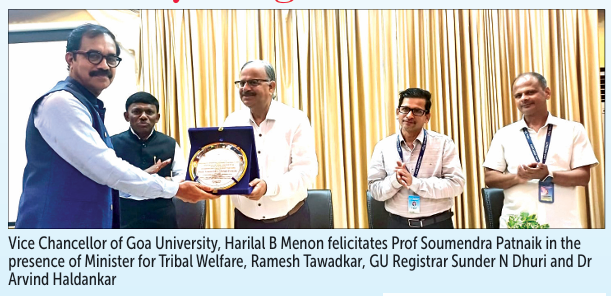
Senior anthropolo gist Prof Soumendra Patnaik on Tuesday supported the demand of Goan ST commu nity for 5% political reser vation in the Assembly and Parliament saying that polit ical representation is a cru cial step toward empowering the community and ensuring their voices are effectively in tegrated into governance. “From a scholarly per spective, increased political representation is a crucial step toward empowering the community and ensuring their voices are effectively integrated into governance,” said Prof Patnaik, Profes sor of Anthropology, Uni versity of Delhi, and former Vice-Chancellor, Utkal Uni versity. He was speaking at an event organised to inau gurate the Dr Kashinath Jalmi Chair in Konkani Tribal Studies at Goa Uni versity. He said that despite fulfilling all necessary criteria, these communi ties have faced a long and ongoing struggle for for mal Scheduled Tribe (ST) recognition. “Yet, what makes the Goan tribal model par ticularly significant is its successful synthesis of three core elements: kinship (the principle of birth), territory, and de mocracy.
This integration serves as a powerful guide for local ex istence, especially through its emphasis on communitari an ownership and the democratic management of natural resources. Today, however, these traditional structures of communitarian living are facing significant challenges,” Prof Patnaik said. He said that there is a critical need for expanded, inter disciplinary study into these communities—focusing on their historical negotiations, political wisdom, ecological practices, and humanitarian values. Highlighting the need for children from the tribal com munity to get educated for uplifting themselves, State Minister for Tribal Welfare Ramesh Tawadkar said, “The State government is taking many steps in funding projects to encourage youth from Goa’s ST community to upgrade themselves through education and thus uplift themselves.” Vice-Chancellor of Goa University, Harilal B Menon said that rather than viewing tribal communities merely as subjects of anthropological research, the Chair must recognise them as repositories of generationally evolved knowledge encompassing forestry, medicinal plants, agri culture, biodiversity, climate, and sustainable living. “A primary responsibility of this chair will be to document this disappearing oral history, stories, and rituals, ensuring the communities remain the rightful custodians of their knowledge.

To achieve this, the Chair should operate on the principles of participatory research,” Prof Menon said. He said academic engagement must shift from studying communities to studying with communities. Associate Professor of Sociology, Goa University and co ordinator of the event, Dr Arvind Haldankar said that the Dr Kashinath Jalmi Chair in Konkani Tribal Studies, champi oned by Dr Prakash Parekar, Associate Professor of Konkani & Vice Dean (Research) at Shenoi Goembab School of Lan guages and Literature, Goa University Campus, will institu tionalise sustained academic engagement with the history, culture, and contemporary aspirations of Goa’s tribal com munities.