Team Herald
MARGAO: More than two months after the High Court issued directives on illegal roadside structures along highways, implementation remains mired in controversy as village panchayats and the Public Works Department (PWD) engage in a bureaucratic tug-of-war over responsibility.

Several Salcete panchayats have formally requested PWD’s Roads division assistance for technical support in surveying illegal structures. Local authorities argue that while these constructions fall within panchayat jurisdictions, the land itself belongs to the PWD, making joint action necessary.
“The PWD cannot simply wash their hands of responsibility when the property in question was acquired by them specifically for road construction,” remarked one Sarpanch who requested anonymity. “We need their technical expertise to properly identify encroachments on their land.”
Cavelossim Sarpanch Dixon Vaz was more direct: “This is PWD property. They must participate in identifying structures built illegally on their land.”
The April 6 High Court ruling on a suo moto Public Interest Litigation (PIL) established guidelines for removing illegal structures but created confusion regarding agency responsibilities. Panchayats claim the court directed them to conduct surveys and compile lists for the Goa State Pollution Control Board (GSPCB) without specifically addressing PWD obligations, despite the department’s ownership of the affected areas.
Meanwhile, local speculation suggests years of political tolerance allowed these roadside establishments to flourish, providing livelihoods for residents while ignoring land use regulations.
Elsewhere, the village panchayat of Seraulim has scheduled inspections beginning from Tuesday. As stated in their public notice dated April 30, 2025, officials will conduct surveys of “illegal constructions on roadside/Highway/Major roads” and commercial operations in all seven wards under their jurisdiction.
Adding complexity to the situation, encroachments on Moti Dongor in Margao have also come under scrutiny following the court’s ruling. These settlements on Comunidade lands have allegedly received political support over the years, further complicating enforcement efforts.
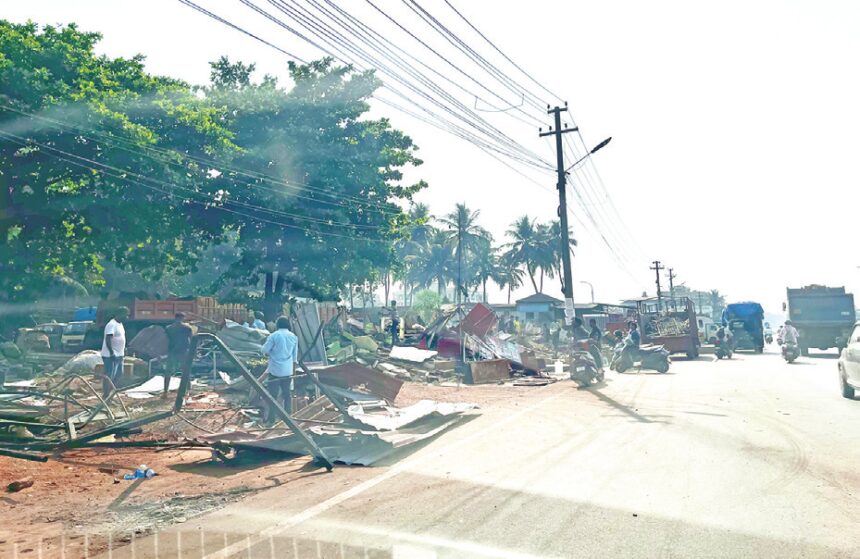
Despite the court order’s clear intent, little has changed on the ground. Near the Comba railway crossing, makeshift shops (gaddas) continue to operate in areas previously designated for PWD road widening, highlighting the gap between judicial directives and their practical implementation.
As this bureaucratic standoff continues, the illegal structures in the taluka that prompted the High Court’s intervention remain largely untouched. Whether authorities can resolve their jurisdictional disputes and coordinate effective action remains the pressing question for communities across Goa affected by these longstanding violations.
mormugao Council to verify legality of 262 structures
Team Herald
VASCO: The Mormugao Municipal Council (MMC) has issued notices to 262 houses and establishments across its jurisdiction, acting on directions from the High Court of Bombay at Goa.
MMC Chairperson Girish Borker told reporters that the notices are part of a court-ordered drive to identify and verify encroachments along highways and internal roads. “As per the circular, all properties or encroachments adjacent to roads must be examined. We have instructed our staff to issue notices and verify the legal status of these structures,” he said.
Borker said that more than 260 notices have already been served, asking occupants to furnish relevant ownership and approval documents. The verification process will include hearings, expected to begin next month.
“We will assess whether the concerned parties had applied for or obtained the necessary permissions at the time of construction. Based on this, the court will determine the legal status of each property,” Borker explained.