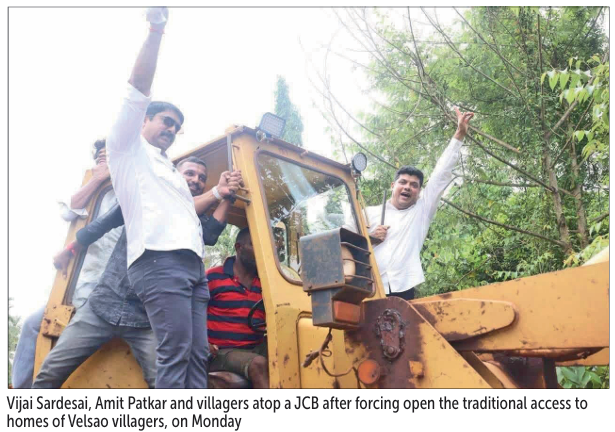
Tensions escalat ed sharply in Velsao on Mon day as villagers and activists confronted authorities and police over the blocking of a traditional motorable access to their homes, with a face off erupting after protest ers brought in a JCB to clear ballast and other material allegedly dumped across the pathway. The protesters pushed ahead despite police attempts to stop them from removing the obstruction, eventually clearing the material from the access leading to more than 20 houses. The confrontation brought senior officials to the spot, with Deputy Collector and Sub-Divisional Magis trate (SDM), Mormugao, Prataprao Gaonkar, and DySP Gurudas Kadam stepping in to defuse the situation. The flare-up exposed growing anger among res idents over the manner in which railway double-track ing work is being pushed through despite a contin uing dispute over the land and the villagers’ insistence that their traditional access cannot be sacrificed. Goencho Ekvott general secretary Olencio Simoes said the villagers had been left with little choice after repeated attempts to get the authorities to intervene failed. “We are forced to take the law into our hands because on Friday, and sub sequently, we had gone to the Collector,” he said, add ing that the Collector had sought documents relating to the Railways’ claim over the disputed land. Simoes said the vil lagers had already ap proached the Collector about a month ago when a similar issue arose and had subsequently warned the authorities that they would be forced to act if the obstruction was not removed. “Our access has been blocked.
We cannot allow access to be blocked. Peo ple cannot be landlocked, and people should not be prevented from living in their homes,” he said. The protesters’ action was backed by GFP pres ident Vijai Sardesai and Congress leader Amit Pat kar, who took aim at the government’s handling of the railway project. Sardesai questioned the Railways’ claim over the disputed stretch, pointing to Portuguese-era property records produced by the vil lagers. He said such histori cal records could not simply be brushed aside, particu larly when, according to the protesters, the Railways had failed to produce its own title documents before the authorities dealing with the dispute.

He accused the Railways of encroaching on villagers’ land and questioned how double-tracking could be allowed to proceed while the ownership dispute remained unresolved. Sardesai also hit out at Cortalim MLA Antonio Vas, demanding that he resign if he could not stand with the affected residents. Media persons repeatedly sought Vas’s response, but the MLA declined to comment. Patkar accused the government of using the railway project to bulldoze its way through local concerns. “The government of Pramod Sawant has bulldozed the area and forced dou ble-tracking to increase coal transportation,” Patkar said. He said residents would not allow themselves to be pushed out of their homes and alleged that similar attempts to take people’s land were taking place else where in Goa. Residents said the immediate issue was not merely the ownership dispute but the very real danger of being cut off from their homes. Local resident Sandra Rodrigues alleged that Rail Vikas Nigam Limited (RVNL) and its contractor, Surya Construction, had encroached on the villagers’ land. “This is our land. It is not their land. They do not have any papers to show that this is their land,” Rodrigues said. She said the residents’ documents showed that their land extended up to the existing railway track and questioned the Railways’ claim over the stretch where work was being carried out. Rodrigues warned that another track would also compromise emergency ac cess to the houses. “If we want an ambulance or anything to come through here, it won’t be possible if they put another track,” she said. “The land that we are standing on today is our land. It is the land of the villag ers of Velsao,” she said. Agnelo Rodrigues of Goencho Ramponkaracho Ekvott and activist Xencor Polgi also backed the residents, disputing the Railways’ claim and opposing the double-tracking work. The protesters questioned the need for further expan sion of the corridor and alleged that the project was being driven by the larger objective of transporting coal while the concerns of those living alongside the tracks were being ignored. Zarinha da Cunha accused the government of pushing ahead without ade quate planning. “Our government has lost its mind, or has no mind, no proper planning and no scientific application. They are only concerned with corrup tion,” she alleged. The administration, however, stopped short of taking a position on the own ership dispute. Gaonkar said the question of ownership was sub judice and could not be de cided by him.
Instead, he examined whether access to the houses could be main tained, inspecting the site and checking possible routes using Google Maps and a land survey. He proposed three options to the Railways, including an alignment along the railway side, an alternative route and a 1.5-metre-wide passage along the edge of the railway track. He also told residents they could approach the court for a stay if they wanted the railway work halted pending adjudication. Crucially, Gaonkar assured the villagers that their Right of Way would not be blocked. The assurance, however, did little to ease the anger generated by the day’s confrontation. Residents welcomed it but demanded that it be implemented on the ground rather than remain another administrative assurance. Gaonkar put the number of houses directly affected by the present obstruc tion at around three to five, but residents disputed this assessment and main tained that more than 20 houses depend on the traditional access. Goencho Ekvott founder member Orville Dourado questioned why the Collec tor and Mamlatdar had failed to prevent the alleged obstruction despite repeat ed complaints. “It is extremely unfortunate that the Collector and Mamlatdar have failed to act despite being repeatedly informed about the ground situation.
The adminis tration cannot simply stand by while access to more than 20 homes is blocked. The authorities must act independently and protect the rights of the villagers rather than allowing any agency to proceed unchecked,” Dourado said. The Railways maintained that it was working on railway land and said its claim was supported by Government of Goa records. A railway official said the ISLR had inspected the area two or three times and that the findings available with the Railways supported its position. “The work that we are doing, we are doing it on our railway land,” the official said.
The Railways also made clear that the confrontation would not derail the dou ble-tracking project, while offering a 1.5-metre passage along the side of the track as a way of addressing the access issue. “We are thinking of giving them the passage first, on the side. One and a half metres,” the official said. The Railways further said the disputed stretch did not presently have a survey number and that the process of assigning survey numbers was under way with the ISLR. That position has done little to settle the dispute. Villagers continue to rely on Portuguese-era property records to assert ownership, while the Railways insist the land belongs to it. The ownership question remains pending before the ISLR. Simoes warned that residents would monitor the situation and intensify their agitation if the access was blocked again, leaving Monday’s confrontation as a stark warning that the railway project could face increasingly fierce resistance wherever it collides with the basic right of residents.