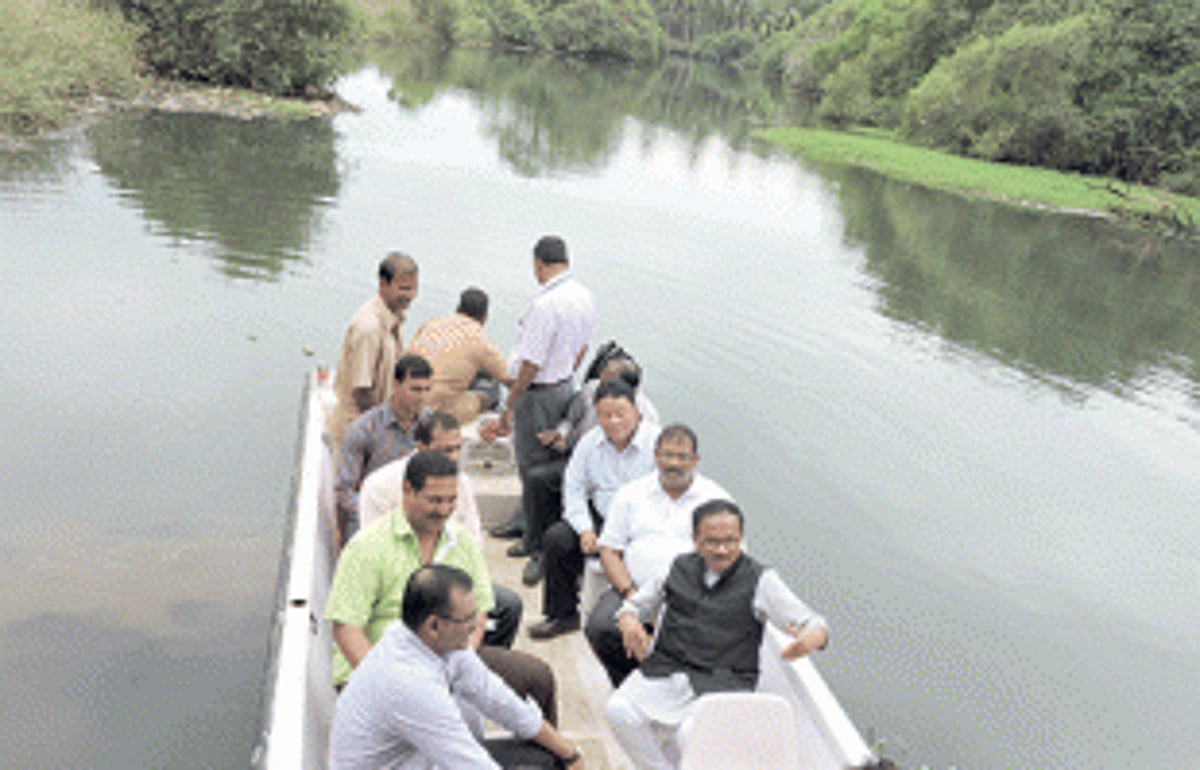
18 months after that famous boat ride on River Sal to assess its pollution levels, the Salcete MLAs accompanied by the Chief Minister this time went for another boat ride and carried out another inspection of River Sal.
While the launch of the dredging and desilting work of River Sal considered to be vital to carry out work to address pollution was celebrated by Salcete locals, the concern however is about the time it took for this to happen given the many deadlines given by chief minister Laxmikant Parsekar’s predecessor Manohar Parrikar.
Moreover, the questions are when River Sal will be cleaned of its pollution entirely given that the lifeline of Salcete was found to be the most polluted river in Goa by the Goa State Pollution Control Board (GSPCB). It is to be noted that the highest faecal coliform and e-coli content has been recorded in river Sal and the river water was deemed unsafe for human consumption as per the GSPCB report released in June 2015, a little over six months ago. River Sal passes through eleven villages of Salcete including the coastal villages starting from Margao and drains into the Arabian sea at Betul.
Former Chief Minister Manohar Parrikar had visited River Sal in March 2012 soon after getting elected to power and made tall promises of swift action while offering various explanations as to why the river was polluted.
In February 2014, Parrikar had met another promise of cleaning the River Sal in one year’s time during the commission of the 20 MLD Sewerage plant in Navelim.
On January 19, 2016 Tuesday, Laxmikant Parsekar and Avertano inspected the treatment plant and hope was expressed that by March 2016, the issues with the STP would get addressed and with this, sewerage would stop flowing into River Sal.
The biggest issue with River Sal is the amount of sewage and waste being dumped into the River. Parsekar had addressed this issue at the commissioning of the Colva sewerage 7.5 MLD Sewerage Treatment Plant last month and GPSCB had issued notices to various establishments as well directions to primary health centres to inspect and verify the houses and establishments and remove the pipes connecting the establishments to the river.
“The biggest issue is with the flow of sewage into River Sal. It flows from Navelim, Khareband and Margao. All the storm water drains in Margao are polluted with sewerage and the ones at Pajifond and old market are dumped into River Sal,” said Terrence Pereira from Margao.
The state government had even filed an affidavit in the High Court stating that an inspection was conducted to verify the causes of pollution in the river, which is leading to destruction of shellfish. At that time, a three member team had studied the mass mortality of ‘tisreo’ (clams) in Sal and had called for monitoring and reducing man-made pollution by improving sanitation infrastructure for the fisheries sector in River Sal. They had listed out various reasons including lack of hygiene, sanitation facilities on the river bank and also lack of a waste collection and disposal system at the Cutbona jetty.
Local fishermen further complained about the increasing levels of what they suspected to be acidity in the water and they claimed it was killing oyster larvae besides clams on a large scale and had led to the decline in local fish like ‘kubhe and xinnaneo.
Farmers who have fields near the nullahs or lakes in Salcete have also complained about how pollution has destroyed their cultivation and has caused them to lose their livelihood. This affected labour as they were scared after some of the farmers suffered from skin infections due to the contamination in the water.
In Cuncolim near the industrial estate, the nullah that connects to River Sal was inspected for the presence of heavy metals. However, reports denied the presence of the same. In this area, the GSPCB had conducted ground water bio-remediation of River Sal which involved the use of naturally occurring organisms to break down hazardous pollutants into less toxic or non-toxic substances. The same treatment is expected to be used for the entire stretch of River Sal.
“We have heard several reasons as to why there was a delay but there was a lack of urgency in the first two to three years. To clean the Sal, it will take a lot of time and it requires a holistic plan covering the entire stretch of River Sal together,” said Agnel Fernandes, a local fisherman acknowledging that this was a start but hoped that the incessant delays will now stop.