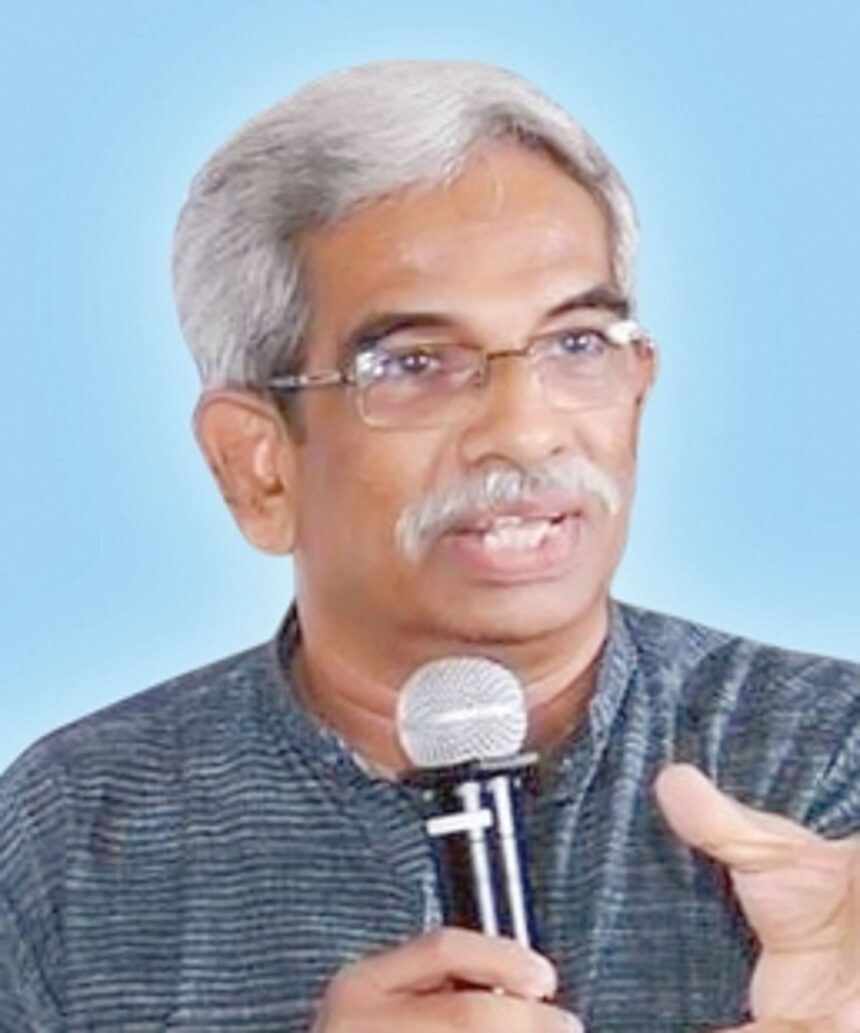
This tribute is to a person who laid the foundation of management education in Goa. He was a true visionary, walking much ahead of his times, planning for the future of management education. He was none other than Prof Ancheri Sreekumar, former Dean of Management Studies at Goa University who retired after serving the university for two decades and passed away last month.
He earned his first degree in engineering followed by an MBA in operations from Cochin University, and later a Fellows program from IIM, Ahmedabad. He joined Goa University in 1989 as a Reader in Management Studies and voluntarily retired in 2010. He passed away on November 29, 2015.
During his career spanning two decades at Goa University he held the positions of Head as well as Dean of Management Studies. He pioneered the introduction of choice based credit system in management programs in Goa. Realizing the need for quality management education, he introduced the BBA program in under graduate colleges. This program had several unique features like soft skill training, open book examination, executive interactions and training for facing interviews. He believed undergraduate education should mould personalities and introduced non-business courses in business programs.
IIM Ahmedabad, of which he was a fellow, had a profound influence on him. His meticulous attention to detail went to the extent of providing chairs in semi-circular fashion to facilitate interaction and providing plug points for laptops in all places where students causally sit, and a book bank at the department, so that every moment could be converted into a learning experience. The door of the management department was always open so that students could come at any time and use the open spaces to create a learning experience 24×7. He believed that learning is by interaction with peers. He also created many journal, company and industry data bases at the department.
He was a Samaritan who always placed the students first. Student-centred learning was his mantra. He believed that students should exercise their brain to develop their academic strength and saw the role of teachers as mentors and facilitators. To this end he advocated and introduced case study method following the IIM and Harvard tradition at Goa University. Every session was reading based and had a case or an exercise that the student should do. Value was created through discussion among diverse participants. He went to the extent of even proclaiming that the best teacher is one who makes himself progressively unnecessary. This was a prelude to the independence of the student who would be thrown into the turbulent waters of corporate managerial cadres.
For him knowledge was never passive. Application was the catchword. “Should you know to manufacture a car to drive it and reach somewhere?” he would ask. He tried to simulate a world for the students which resembled the real corporate world. He let students have access to books, internet, data bases etc for solving their problems and writing examinations because in the real world they would have access to all these and they had to only use them wisely to make decisions.
Technology was a great enabler for him. He was the person who brought “Moodle”, a free course management software to Goa University. Use of this software, along with other good practices has won many accolades from accreditation bodies like NAAC. Moodle helped him to archive every assignment, every project that students did. He also arranged to video tape all the presentations and interactions by research students and would spend nights archiving them and viewing them to give comments.
For him everyone was equal. He did not mind sharing a cup of tea with the lowest person in the organizational hierarchy. For his colleagues he was a great motivating force. With one glance he would trigger a trail of introspection in people around him. Humility was his hallmark. He always occupied a small room just like his fellow workers.
He had a taste for fine things in life. He loved movies and many of the observations from the movies he brought to his classes and discussions. Novels, poems and music found place in his learning tools. He was interested in learning culture. He looked down upon nothing and no one, listened to everyone carefully. He never discussed people but only issues, never blamed anyone.
During his period transparency was at its peak. He believed that each one had to contribute. He was seen always oriented to work. By this passion he motivated others work and learn. He was a boss who never bossed.
As far as research is concerned he had the most innovative ideas. He believed that research is ignited by a discomfort in the mind. He would say as a researcher “If you don’t have doubts don’t research”. Are you prepared to live with uncertainties and ambiguities, he would ask. He always taught people to own their creation and be self-made. He only questioned like Socrates and taught students to ask intelligent questions. He believed that what one should learn is the ability to learn.
He will always remain in the minds of people for his contribution to management education and research. His ideals as a teacher will be always cherished. The systems he built will last for decades.