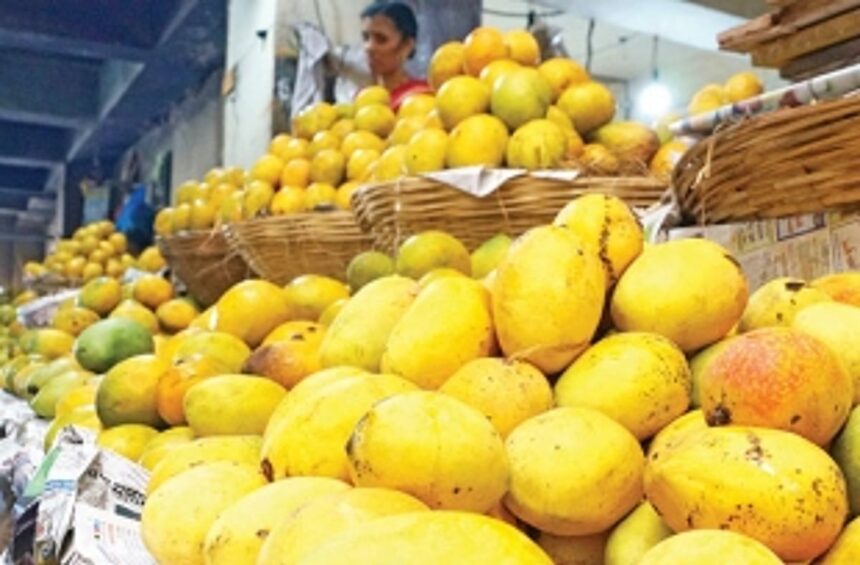
uch to the disappointment of Goans, the lockdown has delayed the sale and entry of mangoes into the market. But what has disappointed the farmers is something that goes beyond the threat of coronavirus but that of climate change, which they believe has also impacted the production of the king of fruits and the mango crops.
A local resident lamented that this is the time of the year that people usually move out and go to the market to buy the seasonal fruits but due to the lockdown, their ability to move out has been restricted as well as the presence of vendors selling mangoes.

While the cashew and jackfruit are already available in the market, people are eagerly awaiting for mangoes to enter the market.
Vendors also stated that most of the mangoes available in the market are not locally grown mangoes but have been imported once from other States such as Maharashtra, Karnataka and Tamil Nadu. This has created a ‘preference problem’ as most of the customers ask for various types of mangoes grown in Goa such as the Mancurad and Alphonso variety. These vendors have non-Goan mangoes such as Hapus Totapuri, Lalbagh mango and other varieties.
Such vendors can found along the road sides as well and are ruing the fact that unlike an average season, the sales are not as high as before.
Mango farmers share a similar sentiment and while those families who own mango trees are doing fine as they usually grow it for self consumption and share amongst friends and relatives, with the exception of those who sell the produce commercially, most of the farmers are used on a bumper sale given the high demand not just in Goa but in other parts of India as well. There have been similar reports in the country about how the export of Mangoes has come to a complete standstill leaving producers worried about their livelihood.
A farmer mentioned that the sale of the seasonal fruit in these two three months helps them run their operations and with less income coming in, they are tense about their future. There is still some time left, they add and hope that some amount of business does take place.
They however, have another worry and that is not COVID-19 related but about the impact climate change has had on their crops.
Farmers lamented that they had to deal with the vagaries of weather, which has delayed their crops by a month now.
“Due to the fluctuation in temperature, this year’s mango crop had to face the brunt of nature. There was a short winter as well, which has had a direct effect on the growth of our crops and has delayed its availability in the market. Right now only 20% of the average mango produce by this month is in the market,” said a farmer.
Usually mangoes enter the market by mid-April; however mango traders and cultivators have claimed that this year 80 per cent of the mango crop is not ready to enter the mango crop this month.
Other cultivators concurred and said that due to the short winter season, the crops have not flowered due to which instead of fruits, only leaves have grown causing major loss. Further, 80% of the mangoes produced are yet to be plucked and that the same will start by the first week of May and should enter the market by May 25.
This 80 of produce will be ready by first week of May when they will start plucking the mangoes and by 2nd week of May mangoes will enter into market in huge quantity and within two weeks that is by 25 may, mangoes will be over.
Mango traders further lamented that the absence of labour to pluck and distribute mangoes has also been a hindrance. “Most of the labourers are from neighbouring States and they have gone back home and now since the borders are sealed, they are not available and the farmers are not in the same position as before to pluck mangoes as the same speed as earlier.
Some farmers fear that their crops and produce may be wasted as time is of the essence and they may not be able to complete all the work at such a short notice without manpower.
“Due to the lockdown, there are no labourers available. We managed earlier (before the lockdown) but now we are going to face difficulty since the quantity is huge and there is not enough manpower. There is a fear that we won’t be able to pluck all the mangoes from the trees also”, said Mahesh Naik another farmer.
There are also some landlords who have a vast number of mango trees, which are given on rent to mango cultivators and there’s an arrangement with the traders based on the quantity of the produce, who then sell the mangoes in the market. However, even they have been hit by the lockdown.
Further, there were some local factories and companies that would buy mangoes in bulk from Goans but are now depending on produce being brought in from outside Goa due to the current circumstances. This also has due to economic reasons given that these mangoes are delivered at their door steps and for a lesser price.
However, local cultivators have hit out at this practice and also alleged that mangoes from outside the State are produced using artificial methods of ripening, while the local producers use natural methods. “Mangoes from outside Goa may cost less but can hurt your health more,” quipped a local cultivator.
But for now, they are too caught up with what is happening with their farms and their ability to sell. They point out that in the month of April, they grown and plucked some amount of mangoes but most of them were distributed to their family and friends given that the markets was shut. The traders on the other hand were not in a position to distribute the produce to the vendors or see that it is sold in the market during the lockdown, which has had a domino effect on the this sector. Felix D’souza, another farmer added that even though the crop was short, they were scared to move out due to the lockdown restrictions. He added that they managed to distribute the same amongst family members, neighbours and friends.
“Compared to previous years, this year there is shortage of mangoes in April. This year out of 100, only 25 trees have flowered. However in month of May there will be availability of mangoes in huge quantity which will get over within two weeks. Due to the climate change and shortfall in days of winter, mango tree have not flowered as the growth has been delayed,” Rajesh Dhargalkar, a mango trader from Siolim.
Another farmer named Thomas, who has taken Mancurad trees on rent, opined that due to the restrictions, the vendors who are selling produce procured from outside the State are dominating the market and are also controlling the price right now. “However, there is no comparison to Goan mangoes. Usually the crops are ready by April but this year it will be available in May,” he added.
. Another farmer Yogesh Salgaonkar assured that mangoes will be available by the first week of May as there is still a big demand for the same.
Amey Natkar, in-charge of the Mapusa sub-yard agreed with Yogesh and said mangoes should be available by the first week of May. He was also of the opinion that once the local variety like Mancurad and Alphonsos enters the market, the demand will surpass that of the mangoes from outside Goa. He also demanded that there be strict checking on artificial ripening of mangoes, especially from those procured from outside Goa. He also called on the government to ensure a system in place to facilitate the distribution and sale of mangoes for farmers/vendors by maintaining social distancing, even during the lockdown period and thereafter.
Farmers are still hopeful that even though there has been a delay, they will be able to salvage the season this year