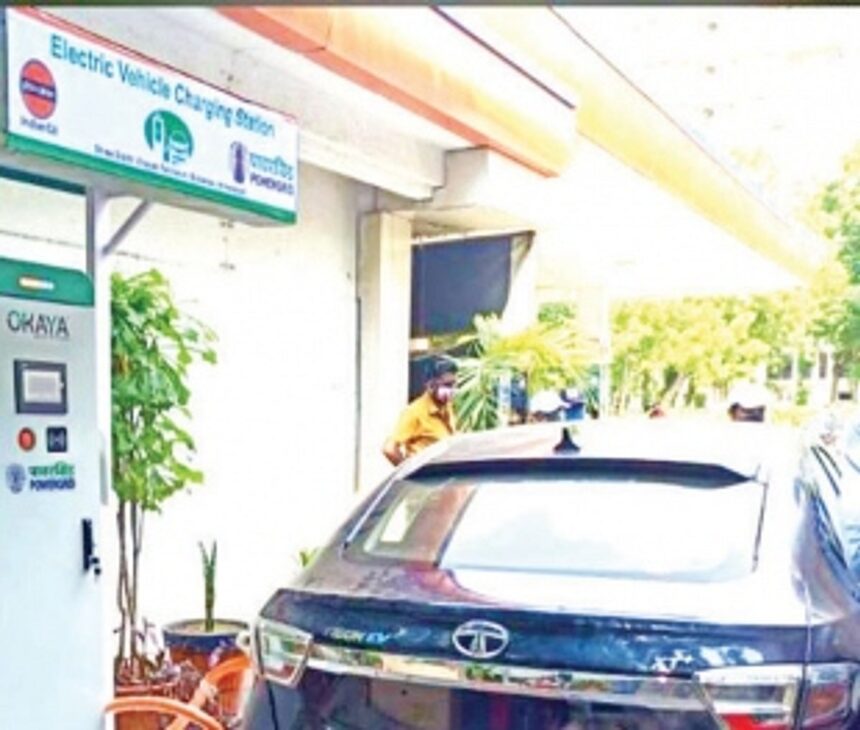
Observing the fillip given for the electric vehicles during the last Union budget and ever rising fuel prices with a threat to environment, the Goa government has recently released its draft policy on Electric Vehicles (EV) and the stakeholders which includes dealers in vehicles and even experts in clean energy have come up with their sharp reactions, full of suggestions, which the actual policy, should carry.
President of Goa Automobile Dealers’ Association Prashant Joshi while welcoming the “The Goa Electric Mobility Promotion Policy 2021” believes that some of the key issues need to have more clarity and fine tuned based on further interaction with the automobile industry and other experts. (a) Purchase incentive of Rs 10,000 per kWh of battery capacity is a good move. (b) Development of charging infrastructure by deciding on the shortest distance between the other will play a key role.

“Since our State is small in size, planning of such charging infrastructure in every nook and corner of Goa would give more confidence to the buyers of EV mobility. Goa could be an ideal State in providing such infrastructure taking into consideration the local and tourist vehicular movement in Goa,” said Joshi
He went on to add that since the percentage of two wheeler population is higher than four wheelers in Goa, charging infrastructure needs to be in place in parking lots and specially private and government offices parking areas, hotels, shopping malls and restaurants etc. Also the State government should promote charging stations through solar power technology to cut down cost and saving our electricity for industrial and other purposes.
“There is also an urgent need to implement the Vehicle Scrap Policy as once ultimately when you shift from IEC engine vehicles to EV one has to discard his vehicle as a scrap for which scrap yards needs to be in place well in time, to avoid parking of scrapped vehicles on road. This also becomes an integral part of infrastructure which needs to be in place. Ultimately, the whole world will shift for EV mobility which would create maximum disruptions in the transport sector. Let us all accept this new challenge for smooth transition to EV mobility. However, before finalising this policy all the stakeholders have to be taken into confidence to fine tune the same so that it really motivates the buyer of electric vehicles,” said added Joshi.
The Goa Chambers of Commerce and Industry (GCCI), the oldest chamber in Goa’s President Ralph De Sousa while welcoming the draft policy pointed out that target of converting 30 per cent of all vehicles to EV, swapping of batteries, in addition to charging stations, conversion of all two-wheelers involved in commercial activities to EV by December 2025, conversion of all two-wheelers to EV by December 2030 and conversion of transport vehicles and goods carriers to EV is a welcome move.
However, he suggested that, “The high-power committee should have representation from GCCI, CII, and other such bodies, and also representation from vehicle dealers on rotational basis.” De Sousa also pointed out that since there is electricity involved, safety must be taken in to high priority for the common people.
“JERC has fixed the rate at which ED-Goa will charge for electricity supplied to EV charging stations. But what will be the rate at which the charging station charges the EV owners? There is a latent potential business opportunity for existing and new MSME to explore possibilities manufacturing – charging stations, spares, assembly, disposal units etc,” said De Sousa .
Founder of Sun360 Anish Souza believes that despite our fragile ecology, Goa has not been proactive in defining a State policy for EV implementation. Capital incentives from the Centre under the FAME schemes are limited and there is a risk that if we do not implement our policy quickly, EV consumers might not be able to access attractive central schemes that exist today.
He further added that, or objectives stated in the policy are ambiguous and very vague. “There is no mention of how much investment the State hopes to garner from the EV value chain as a result the 10,000 expected new jobs does not seem to have any rationale. As per the policy, Goa tops the country in per capita vehicles with 625 vehicles for every 1000 people. With a population of 15 lakh, we reportedly have 9.37 lakh vehicles. As per the policy, two-third of our total vehicle plying in Goa are two wheelers amounting to 6.2 lakh. The balance 3.17 lakh vehicle covers four wheelers, goods carriers, rickshaws etc. Rather than stating that 30 per cent of new registrations in 2025 (less than 1 lakh vehicles) will be electric, the policy should have a target of 2.8 lakh vehicles (which includes two and four wheeler) by the expiration of the policy by 2026,” said Souza.
Vallabh Kuncoliencar Director of Goa Rajee Auto Pvt Ltd and Secretary of Goa Automobiles Association says that the draft of Goa Electric Mobility Promotion Policy looks promising and questionable at the same time. Promising because of the handsome purchase/demand based incentives being proposed to the end user and two-wheelers constitute almost two-thirds of the total vehicle registrations in the State.
He added that, “The Goa government has proposed a maximum purchase incentive of Rs 30,000 and an additional scrappage incentive of Rs 5000. Additionally, finance support from Convergence Energy Services Ltd (CESL) providing interest subvention on loans will give further boost to sales. Road tax and registration fee will also be waived off during the operative period of this policy. Considering the cost of a premium two-wheeler EV presently averages around Rs one lakh, the purchase incentives reduces the cost of acquisition a two-wheeler EV by almost 40-45 per cent.”

Kuncoliencar further added that the draft policy envisions that all two-wheelers involved in commercial activities such as rent-a-bike and two-wheeler pilots would have to switch to complete electric by December 31, 2025. “Given that rent-a-bikes are used by tourists extensively in Goa to go from one end to the other, this would require proper charging infrastructure across Goa at short distances. With a little over four years to go for this deadline, Goa government has an uphill task to build this infrastructure at a quick pace. Further the draft policy states that all two-wheelers sold beyond 2030 to be 100 per cent electric which looks to be extremely ambitious. The public and private charging infrastructure needs to develop at robust pace to achieve the target,” said Kuncoliencar.
Giving instances Vallabh added that it is pertinent to note here that no major two-wheeler OEMs have launched an EV in the market. Bajaj and TVS have their product ready but it has not been launched in Goan markets. Honda, Yamaha, Piaggio, Suzuki are yet to announce any product. “The two-wheeler EV market share in Goa is currently around one per cent and comprises mostly of start-ups in the EV segment. EV penetration and acceptability amongst consumers will increase in the two-wheeler segment only when major OEMs launch their products,” Kuncoliencar added.
He further suggested and demanded that the State Electric Vehicle Board be designated as the nodal authority for implementation of the EV policy, comprising of officials from departments of renewable energy, transport, electricity and CESL. “Till now there is no representation from the automobile dealers’ fraternity. The automobile dealers are an important part of the EV ecosystem, who work closely with OEMs of EV and the end consumer, hence deserve representation on the board”, he said.
On the issue of defunct battery waste management, the Indian e-waste legal regime underwent a phenomenal drift over time and has only recently embraced EPR and collection of e-waste. Large quantities of EV battery waste presented a unique opportunity to nurture a domestic recycling industry, which is currently in a very infant stage. Tata Chemicals Ltd, for example, commissioned a battery recycling plant in Maharashtra in 2019 but it will take its time to be recon with expertise. Absence of clear scientific guidelines and regulations tailor-made for li-ion batteries, however, leads to poor return of investments in setting up recycling units, as it is a capital-intensive initiative. In October 2019, the framing of a much-awaited recycling policy was proposed by the Union government and is still awaited.