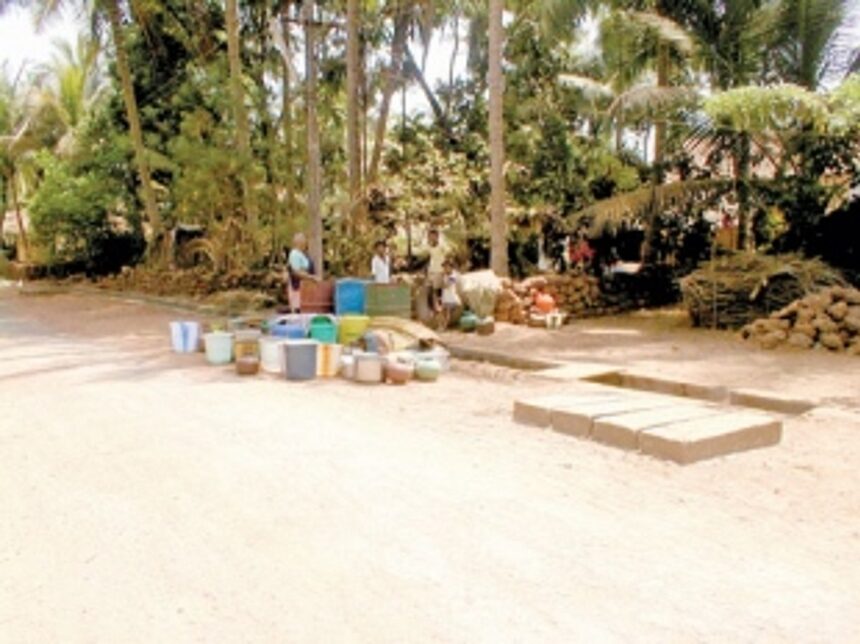
While the wells are running dry, those living on the riverbeds and at the costal belt have plenty of water, but the salinity of the water renders it unusable for their daily needs.
The people wait for the PWD water tankers, and long queues are seen. People wait to fetch water with pots, and sometimes, they are dismayed because after a long wait, they have to carry the empty water pots back home because the PWD water tanker does not turn up.
In Canacona, there is an abundant forest cover and the Cotigao Wildlife Sanctuary. Most of the villages are hilly terrain, and there are many rivers and streams, beside the Arabian Sea on the western side.
The average rainfall per year is around 2,879 mm as per the statistics from the Directorate of Planning, Statistics and Evaluation, and the people can harvest only about 10 percent of the rainwater. The rest gushes into the Arabian Sea from rivers and streams.
Then why are the people complaining about scarcity of water? The AE of WRD, Patil, while speaking to Herald, said that there is plenty of water in the Chapoli dam at Canacona, but the PWD cannot lift the water because the pipes were laid in the 1990’s and the pipes are narrow. Since the demand for water has increased considerably due to the growing population, the narrow pipes cannot deliver much water, and the water that the people get is in trickles.
The water that is piped by the PWD to the consumers is not round-the-clock. The people living in low-lying areas get water, while the people living at a high altitude do not get water in their taps.
AE of PWD (Water supply) Lester D’Souza, when contacted, said that the work of rejuvenating the old pipeline has already been tendered, but the work has not been started.
He further stated that people misuse the water that is meant for domestic consumption; they use the piped water for their orchard plants and deprive the uphill people as the water supply is time-bound.
To add to the woes, the electricity supply is erratic and there are frequent power breakdowns, due to which the motor pumps don’t function, also resulting in the disruption of water supply.
There are many Rural Water Schemes (RWSS) in Canacona taluka and the water is piped from lakes, streams, open wells, springs and tube wells and this water is not properly treated and pumped directly to the consumers.
This correspondent had filed a report in Herald and the same was published on September 16, 2007, under the caption ‘Canconkars’s drink polluted water’. Based on this report, the High Court of Bombay at Goa took suo moto cognizance and Justice R Mohite and N A Britto directed the PWD and other agencies to appear before the court on November 19, 2007.
Thereafter, the PWD swung into action and gave an affidavit stating that various water supply works will be carried by them under a loan from Japan Bank for International Cooperation, which turned out to be JICA, and many frauds were committed; then PWD minister Churchill Alemao is accused of taking kickbacks, which he has denied.
There are two major projects that are undertaken by the WRD: construction of the Karvan and Gavem dams in Canacona. The works on these dams will be completed by December 2017, and according to the AE, after commissioning the dams, Canacona taluka will not face any water scarcity.
These dams have a vast catchment area and abundant water can be supplied to the neighboring regions. Another engineer said that Goa can earn a lot of revenue by supplying water to Karwar, Karnataka, from the dams of Canacona.
The WRD has constructed many bandharas (dykes) at many places in Canacona, but the farmers who used to maintain the bandharas have left their profession as they have grown old and their children have taken up white-collared jobs as they find the agriculture business less lucrative due to the high cost of labour and non-availability of manpower to till the land, remove weeds and harvest crops.
According to Chandrakant Prabhudesai of Loliem, he left cultivating the field as people throw litter, such as plastic and broken glass in the streams, and while moving in the fields, they suffer cuts due to the sharp glass fragments.
Many works that have not been taken up by the PWD are allotted to private PWD contractors, who use substandard materials, which results in the rupturing of pipes and disruption of water supply to the people. It is learnt that the Canacona PWD division has the capacity to undertake maintenance and repair works to the tune of Rs 5,000 and they are hard pressed to undertake the works as that amount has to be sanctioned by the Executive Engineer at Margao. It takes months to get the funds for the required emergency works.
At present, the issue of inadequate potable drinking water is being raised, and one Caitan Vaz and Wilson Fernandes, along with over 50 residents of Ponsullem, had confronted the PWD officials and water supply was restored the next day. Their grievances were that they were not getting piped water for the last six days.
Commercial establishments have grown in Canacona since two decades, and that apart, building construction works are going on. The migrant labourers are also taxing as they clandestinely fetch water from public toilets and other places where people stock water.
Another grievance is that they do not receive water, but they are still billed. When asked, a PWD engineer told that the consumers and persons who lay the pipeline are to be blamed. Despite the flow of water, the consumers keep the taps open and the meter is in operation, and it shows the reading of the air that gushes through the pipes. The remedy for this, he said, is that the consumers should use ‘U’ shaped pipes and at a higher altitude from the ground level.