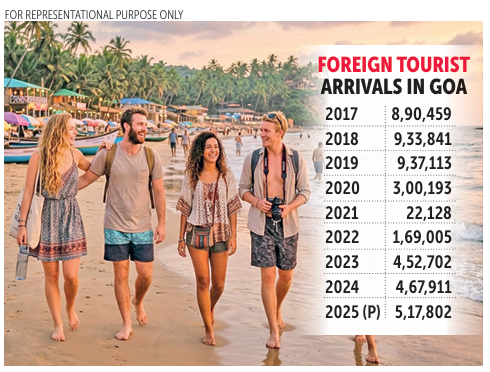
Goa’s beaches are still drawing crowds — but increas ingly, they are Indian tourists with smartphones and weekend plans, not the long-stay foreign travellers who once defined the State’s tourism identity. From Miramar to Palolem and Calan gute to Candolim, the contrast is impossible to miss. Domestic tourism is booming, yet interna tional arrivals continue to slide. The world has begun taking note. A recent BBC report titled “Foreign tourists are falling out of love with Goa. Here’s why” exam ined why travellers are increas ingly choosing destinations such as Sri Lanka, Vietnam, Thailand and Bali over India’s most famous beach destination. The numbers reflect the shift. Foreign tourist arrivals in Goa have dropped from nearly nine lakh in 2017 to just over five lakh in 2025. Domestic tourist num bers, meanwhile, have crossed 10 million. But industry stakehold ers warn that Goa’s traditional international fanbase — par ticularly long-stay European and Russian visitors — is steadily drifting away. Several factors are driving the decline: expensive local trans port, the absence of app-based ride-sharing services, rising ho tel tariffs, overcrowded beaches and mounting competition from cleaner, cheaper and better-man aged destinations across South east Asia. On the ground, tourism stakeholders say the problem goes deeper, pointing to beach filth, stray dogs, aggressive touts, poor infrastructure and a deteri orating visitor experience. Speak to the foreign tourists who still visit Goa, and many echo similar concerns.
They say they want clean, hygienic beaches where they can relax comfortably without having to navigate gar bage, stray animals or unhygienic surroundings. John, a British tourist holi daying in Goa, did not mince words.“There are too many stray dogs roaming the beaches, defe cating on the sand and even near the sea every day. In many plac es, dog waste can be seen along the shoreline, often waiting to be washed away by the tide,” he said. He also pointed to littering by visitors, especially families leaving behind used nappies on beaches.“Families know in advance that children may need changing during a beach outing. They should carry disposal bags instead of leaving dirty nappies behind,” he added. Shawn Martins, a hotelier from Calangute, said Goa is facing a widening “value gap” compared to competing des tinations. “High holiday costs, e-visa technical glitches and the ab sence of free visa-on-arrival options stand in sharp contrast to the superior quality and lower prices available in South east Asian markets,” Martins said. He added that chronic noise pollution and increasing “over-tourism” by unruly, low-spending crowds have eroded the relaxed, bohemian atmosphere that once attracted international travellers. According to Martins, the absence of digital, app-based, fixed-price transport systems — coupled with unreliable public transportation, particularly at night — has created what many tourists perceive as a predatory and expensive travel environment.“Unregulated touts, agents and hawk ers continue to harass tourists at beaches and transit hubs, severely damaging Goa’s hospitality brand,” he said.

Martins also criticised restrictions affecting the enter tainment and nightlife sectors.“A strict 10 pm sound limit, along with the absence of dedicated indoor arenas or des ignated entertainment zones, has severely restricted the growth of music and nightlife tourism. Frequent last-min ute permission cancellations and delays have also branded Goa as a high-risk destination for global music events and large-scale productions,” he added. Veteran tour operator Aloo Gomes Pereira said geopo litical developments have also played a significant role in the decline.“Earlier, Goa received a large number of tourists from Russia and Ukraine. The war between the two coun tries caused a major drop in arrivals,” Pereira said. He noted that rising fuel prices have further increased travel costs globally, affecting tourist movement.“Domestic tourists generally stay for two or three nights, whereas for eign tourists typically stay for a minimum of 10 nights or longer. Hotel rates have also risen sharply because of in creasing operational costs,” he said. Pereira stressed that the government must focus on im proving infrastructure before spending heavily on promo tions.“No foreign tourist wants to see garbage strewn along roads leading to beaches. The growing menace of touts also creates a negative impression. The government must first put its own house in order,” he said. He also expressed concern over the changing character of tourism in the State.“Goa is losing its essence and is gradual ly being destroyed. The kind of domestic tourism Goa is now receiving is not always compatible with the expectations of foreign tourists. Laws must be strictly enforced, and those creating a nuisance should be penalised,” Pereira added.
Travel and Tourism Association of Goa president Jack Sukhija, however, maintained that the decline in foreign arrivals is not unique to Goa.“This trend is being witnessed across the country. Goa is still performing far better than many other States and has managed to achieve tourist ar rival figures comparable to those recorded in 2019,” Sukh ija said. Sita Travels chief operating officer Ernest Dias linked part of the decline to global instability and flight disrup tions.“Foreign tourist arrivals dipped during the peak of the conflict involving the United States and Iran. As soon as tensions escalated, some Goa-bound flights were can celled,” Dias said. At the same time, he pointed out that more middle-class Indians who previously travelled abroad are now choosing Goa for holidays. “Foreign tourists who would otherwise travel to Gulf countries are also expected to choose Goa because of the uncertainty in the region. Goa remains the only State bringing charter tourists from the UK, Russia, Poland and Kazakhstan,” he said. Dias added that Goa’s charter market had suffered heav ily after the pandemic and the Russia-Ukraine war.“Before Covid-19, Goa received tourists from 13 regions of Russia. Arrivals declined after the pandemic and the war, but for eign tourist numbers have still been increasing year-on year. We are also handling FIT (Free Independent Travel ler) business from across the world,” he said. Shack operator Manuel Cardozo believes the govern ment’s approach towards foreign tourism lacks urgen cy.“The government is simply not interested in foreign tourists. They now face difficulties obtaining visas, long term visas have been discontinued and visa costs have in creased,” Cardozo said. “Many countries offer free visas on arrival. If they can do it, why can’t India?” he asked. Cardozo also lamented Goa’s rapid urbanisation and the erosion of its natural charm.“Foreigners once came to Goa for its greenery. Today, much of that greenery has turned into concrete jungle,” he said. “The foreigners still visiting are mostly old-timers hold ing multiple-entry visas.
Young travellers are rarely seen anymore. Tourism infrastructure in coastal areas is poor, and with shacks being dismantled, many beaches are now left completely dark at night,” he added. Tourism Director Kedar Naik, however, rejected claims that foreign tourist arrivals are collapsing.“Negative prop aganda is being spread by PR agencies working for com peting tourist States. We are working towards reaching the 2019 arrival figures that declined during the Covid-19 pan demic. Some flight operations had been suspended earlier but have now resumed services to Goa,” Naik said. He added that the depreciation of the rupee has made India a more affordable destination for foreign travellers, although Goa continues to face growing competition from emerging international markets.“We are also continuing to receive charter flights,” he said. According to statistics released by the Department of Tourism, Goa recorded over 5.17 lakh foreign tourist arriv als last year, registering a growth of 10.66 per cent over the previous year.