

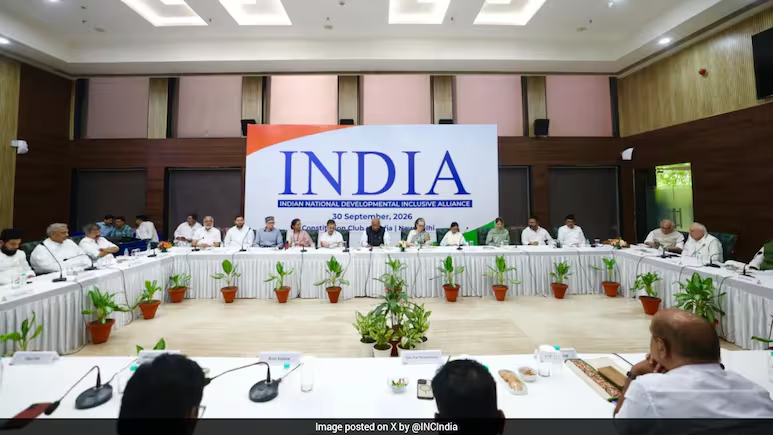
Congress president Mallikarjun Kharge has called for a return to ballot paper voting, as the Opposition INDIA bloc renewed its criticism of electronic voting machines and the ongoing debate over electoral rolls.
Speaking at an INDIA bloc meeting in New Delhi on September 30, Kharge listed five demands, including the use of pre-SIR electoral rolls for future elections, a stronger appeal mechanism before a voter’s name is removed, safeguards against the exclusion of eligible voters due to administrative failures, voting through ballot papers and a simpler voter-registration process for first-time voters.

Kharge’s remarks come amid opposition parties’ continuing concerns over the Special Intensive Revision (SIR) of electoral rolls and the functioning of the Election Commission.
The Congress chief referred to a recent Indian Express report that said Election Commissioners Sukhbir Singh Sandhu and Vivek Joshi had formally raised objections on 14 occasions over a 10-month period concerning decisions and orders linked to the SIR process under Chief Election Commissioner Gyanesh Kumar. The report, as cited by NDTV, raised issues including changes involving the ECINet electoral-roll database, voter-registration forms and decisions related to deletion of names.
Kharge argued that every eligible citizen should have an equal opportunity to participate in elections and said concerns over voter-list revisions needed to be addressed transparently.
He also criticised the use of EVMs and said the INDIA bloc’s position should be to return to ballot papers. Kharge alleged that opposition parties had repeatedly raised questions about EVMs and electoral-roll changes but had not received satisfactory answers.
His demand comes against the backdrop of India’s long transition from paper ballots to electronic voting. According to the Election Commission of India, EVMs were first used on a pilot basis in 1982. The machines were subsequently used more widely, with EVMs deployed in 16 Assembly constituencies across three states in 1998.
The ECI currently describes EVMs as electronic systems used for casting and counting votes and says elections use EVMs along with Voter Verifiable Paper Audit Trail, or VVPAT. The Commission’s voter guide says a voter can see a VVPAT slip displaying the candidate’s serial number, name and symbol for about seven seconds before it drops into a sealed box.
Kharge also criticised the scale of voter exclusions during the SIR exercise. He claimed that 13.3 crore voters had been removed from electoral rolls and argued that the system should bear the responsibility of ensuring that genuine voters are not excluded.
The Congress chief further questioned changes to the appointment process for election commissioners and provisions concerning legal protection for the Chief Election Commissioner and other Election Commissioners.
Kharge said institutional credibility depends on transparency and referred to a Supreme Court observation that independence of the Election Commission must also be apparent.
The INDIA bloc’s latest meeting therefore brings together two separate but connected areas of opposition criticism — the electoral-roll revision process and the use of EVMs.
While the Opposition is demanding a return to ballot papers, the Election Commission continues to administer elections using EVM-VVPAT systems and provides mechanisms for voters to check their electoral-roll status and raise election-related complaints.


