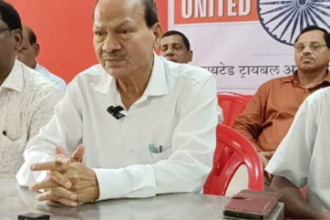
The anti-coal rally at Lohia Maidan on Sunday witnessed a rare moment of political unity in Goa, as Opposition par ties set aside their differ ences to back the people’s movement against coal transportation and han dling projects in the State. Leaders and MLAs of the Congress, Goa Forward Party (GFP), Aam Aadmi Party (AAP) and Revolu tionary Goans Party (RGP) shared the stage under the banner of Goyant Kollso Naka (GKN), declaring a common resolve to protect Goa’s environment, rivers, and livelihoods. The rally drew a large crowd de manding an immediate halt to coal-related projects and questioning the State and Central governments’ ag gressive push for related infrastructure. The show of solidarity was significant not only for its turnout but also for the unlikely convergence it represented. The Congress, GFP and RGP had recently appeared together at a cul tural event led by the GFP — the first such collabo ration involving the RGP — but Sunday’s gathering went further. AAP leaders, who have generally main tained political distance from the Congress and its allies, joined them on stage in what observers de scribed as an “issue-based” alignment rather than a po litical alliance.
After the public meeting, Opposition leaders and party presidents reiterated their stand to the media, condemning what they called the BJP government’s “coal and corporate governance model” and asserting that Goa’s future must not be sacrificed for industrial gain. GFP president and Fatorda MLA VijaiSardesai said the gathering reflected the shared concern of Goans and the Opposition about the direction in which the State was headed. “The BJP is a coal party. If the BJP does not go, coal will not go. If the people of Goa do not want coal, they have to join hands to dislodge the government,” he said, urging Opposition parties to “rise above political differences” to defend Goa’s land, rivers and health. Goa Pradesh Congress Committee president Amit Patkar said the turnout at LohiaMaidan showed that Goans had rejected the government’s development model. “What we saw was Goa saying no to coal and no to destruction. The Opposition’s duty is to ensure that this message is taken to every Goan and raised in the Assembly,” he said, joined by Opposition Leader Yuri Alemao and MLAs Altone D’Costa and Carlos Ferreira. AAP president Amit Palekar, accompanied by MLAs Ven zyViegas and Cruz Silva, said the presentations at the rally showed how coal handling and transportation threaten Goa’s environment and public health. “The data presented proves that Goa’s people are being put at risk. Goa doesn’t need development that destroys its own home,” he said. RGP president Manoj Parab, joined by MLA Viresh Borkar, said his party would help take the movement’s awareness to the grassroots. “Less than a year and a half is left for the 2027 election. The people will get an opportunity to dis lodge the BJP government and stop coal once and for all,” he said. Political observers noted that while the Opposition had earlier come together during broader civil protests — such as the Goa Against Goonda Raj rally following the assault on activist Rama Kankonkar — the LohiaMaidan meeting stood out for its unified tone on a single, critical environ mental issue. Meanwhile, the National Alliance of People’s Movements (NAPM) extended full support to Goans who gathered at the rally, warning that ongoing efforts to turn Goa into a transport corridor for coal and steel industries in Karnata ka would lead to “ecological doom” for the region. In a statement issued by its National Working Group, NAPM said the Centre’s recent announcements con firmed public fears that the three linear projects — power transmission lines, highway expansion and railway dou ble-tracking — along with the Sagarmala initiative, were primarily designed to move coal from Mormugao Port to Hospet in Karnataka as part of a larger “steel and industrial corridor” plan. “For a small State like Goa to be turned into a ‘corridor towards a corridor’ is disastrous,” the alliance said. “Its air, water, rivers, agriculture, fishing and fish-drying spaces, forests, and people’s health and livelihoods are all under threat from coal dust and infrastructure being set up to en able coal transportation.” NAPM asserted that these projects serve corporate inter ests while violating environmental and social safeguards. “We condemn the questionable legal architecture system atically introduced to facilitate this diabolical plan, even as existing laws around environmental protection, land acqui sition and rehabilitation are being brazenly violated,” it said. NAPM called for immediate steps to protect the coastline and livelihoods of local communities. It urged the govern ment to de-notify Goa’s rivers, stop the double-tracking project, and return land acquired “through draconian leg islation”. The alliance also demanded a halt to the ongoing port ex pansion in Mormugao taluka, citing overwhelming public opposition and called for restoring people’s participation in planning and decision-making under local self-govern ance laws, including within the Mormugao Port Authority’s jurisdiction. Saluting the LohiaMaidan mobilisation as a powerful assertion of public will, NAPM urged the State to respond “with reason and not repression”.