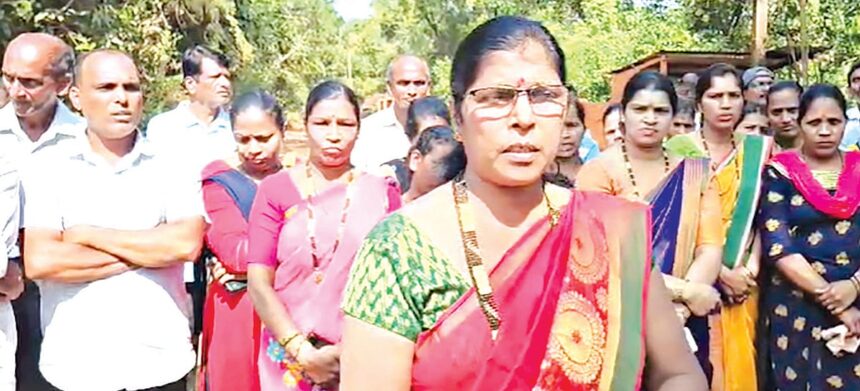
The transportation of iron ore through the villages of Sarmanas and Pilgao has sparked an outcry among residents, who cite dust, noise pollution, and disregard for environmental norms as significant disruptions to their lives. With trucks rumbling through the area almost daily, the villagers have raised demands for stricter adherence to environmental guidelines and a reconsideration of mining operations that, according to them, offer no tangible benefits to the local community.
Daily disruptions and health concerns

The routine transportation of iron ore, beginning at 8 am and running until 1 pm, resuming again from 2 pm to 6 pm, has turned life into a nightmare for residents. The incessant noise, coupled with rising dust, impacts the entire village, from students to senior citizens.
Sunanda Volvoikar, a housewife from Pilgao, expressed her anguish: “We are suffering a lot due to the mining operation and transportation of iron ore. My son, who is in the 10th standard, cannot study properly because of the noise made by the trucks. The drivers deliberately apply noisy brakes, honk, and play loud music. Dust from the trucks settles on our houses, clothes, and even our food.”
Others in the community, like Pandurang Chawan, pointed out the devastating impact on sleep and health: “Our sleep is disturbed every night, and we’re forced to eat dust and breathe polluted air. Even our water wells have become contaminated. The leaves of our trees are covered in thick layers of dust, and despite cleaning our homes multiple times a day, it’s impossible to keep the dust out. Agriculture, too, is affected, as the soil quality has deteriorated.”
Senior citizens, already battling health challenges, have found the situation unbearable. Ganga Bai, an 80-year-old woman, described her plight: “I recently had an eye operation and was advised to sleep well. But how can I sleep when there’s constant noise from trucks? Even my blood pressure has gone up. The situation is just unbearable.”
Economic challenges and betrayal by mining companies
Many villagers feel betrayed by mining corporations and government authorities, citing unfulfilled promises and worsening living conditions. After Vedanta retrenched 150 local workers in June 2023, many former employees have been left with no means of livelihood.
Nilesh Karbotkar, one such retrenched worker, highlighted the struggle: “We lost our jobs because of the company’s decisions, even though many of us are still capable of working. We gave up our farmlands to these mining companies in exchange for jobs, and now we have nothing. The government and local MLAs are not helping us. How are we supposed to feed our families?”
Similarly, farmers like Sudhakar Vaigankar have demanded the return of their lands, which were rendered unusable for agriculture due to mining operations. “The unrest in the village started when the workers were retrenched in 2023. We have no other means of income now. At least if we get our lands back, we can grow crops and feed our families. Around 130 farmers have been affected in this way.”
Noise, dust, and
broken promises
Residents argue that the transportation activities violate the environmental clearance (EC) granted to Vedanta by the Ministry of Environment, Forest, and Climate Change (MoEFCC). According to the clearance, ore transportation is allowed only during specific times and along particular routes, which are meant to avoid passing through residential areas. However, these norms are reportedly being flouted.
Environmental activist Ramesh Gawas pointed out several violations: “Sprinklers and wheel-washing systems, mandated by the EC to control dust, are missing. The mining company also uses public roads and has sought additional time for transportation beyond what the clearance allows, which raises suspicions of illegal activities.”
He added, “The mining company is creating unrest by failing to address villagers’ demands and continuing its harmful practices with government backing. It’s evident that the authorities are more focused on supporting corporate interests than protecting villagers.”
This is not the first time that residents have raised concerns. Recently, villagers accused the government of permitting illegal iron ore transportation during the night, from 11.30 pm to 5.30 am, in violation of EC norms. The noise has disrupted sleep, further stressing families who already endure irregular water supplies and the health impacts of pollution.
Kamlakant Valvaikar, a local farmer, emphasised the toll of these practices: “Mining operations have even resumed at night under police protection, despite our protests. The right to sleep is a fundamental right, but here, it’s blatantly ignored. How are office-goers, students, and daily-wage workers supposed to function without sleep?”
Some villagers also allege that Vedanta misrepresented its requirements during its EC application, claiming to need only 900 metres of public road while instead using larger portions of village routes.
The mining operations in Sarmanas and Pilgao have a contentious history, rooted in land disputes and changes in ownership. Originally managed by Dempo Mining Corporation, the mines were acquired by Vedanta in 2011. Over the years, promises of systematic transportation and community benefits have failed to materialize, exacerbating tensions.
As the situation stands, the conflict reflects deeper struggles over corporate accountability and the preservation of basic human rights, with villagers determined to fight for justice and environmental sustainability.