Govt has to wake up and see the damage: Locals
DHIRAJ HARMALKAR
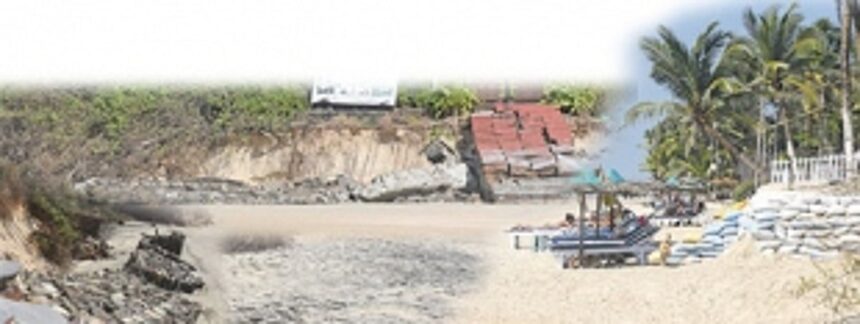
Locals are quite perturbed with the damage caused to the Cansaulim-Arrosim- Velsao coastline due to the recent Cyclone Kyaar and heavy rains. This issue has troubled the fishing community in particular as well as others residing near the beaches. The general secretary of Goenchea Raponkarancho Ekvott (GRE), Olencio Simoes has called on authorities to immediately take cognizance of this issue. The fishing community has called on the government to take up the restoration work on the beaches on a war footing.
They point out that the amount of sand erosion that has taken place this year on the beach Cansaulim- Velsao beachline is unlike previous years and that such kind of damage has not been seen in the recent past.
From rough sea waves, to high tide line, to the rise in sea levels and uprooting of trees, they say there is enough for the authorities to assess and start planning as to how best to deal with the current situation. Locals have also warned that if the government doesn’t act now, the situation will simply deteriorate further. It is to be noted in other beaches across the State, temprorary strsucutrers of fishermen like sheds, huts and even boats in some cases, were damaged, for which they have demandd compensation.
Simoes stated that the Water Resources Department (WRD) should immediately look at mitigation measures to stop the erosion of beaches at Velsao, Arrosim and Cansaulim and tackle the threat of sand erosion across the State.
“WRD has to work on war footing as the access to the beach is now non accessible. The erosion is 12-feet-deep and our huts including houses are on the verge of getting washed away,” he added.
He quoted a survey done by the ‘National Centre for Coastal Research’ (NCCR), which stated that over the last 26 years, India has lost 33 percent of the coastline. He further warned that almost 20 per cent of Goa’s coastline could be lost in the future. He added that according to NCCR, an institute which comes under the Ministry of Earth Sciences, the major reasons for erosion are: changes in the wave pattern, wave intensity, cyclones and depressions that bring heavy rains and make the waters along the coastline choppy, reduction in sediments that rivers and other water bodies bring to the sea, rising sea levels and human activities like construction and dredging of ports.
Olencio claimed that the unregulated dredging done by Mormugao Port Trust (MPT) has affected the beaches of Velsao and Cansaulim. “The maintenance dredging carried at MPT of around 5 lakh cubic-millimeter (Mm3) of sediment is dredged every year. Due to this continuous dredging of such a large quantum, the ecology of the region is being destroyed and this has aggravated sand erosion and has caused drastic morphological changes and now this has adversely affected other beaches too including Velsao,Arossim and Cansaulim beaches,” added Olencio.
Olencio further claimed that the dredged sediments in port areas are usually dumped in deep seas and that the sediments should be dumped along the coast nearby with proper care, which will help stop the erosion.
—
Benaulim has seen better days!
Julio D’Silva
few days after Cyclone Kyaar had moved away from the Goan coast, local residents were alarmed at the devastation it had caused.
“Kyarr dislodged the High Tide Line marker at Benaulim beach, washed away trees etc. The sand dunes bore the brunt of the strong waves and the dunes were cut at several places, some even at a height of more than two metres,” said Benaulim based activist Rudolf Barretto.
While Kyaar also uncovered many hidden truths, activities of certain sections, which would have otherwise gone unnoticed, the major concern was about the high level of sand erosion.
Rudolf also mentioned that some of the coconut saplings that he had planted were destroyed due to the flooding caused by the cyclone and further pointed out that the area remained water logged for at least three days.
“When Kyarr came calling, the sea water entered and inundated the land beyond the dunes. The average elevation of Benaulim is just 1 metre above sea level. It’s almost at sea level at the shore line. These sand dunes are the first line of defence against floods,” Rudolf added while expressing concern about the future if the sand dunes suffer further unchecked damage.
He added that although the water has now receded, it has left behind a layer of black soil that is nothing but the salty sediment of the sea water, which makes the soil unhealthy for any vegetation now.
Sea water then had also entered the main beach areas where vehicles normally park. There were similar issues up ahead at Sernabatim too.
Another matter of concern was the fact the High Tide Line markers, which had been put up on the beach were dragged away and right now one cannot say where the high tide line lies as the markers that were washed away, have not been replaced.