Uphill task for authorities to address all issues
Despite there being two sewerage treatment plants (STP) in Margao, the sewerage treatment leaves much to be desired with locals complaining of untreated sewerage very often being released in the small rivulet next to the plants at Sirvodem.
The two plants at Margao are the 20 MLD one managed by the Goa Sewerage Infrastructure Development Corporation and the 6.7 MLD one managed by JICA, which primarily accepts sewerage from the old connections including the under replacement North Main line.
It may be recalled that then Chief Minister (late) Manohar Parrikar had commissioned the replacement of the North Main line as that line had actually crumbled and at various places sewerage was flowing freely in the open.
In fact, in Comba the situation was so bad that people could not use their toilets as they would not flush and the children were deprived of their only playground as it had turned totally dirty with sewage prevailing everywhere.
Engineer Akshay Dessai, who is in charge of the JICA plant, admitted that there is seepage of mud and stones in the system. “We have installed a grit and stones separator but yet the problem persists probably because there is work of replacing the pipes going on,” he said.
Besides the sewerage coming through the network, the JICA plant is also treating the sewage brought everyday by tankers to the plant. On an average 35 to 40 tankers are emptied every day at this plant and most of them are from Margao and surrounding areas.
Assistant Engineer Joaquim Vas who manages the GSIDC plant that was commissioned in 2017 said they get sewerage from Margao, Fatorda and Navelim areas and admitted that the plant is operating below its capacity of 20 MLS as people are not very enthusiastic about getting connected to the network.
He disclosed that Margao MLA Digambar Kamat had initiated a movement where the municipal councilors would meet people and get them to take the connection but after the initial buzz that movement died a natural death.
Although the municipal council has now decided to move for disconnection of water and power supply to those who do not take sewerage connection, not even one person has been served a disconnection notice and it appears that this too will remain an empty threat from the authorities.
Giving connections is also another problem, as at various places the pipes have not been laid across the road by cutting the road. According to Assistant Engineer P Rane, crossing is done in Colmorod areas while it remains to be undertaken at Gandhi Market and Housing Board.
Incidentally nearly 95 per cent of the connections due in Fatorda are done while in Margao about 50 per cent are done and in the two wards of Curtorim that are in Housing Board, the work will start only when the monsoons end,
Assistant Engineer Abhay Gaude disclosed that in Margao 522 sewerage connections are given of which 331 are for residential houses and 1,851 flats have been connected to the network in Margao. In Navelim 682 connections are done of which 589 are houses and 93 are buildings having 611 flats.
—-
Locals upset with delays after delays
There is a growing discontentment amongst Ponda residents over the inordinate delays in completing the Sewerage Treatment Plant (STP) project. As a side consequence, the locals have also been experiencing bumpy rides on the roads, which are constantly being dug up to lay the sewerage chambers. What’s worse is the manner in which the roads are left after the sewerage chamber is constructed, making it a nightmare for commuters. On this point, locals believe that the only solution is when the construction of the STP is completed, which they want done at the earliest.
It may be recalled that the work on digging for laying sewerage lines chambers had commenced in April 2016. A year later, around the 2017 monsoon period, roads that were dug for the construction of sewage chambers, collapsed in the rains. This led to several accidents and major traffic jams. Years later, the story has remained the same and the number of accidents has only increased due to the poor quality of the roads where sewage chambers have been constructed. This has been the case not just in Ponda town but across the taluka.
Ponda MLA Ravi Naik pointed out that the STP is the need of the hour to take care of the sewage generated and ensure that it is not being dumped into the open.
In this regard, he has called for several meetings with the PWD and Sewerage
Dept officials. He urged the government agencies to expedite the work on the STP and warned of calling for an inquiry in view of locals being inconvenienced due to the bad road quality.
Presently, four STPs have been proposed in Ponda taluka, namely Durbhat, Kavlem, Curti and Bandora.
The one at Durbhat Agapur panchayat has been completed and is operational. The work on the STP at Kavlem Ponda is ongoing. Former PWD Minister and Marcaim MLA, Sudin Dhavalikar, who was instrumental in introducing the STPs in Ponda taluka, stated that the 15 MLD Plant at Kavlem, which will treat the sewerage of Ponda town, will hopefully be completed by the end of this year. He further appealed to locals of Curti and Undir to cooperate with the STP project coming up in their area. He explained how it stands to benefit the water bodies and environment, which is currently being polluted in the absence of a sewage system as people have been found releasing sewage into the nullahs.
However, locals of Curti have opposed the STP claiming that it’s coming up in a residential area in the Housing Board colony. Similarly the STP at Bandora has been opposed by Undir locals on the grounds that it is proposed to come up in close proximity to a residential area. However, the government has remained firm and is continuing with the project work. On this point, locals from Curti and Bandora have claimed that they are not against STPs but want it shifted away from the residential areas as they are concerned about the stench that may emanate from the STPs once it starts functioning.
According to Sewerage Dept official Prakash Gawde, 90 per cent of the sewerage line work has been completed and the department is hoping to complete the project within the next few months.
However, locals will have to wait for the better roads, as NOCs to hotmix these roads will be given only once the sewerage work is completed. In some areas, the work of laying of sewerage lines like in Tusk Ponda is still pending.
PWD Minister Deepak Pauskar said the repair of the pothole-ridden roads is progressing in Ponda. He added that they are waiting for the sewerage work to be completed before they start hotmixing to avoid future scenarios where the roads are dug again.
—
Only good on paper, still waiting on results on ground
A sewage treatment plant (STP) for Mapusa is a top priority and there cannot be any further delays in getting the proposed line for Mapusa operational. In Mapusa, there have been instances of sewage flowing through the gutters and overflowing septic tanks, leading to a stink of sewage permeating in the air. There have been allegations that sewage water from hotels, buildings and residential complexes has been overflowing from septic tanks and soak pits, with the blame laid on the Sewerage Department for the delay in getting the underground sewage system ready on time.
Even as the National Green Tribunal (NGT) has directed the State government to act swiftly on untreated sewage being discharged into rivers, less than 40 per cent of the population of Mapusa has its own septic tank and soak pits. The sewage from most of the area is sent to Panjim via a tanker. Others are openly and fearlessly releasing their untreated sewage into the nullahs which are further released into the Mapusa Tar River.
In Mapusa, disposal of sewage is a major problem as the cooperative societies are not functioning properly and the multi-housing dwellings continue using soak pits for the last several years, despite the soil reaching its maximum capacity to soak the sewage. In some places, sewage is even seen flowing out on to the streets, which are a major health concern. The Mapusa sewage system is still not fully complete and even in areas where the sewage pipeline has been laid, there are many buildings that are still to be connected to the system. The Mapusa sewerage project was expected to be completed by May 2016. The project is being funded by Japan International Cooperative Agency (JICA).
For the purpose of sewerage work, Mapusa town has been divided into three zones. Khorlim comes under Zone 1, Mapusa market and adjoining areas come under Zone 2, while the court, district hospital and Kamarkhazan where the STP is being constructed comes under Zone 3.
The work of constructing the STP has been completed, while the work in Zones 1 and 2 is yet to be completed.
There will be 1,500 manholes among which the work of 866 manholes has been completed. Horizontal Directional Drilling (HDD) technology is being used in this project. Around 70 to 80 per cent of the residential buildings will be covered under this project. The Mapusa MLA, Joshua D’souza said that the phase one work for the sewage plant at Mapusa is underway. “Once that is ready all the sewage from Mapusa will go there and that will be the primary plant. Currently most of the sewage is going into the septic tanks or by tankers to Panjim, “said Joshua.
The Chairperson of Mapusa Municipal Council (MMC), Ryan Braganza told Herald that the phase one work for the construction of a STP for Mapusa is underway. “Currently most of the waste is going into the septic tanks and others may be releasing their waste into the nullah. Once the phase one and two for the STP is completed all woes related to sewage is Mapusa will solved,” said Braganza.
Sources in the Public Works Department (PWD) said that Mapusa has witnessed a vertical growth in the last decade but the residents are yet to get sewage connections even though the government has made it mandatory for new constructions.
The source further went on to add that two agencies, Sewerage Infrastructural Development Corporation of Goa and Japan International Cooperation Agency (JICA), are executing work on the sewerage network while the PWD will look after the release of connections after the plant at Mapusa is ready. The public will be charged through water bills.
A councilor from MMC, Rajsingh Rane said reiterated that waste is going to Panjim as Mapusa does not have its own STP.
“Most of the people are sending their waste to Panjim. Some people have their own soak pits and septic tanks. No doubt some people are releasing their sewage straight into the nullahs. A functional STP for Mapusa is the need of the hour with the rise in the number of construction and commercial establishments in the town,” said Rane.
Another Councilor, Tushar Tople who is very vocal about issues plaguing the locals said that in the jurisdiction of MMC work of laying the sewage pipeline in ten wards had already started.
“In Mapusa municipal area in ward numbers – 17, 18, 14, 16,13,10,12,9,19 and 20 – PWD had started the work of laying the sewerage pipeline. This phase one work was sanctioned to the tune of around Rs. 110 crores. The work is in progress, once completed Mapusa will be free from sewage stink and the Tar River will be cleaner,” said Tople.
A local on condition of anonymity said most of the sewage in Mapusa is going into the River Tar via nullahs.
“The work for a STP in Mapusa is still in progress. The sewage pipeline is being installed in two phases. Maximum houses in Mapusa do not have a septic tank and has been that way since the Portuguese regime as the pigs would handle it earlier. Some of the new houses and buildings have their own soak pits,” she said.
Mapusa constituency resident, John Lobo pointed out that the first phase of the work was stalled due to lack of funds.
“The second phase was opposed by the locals as the waste from Porvorim and Saligao was proposed to be sent there. Presently, many people from Mapusa are sending their sewage in night soil tankers. While the sewage from the old buildings are leaking as the septic tanks are full. We have made several complaints to our councilor, MMC and even the Goa State Pollution Control Board, “said Lobo.
One can recall in 2018, the MMC itself had unanimously resolved to oppose the work on the proposed second phase of the STP at Camarcazana, Mapusa as the plant was supposed to treat the waste from Porvorim constituency and parts of Saligao constituency as well as the other surrounding areas.
—
This STP is running entirely on solar power!
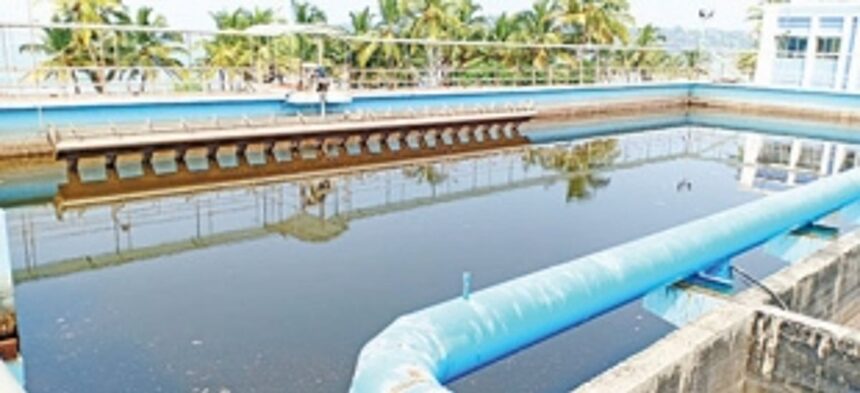
If there is any silver lining in this mess, it is the 20 MLD Sewerage Treatment Plant (STP) located at Katem, Baina, Vasco. It’s also fully operational on solar power.
The sewage received from Mormugao taluka is treated at this plant using C-TEC technology. This plant generates 500 kw of solar power from the solar panels, which are installed near plant and from this, 300 kw of solar power is used to run the treatment plant, according to Sewerage & Infrastructural Development Corporation of Goa Ltd (SIDCGL) officials from.
The STP at Katem was built utilising funds of around Rs 47 crore. The plant was inaugurated and made functional on September 30, 2017 in the presence of the then Chief Minister (late) Manohar Parrikar, PWD Minister Ramkrishna ‘Sudin’ Dhavalikar, Vasco MLA Carlos Almeida, Mormugao MLA Milind Naik and others.
Assistant Engineer of this plant Ganesh Kodlikar explained that this plant caters to the entire Mormugao taluka. “On an average 6 MLD sewage is received and treated in this plant. This plant was built keeping in mind the future years and therefore 30 years is its life and later it can be upgraded if required,” he added.
Further when asked about the construction work which is taking place in the plant premises, AE Kodlikar informed that the main part of this plant is operational. The pump house work is in progress.
He further revealed that from various pumping stations, the sewage is pumped to this plant, which is treated with the use of CTEC technology with Sequence Batch Reactor (SBR). There are two reactors in this plant and one reactor has a three-hour-long cycle capacity.
Another official from this plant informed that the sewage is treated by filling, aeration, settling and decanting and that this entire process is ‘CTEC’. After the treatment of sewage, the sludge derived is disposed off on a drying bed, which is at the end of this treatment plant. This sludge after treating can be used as a fertiliser, for land filing purpose.
Kodlikar also mentioned that efforts have been taken by their corporation to tie up with the Agriculture Separtment to provide this fertiliser so that farmers can be benefited. “Even the treated water can be also taken by the people, whoever feels it’s needed from treatment plant” he added.
When asked about how the entire plant works, Kodlikar revealed that there are solar panels installed near the plant. “This plant works on solar energy, which is generated within plant premises. Around 500 KW Solar power is generated whereas only 300 KW is required by this plant to function. We give the generated power to the Grid Electricity Department, who then provide us with the amount of power required,” he added.