Creating jobs is one of the biggest challenges facing every country- both developed and developing. State like Goa, where over 65 percent of the population is in the economically active age group of 18-45 years, unemployment has been the major hurdle in its growth. Chief Minister Manohar Parrikar too admits to this very fact.
“For a state like Goa employment will always be an issue. Goans want white coloured job and that people have slowly forgotten the concept of ‘dignity of labour,” Parrikar said while delivering the Independence Day address on August 15, 2017.
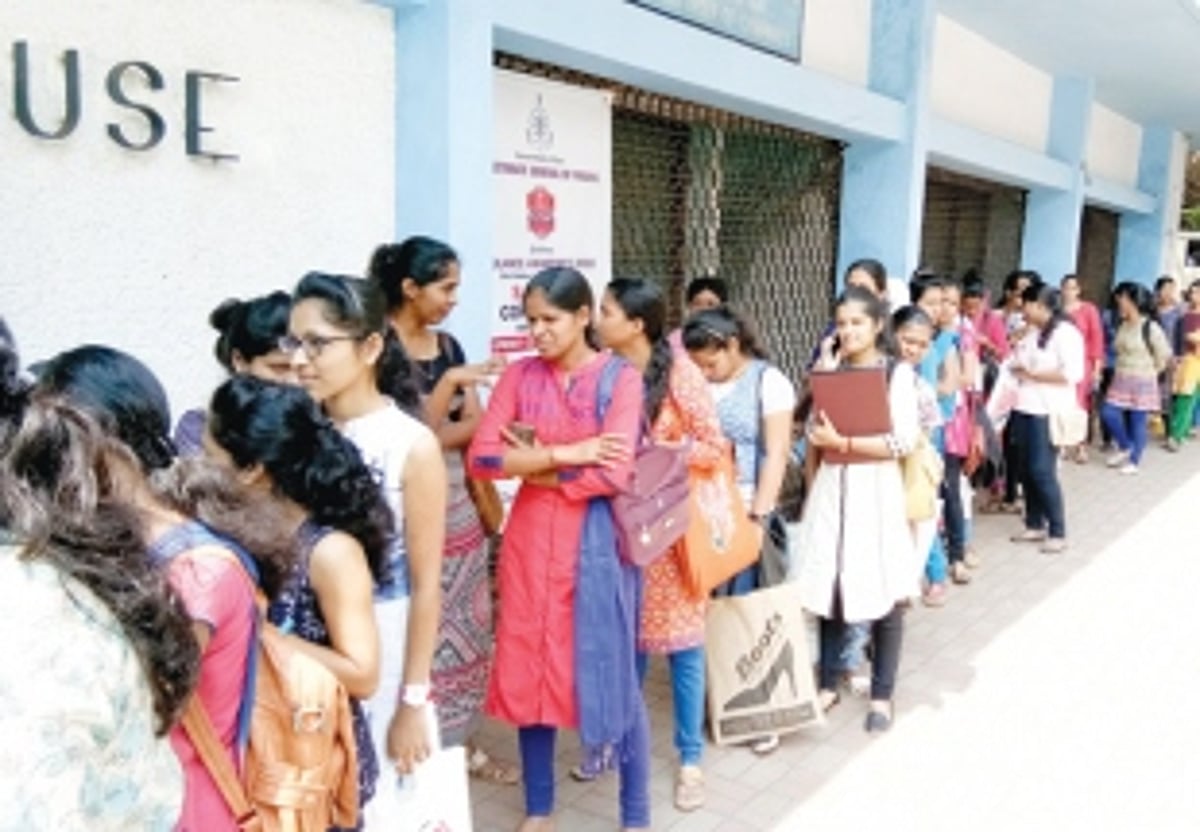
This is very much true. As a result, one witnesses a rush towards government jobs, while the traditional occupations like fishing, agriculture, tourism- which are considered as the revenue generating sector- being taken over by the non-Goans.
Goa has reached that stage of the demographic transition wherein more than 65 percent of the population is in the economically active age group of 18-45 years- commonly referred to as the ‘Demographic Dividend’. For Goa, to tap this dividend it is necessary that the economy is able to generate enough job opportunities to productively absorb this economically active population.
However, the successive State governments have failed on this front drastically- thus one could see never ending craze for the jobs in the government sector- which not only gives you job security and a decent salary, but also gives you that pride of being a ‘Government Servant’. Weekly offs, public holidays and other paid leaves- is something that makes this sector more attractive.
“The craze for government jobs is basically because, government has not been able to provide quality jobs for the qualified professionals in the industrial and private sector. Though there is 80 percent reservation policy for industries, one hardly goes to see, whether 80 percent jobs are provided to Goans and if yes, then the quality of jobs it has offered,” an industry expert said.
The then Bharatiya Janata Party’s key election promise in 2012 was creation of 50,000 jobs over next five year in various industrial sector; however, they failed significantly, in achieving the goal. State failed miserably to create the required number of ‘white coloured’ jobs to its people. The 50,000 jobs was promised in the Goa Investment Policy 2013-18, with 25,000 crore investment.
The Investment Promotion and Facilitation Board (IPFB) constituted in October 2014 as per the Goa Investment Promotion Act, was a single window system to grant in-principle permissions to the investment projects in the State. IPFB is headed by Chief Minister Manohar Parrikar himself.
Accordingly, it has granted in-principle permissions to 156 projects with total investment of Rs 12,374.36 crores and a total employment potential of 23,000.
Over 6000 crore investment proposals with another 18,500 job opportunities is pending approval.
However, the project proponents in their proposals do not describe the quality of jobs they are offering, nor does IPFB inquiry into it. What is interesting to note here is that, the projects that are approved by IPB till date, mostly deals with tourism, hospitality, red industries, which rarely offers decent salaried job. There are some pharma companies, which are also granted permission.
With job creation being the biggest challenge, the BJP led coalition government is now laying emphasis on ‘job creators rather than job seekers’ -dream concept of Prime Minister Narendra Modi ‘Make in India’.
The introduction of the Startup Policy, with aim to make Goa feature among the top 25 destination for early stage companies in Asia by 2025, is the first major move towards ‘job creators’.
“Government cannot provide more than 2000-2500 jobs to youths in a year. We want youths now to become entrepreneurs. We have launched Startup policy. Youths should venture into entrepreneurship by taking advantage of various schemes like that of Chief Ministers Rojgar Yojana (CMRY),” Parrikar said.
“Every Member can easily tap the entrepreneurship skills of around 100 youth which will lead to employment to around 2000 people,” he added.
By unveiling the StartUp policy, a startup ecosystem has been created in the State. Through the new policy initiatives which would not only promote startups particularly in the Information Technology sector but also the micro units would be able to graduate faster as small and medium units. The required policy guidelines and infrastructure would be in place in coming days.
“The idea behind having a start-up policy is to create employment in Goa and stop brain drain from the state. We want our young brains to become entrepreneurs rather than finding a job. We are providing them all the support,” Minister for IT Rohan Khaunte said.
If this objective is achieved the goal of jobrealization through self-employment would be complete as self-employment is the answer to providing jobs to the huge proportion of population in the economically active age group.
“Becoming an entrepreneur rather than finding a job must be the aspiration of young people. We need to encourage students to become job creators and not just job seekers. They should learn to challenge the status quo, take risks and create, as opposed to simply absorb,” former president of Goa Chamber of Commerce and Industries (GCCI) Manguirish Pai Raikar said.
With a focus on promoting Goa as a preferred Information Technology (IT) destination, Government proposed to introduce revamped IT policy, which along with the schemes offered under the StartUp policy will be rolled out by March end.
“With the kind of IT policy we will be offering along with schemes for Startups, we are sure that the immediate brain drain will stop,” Khaunte said.
Khaunte claimed that the proposed IT Park at Chimbel and Electronic System Design and Manufacturing Park (ESDM) at Tuvem will create employment opportunity to nearly 10,000 people at the beginning.