But I do not want in this article to dwell on personalities, I wish to talk of broader issues of betrayal of people’s trust, of the complete disconnect between what our political leaders preach and what they practice. But India is a vibrant democracy and I wish, above all, to discuss how we, the sovereign people of India, may set things right, make our leaders walk the talk.
Our respected Prime Minister, Narendra Modiji, delivering his very first victory speech in Ahmedabad talked of “Vikasko janandolan banayenge”, that his Government is committed to carrying on development as a people’s movement, and has reasserted this theme on many occasions. Certainly, people aspire for development. After all, vikas literally means the opening of a flower bud. Jain philosophy asserts that the wheel of time is forever spinning. During avanati-kala, period of decline, it rotates from happiness to sorrow. On the other hand, during vikas-kala, the period of development, it spins from sorrow to happiness. So development should be for ‘buhujanahitay, bahujanasukhay’; the process of development has to be a process of enhancement of the level of happiness of the majority of the people.
Joseph Stiglitz, an economics Nobel laureate and one-time chairman of President Clinton’s Economic Advisory Council offers an insightful analysis. He suggests that development should result in an enhancement of the totality of nation’s four-fold capital stocks: the capital of material goods and services, the natural capital, such as soil, water, forests and fish, the human capital, including health, education and gainful employment, and the social capital, comprising mutual trust and social harmony. Genuine development will not entail merely growing one capital stock while depleting others, so that the sum total of the four is actually on the decline.
Our current pattern of economic development is not in the least a balanced process resulting in the overall enhancement of the totality of these stocks. Thus, mining in Goa has severely damaged the precious water resources of the state, and the air and water pollution, including high levels of metal content in the major drinking water reservoir of the state has had adversely impacted health. When there are attacks on young idealists like Nilesh Gaonkar and Ravindra Velip social harmony is seriously disrupted. Alongside making development a people’s movement, our new Government is talking of ‘minimal government and maximal governance’. But this seems to be perversely interpreted as shirking all responsibilities towards social welfare and handing over land, water, forest and mineral resources to moneyed interests in violation of environmental regulations and democratic rights of the people. This single minded focus on industrial growth is nurturing a money-centered violent economy.
Evidently, India must correct these distortions. We must, of course, continue to develop modern technology-based industries and services, but all empirical evidence shows that these cannot generate employment on the massive scale required. Indeed, the rate of growth of employment has actually declined from 2% to 1% just as the rate of GDP growth has gone up from 3% to 8%. It is therefore imperative that this modern sector must rein in its adverse impacts on the labour-intensive, natural resource-based occupations and livelihoods. Our democracy provides for this through the 73rd and 74th constitutional amendments promoting decentralized management of natural resources. The Biological Diversity Act assigns a vital role to the Panchayat Raj and Municipal institutions in managing ecological resources. The Forest Rights Act empowers the gramasabhas to plan for and manage local natural resources. We, the people, must make our leaders walk their talk and stop the on-going sabotage of these constitutional provisions. We must ensure that our Governments respect human labour, and work with nature and people to move forward on a path of genuine development – a path that would be very compatible with the intention of making development a people’s movement.
Verle, perched atop Sahyadri Mountains in Sanguem taluk provides a glimpse of how we may conduct development as a people’s movement. In this charming village blessed with nature’s bounties the locals have initiated a cooperative tourism project. The visitors stay in the homes of the locals, which have been equipped with all basic modern amenities, and enjoy home-cooked food. The cooperative society has trained three local youth to serve as nature guides who take one around to one’s heart’s content. This small activity is a nice example of how one may encourage development benefitting people at the grass-roots while safeguarding the natural heritage.
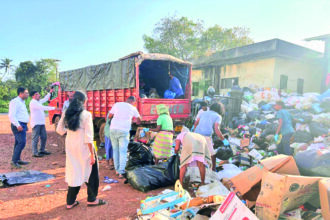
Recently I had requested students of Goa University to write an essay on any issue of their interest. Many of them chose tourism as their topic; they were much concerned with its negative fall-outs. These included depletion and pollution of ground water, ever growing piles of solid waste, encroachments on public beaches and most alarmingly growing drug abuse, associated crime and women’s insecurity. They also felt that little of the economic benefits reach the people of Goa. Why then do we need such development? Why not focus future tourism development on enterprises that are nature friendly and give full scope to local initiatives like Verle?
Furthermore, Goa could revive its currently stagnating mining business and mismanaged community resources through novel initiatives involving people. In this context, the provisions of the 2006 Forest Rights Act conferring management rights over Community Forest Resources to tribal, as well as other traditional forest dwellers are very pertinent. The ownership of such Community Forest Resources remains vested with the state, and these cannot be diverted to other purposes. We have excellent examples from Gadchiroli district of Maharashtra of how good management of these Community Forest Resources is bringing economic prosperity to tribal communities that were leading a precarious existence earlier. Notably, the people are on their own protecting part of these forests as newly constituted strict nature reserves. The Forest Rights Act is especially applicable to villages like Caurem in Goa’s Kepem taluka. Here palpably illegal mining operations have severely damaged water resources, adversely affected farming and horticulture, and created social anger and tensions. The mines are currently closed because of the illegalities and the Caurem Gram Sabha has unanimously resolved that that if they are to be restarted, this should be done through the agency of their Multi-purpose Co-operative Society.
The Government of Goa ought to seize this golden opportunity and do all that it can to ensure that it succeeds. True, the cooperative sector has had its share of problems, but so has the private sector and state enterprises. At the same time there are shining examples like Amul Dairy of successes in the cooperative sector. People of Goa must therefore insist that the Government will actually make its talk walk and vigorously support initiatives like mining, tourism and forest resource management in the cooperative sector.
(The writer is an environmentalist and headed the Western Ghats Ecology Expert Panel 2010)