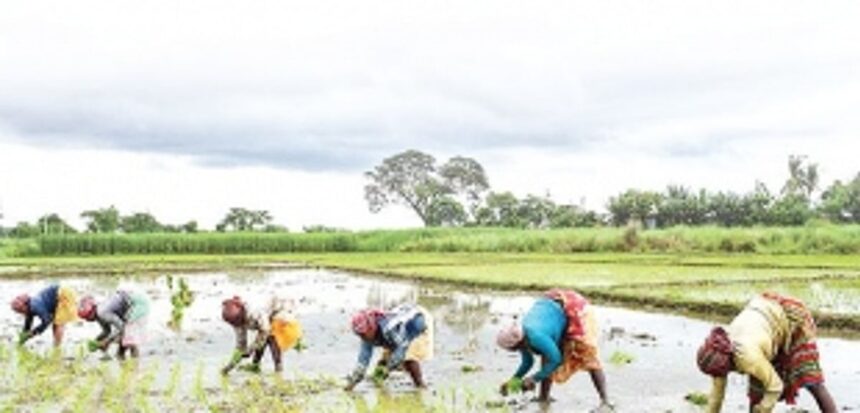
Last week, architect Tallulah D’Silva made a poignant case for the preservation of the agricultural lands of Taleigao. Apart from being a food bowl, the fertile soil is a vital part of a climate resilient ecosystem in Taleigao, aiding groundwater replenishment; its waterways helping to channel monsoon deluges. It is also a snapshot of Goa’s bucolic getaways that tourists come to experience. But this idyllic backdrop is now under siege. This rampant destruction of the very landscape that draws in tourists – particularly in the unscrupulous manner in which it is occurring– is happening not just in Taleigao, but across Goa.
Trading green fields for hideously grotesque, lurid concrete buildings to house temporary visitors is akin to killing the golden egg-laying goose, and then hosting a party to celebrate your incompetence. This is not development. This is a problem, and filling fallow fields to spur such concretisation is not a long-term solution, but offers only short-term financial gain. Ironically, these buildings become non-performing assets during global crises, like the pandemic we are currently experiencing, not to mention during other cyclical – now systemic – economic booms and busts. This model is discerned as development and propagated as sagacious truth. Mired in this short-sightedness, one becomes blind to the bigger picture.

Of course, the first step in dealing with any problem is acknowledging you have one. It is necessary for perspective and progress. Demographically, Goa has outbound migrants and inbound returnees. It is fathomable that some of the latter come with their share of cognitive bias. They have seen “development” in the cities and urban centres they return from, and want to emulate, and recreate, those conditions in a place that is neither suited, nor conducive to such an exercise. A place like Dubai, with virtually no flora or fauna to speak of, builds skyscrapers of glass and steel to keep the harsh desert conditions out, spending inordinate amounts of ludicrously unsustainable energy to achieve such climate control. This cannot be emulated in Goa, and to expect otherwise is preposterous. Yet, such “adapted” constructions, albeit not as glitzy or ostentatious, dot the land, marring the landscape.
Another cognitive bias is that a dip in tourism will decimate Goa’s economy. The truth is far from it, as even a cursory perusal of the state’s own economic reports will show. Agriculture and fisheries contribute just as much, if not more, to Goa’s economy. There was a time, not to so long ago, when these were the predominant shares. Goans celebrate several harvest feasts because of its historical food security. Ironically, much of its food is now imported, so what exactly is being celebrated?
Looking at examples to emulate, how about building an underground public transport system that does not impact the lands above? Perhaps like the one in Lisbon. Built in 1959, the project encompasses much of the city, providing connectivity to its people and tourists, without drastically altering its Lisbon’s famed architecture, public parks or monuments. Alternatively, we could seek inspiration from the many local, narrow-gauge rail lines that unfailingly connect commuters in rural Japan. In fact, any prefecture in Japan is a worthy case study in urban development. Just take a moment to ponder the myriad challenges architects and builders face, and then factor in environmental compatibility and adherence to aesthetics.
Such biases are detrimental to achieving any modicum of real development or progress, and would seemingly put the agriculture and tourism sectors at loggerheads with each other. But what if these sectors, along with intelligent official policy-making , could work together to provide a fresh perspective? A solution that includes incentives for: reverse migration and job growth/retention, the preservation of agricultural land, the restoration of beautiful old Goan homes, new economies of scale and community-driven micro-farming, increased food security, and the creation of a new, more sustainable tourism sector that empowers local homeowners? Enter: agritourism.
Imagine experiencing Goan hospitality in a lovely old traditional home, overlooking fields, where all your food is grown on-site or locally sourced. Tourists can participate in traditional practices like ‘purumenth’, learn age-old recipes and their ingredients, and old cooking methods – something truly unique to Goa’s intangible culture and heritage – while being thoroughly immersed in the farm-to-table experience. This holistic experience is independent of seasonal fluxes – because there are experiences to be had throughout the year, even when the land is fallow – and balances demand for hotel stays, and the consequent need for their unsustainable development. It also offers new exploratory escapes for Goa’s domestic tourists. All of the surplus fruits, vegetables, herbs and spices grown at these homes can be sold at community markets, which gives patrons a platform to connect, learn and subsequently enhance their own offerings to guests.
In summary: Preservation of agricultural land? Promulgation of farm-friendly policies? New, more inclusive tourism sector offering unique experiences, while also contributing to sustainability? Check. Job growth and skill development? You bet. People holding on to their traditional houses because they now see them as assets and not just cumbersome, savings-depleting relics to be pawned off to “outsiders”? One can hope. Generation of new revenue streams without adversely affecting land use, abetting concretisation, aiding unscrupulous profit-mongers or negatively impacting biodiversity? Accomplishable with high probability. All this with the added bonus of helping reverse the mass exodus of Goans seeking figurative greener pastures elsewhere for literally greener ones here – a bone of contention that many publicly lament, but privately participate in.
There is empirical proof that such an agritourism model not only exists, but has thrived, resulting in several socio-economic benefits, like empowering women with financial and entrepreneurial freedom. The country most famous for reviving its waning agricultural prowess into sustainable tourist offerings is Italy, through simple legislative policy. In 1985. It is 2020. Goa is only about 35 years behind, but thanks to the pandemic, is pretty much on level playing field for a reboot. Today in Italy, ‘agriturismo’ not only contributes to the agricultural industry’s share of the GDP pie, but also provides a significant contribution to the tourism sector. This, in a country that has Rome, Venice, Florence, Milan and the Vatican! Apropos, since we have a penchant for simulating ersatz western models, perhaps agritourism would be an ideal one to copy in Goa. Tried and tested, reproducible and impactful, this could be construed as development. The battle here, unequivocally, is not finding inspiration, but finding the right inspiration.
It is patently apparent that issues like destruction of agricultural land, deforestation, soil erosion and degradation, and many others that environmentalists like to keep picketing, cannot dissuade or perturb the commercial realpolitik and their concretisation cohorts. Their only purpose appears to be to make money while perpetuating the cognitive bias that buildings equal development. The only way to save these lands is to propose new industries and sectors that can leverage these assets as bringing long-term sustainable growth, appeasing both those who care about the land and those who only want to profit from it.