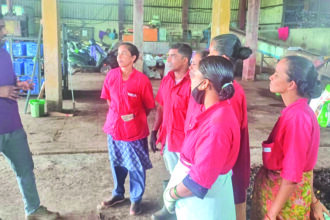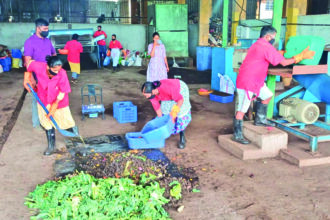
In the remote village of Adne-Balli located in Quepem taluka, around 180 women have come together and implemented a Watershed Development Project (WDP) that is turning the water stressed area into a water surplus area.
Against the backdrop of the problem of less water in rivers, the water levels in this area have shown signs of improvement and there is documented rise of 15 cm in the project area during lean season.
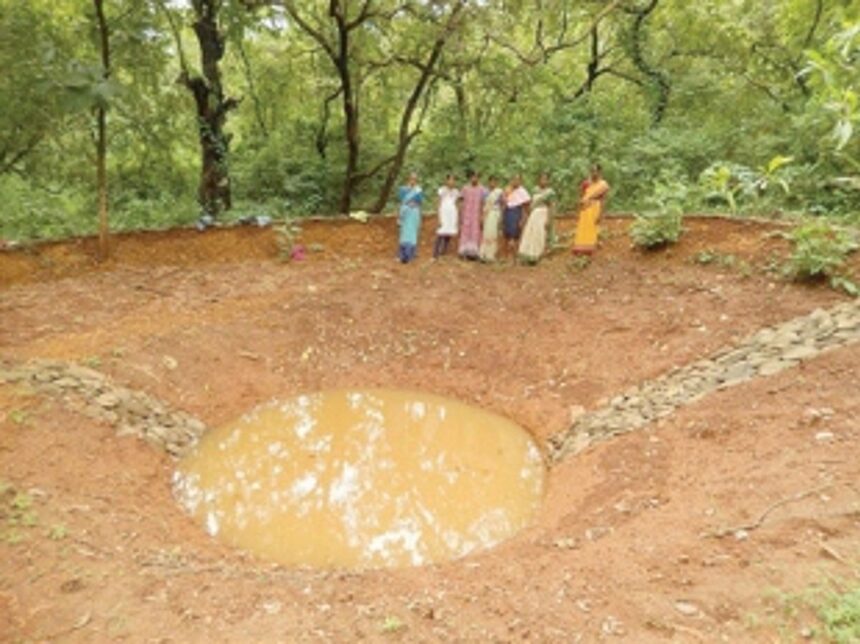
To achieve this, till date these ladies have dug 83,500 trenches, 328 gully plugs, 158 Loose Boulder Check Dam, 12 Gabion, 32 Sunken Ponds and 8680 running meter of live fencing. All these works have been done by using local people and no outside contractor and involved use of only local materials like boulders and there is no use of concrete. 90% of the money spent has reached directly to beneficiaries through their respective accounts.
To implement this project that started in 2012, the women formed 13 self help groups and one Watershed Association – ‘Somnath Panlot Sangh’- and it has strengthened the organization of community at grass root level and reduced seasonal migration.
The WDP promoted by Goa Shipyard Limited, Vasco as part of its Corporate Social Responsibility is executed by Mineral Foundation of Goa, Panjim and promotes participatory soil and water conservation activities by providing livelihood opportunities to the local community.
Till date Goa Shipyard Limited has spent Rs. 64.44 lakh on this project. The project has generated water harvesting potential of 30,000 cu.m that will ensure that 7.20 crore litres of rain water will be recharged every rainy season and will also arrest the movement of top fertile soil.
“The project developed sense of ownership for willing local people about the assets created and empowered the local community socially, economically and environmentally. Besides soil and water conservation activities, the ladies have started cultivation of vegetable and selling it to Goa Horticulture Development Corporation. The members of Watershed Association have started certain money as corpus for future maintenance and activities which has crossed Rs. 2.00 Lakh. A group has come together and availed solar fencing which will enable them to use the land more intensively,” said Dr Sachin Tendulkar, Senior Programme Manager, Mineral Foundation of Goa.
The project was initiated based on study initiated by Goa Shipyard Limited to identify the areas where GSL could intervene through their CSR funds. The study was conducted by Tata Institute of Social Science. However, before this project could begin, the idea itself seemed like a daunting task to the community especially the women of the area given their other daily commitments. To engage with the locals and get them on board Mineral Foundation of Goa took up a series of awareness meetings in different wards after they were identified as Project Implementing Agency and took some of the ladies on exposure trips to other parts of Goa where such projects had been implemented in the past.
“The project will continue till 2017 and will undertake more soil and water conservation structures so as to harvest at least 80% of the rainfall and recharge it into the ground,” added Dr Tendulkar.
Amongst the goals and objectives of the project, emphasis was laid on promoting soil and water conservation through participatory approach and to increase the time of concentration in watershed area and indirectly help in flood mitigation measures.
This helped increasing the base flow in streams and rivulets during lean season to support ecosystem services and reducing the sediment load in water bodies flooding.
The project has also helped increased awareness level of community about the dangers of desertification and water shortage and about dangers of forest degradation and associated climate change.
“It also helped to promote renewable resources like solar energy, biogas and achieve efficient use of fuelwood,” said a villager involved in the project.
She added that participation of large number of ladies in this program has helped in taking the message of environment conservation to every household and built the ownership of conservation practices amongst the villagers.
“Through this we have been freed of the problems associated with smoky areas as there is more awareness about biogas, solar cooker, solar lantern and energy efficient gadgets that have been partially implemented.
“Increased income in each household will help in adopting energy efficient gadgets in the household and reduce energy consumption,” said Dr Tendulkar while talking about what the project hopes to achieve.
On that note, he said that there will be more focus on diversification of agriculture through Good Agriculture Practices and increased availability of water will do away the uncertainties related to water and pointed out the increased level of well will reduce the requirement of storage of water and reduce resultant inundation.
Another interesting aspect of the project is that it has increased biomass and enhanced Carbon Sequestration potential of watershed area and it has promoted conducive microclimate for promotion of flora and fauna.
Digging of trenches, sunken pond, gully plugs, loose boulders, gabions have arrested the flow of top soil and organic matter which otherwise would have landed in nullahs and streams and lead to flood and also anaerobic decomposition of organic matter thus releasing Green House Gases.
“Promotion of biomass through live fencing of Gliricidia spp. has helped in arresting erosion, providing green manure, fixing nitrogen in soil and cutting down on requirement of Nitrogenous fertilizer. Microcredit and linkage with agriculture department through this project has helped people in adopting vermicompost technology and biogas system reducing the generation of biogas and better utilization of its potential,” said Dr Tendulkar.
The project has also promoted climate smart agriculture technique like SRI.
“Increased use of green manure and vermicompost has reduced use of chemical fertilizer and resulting environmental pollution due to leaching,” said a supervisor of the project.
Another eco friendly aspect is how the increased recharge of ground water has extended the moisture regime and supported the local flora and fauna including birds, reptiles, amphibians, butterfly, and insects etc which are part of the food chain.