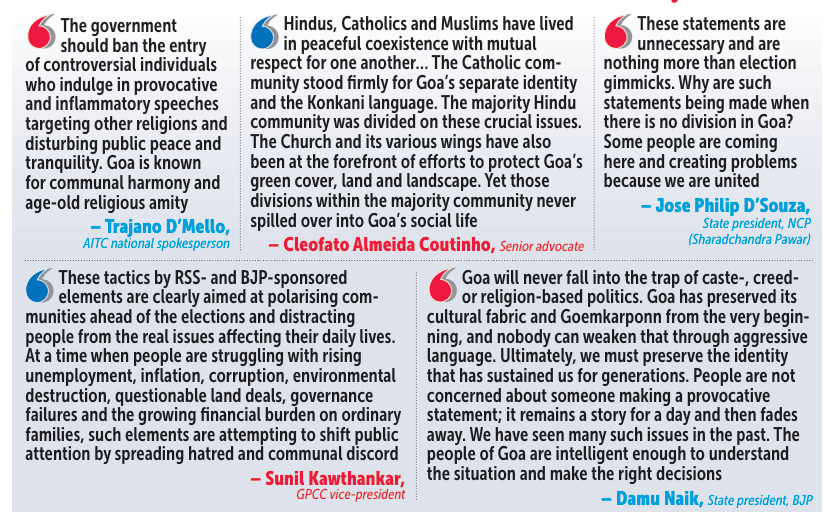
As Goa moves closer to the next Assembly election, a series of provoc ative statements by contro versial figures from within and outside the State has triggered concerns that attempts are being made to inject communal polar isation into a society long regarded as one of India’s strongest examples of reli gious coexistence. Recent remarks by Gau tam Khattar, former RSS Goa Prant Sanghchalak Subhash Velingkar and Tel angana MLA T Raja Singh have sparked debate over whether divisive rhetoric is being deliberately am plified to consolidate vote banks ahead of the polls. Critics argue that the growing frequency of such statements is not an isolat ed phenomenon but part of a wider political strate gy aimed at shifting pub lic discourse away from governance issues and to wards identity-based mo bilisation. AITC national spokes person Trajano D’Mello questioned why authori ties have not acted more decisively against individ uals accused of making in flammatory remarks. “The government should ban the entry of contro versial individuals who indulge in provocative and inflammatory speeches targeting other religions and disturbing public peace and tranquillity,” D’Mello said.
“Goa is known for communal harmony and age-old reli gious amity,” D’Mello said, alleging that provocative speech es are being tolerated to polarise sections of the electorate at a time when the ruling establishment faces a difficult electoral landscape. He pointed to the previous ban im posed on Sri Ram Sene chief Pramod Muthalik during the Manohar Parrikar government, arguing that authorities had once recognised the dangers posed by inflammatory rhetoric. The concerns extend beyond party politics. Senior advocate Cleofato Almeida Coutinho said Goa’s social fabric has historically been defined by shared cel ebrations, mutual respect and deep-rooted secular tradi tions that have survived political and cultural disputes for decades. “Hindus, Catholics and Muslims have lived in peaceful coexistence with mutual respect for one another,” Coutinho said, noting that festivals such as Ganesh Chaturthi, Christ mas, Eid, local zatras and the Feast of St Francis Xavier con tinue to draw participation across communities. According to him, even major political battles over Goa’s identity, language and education never translated into sus tained communal divisions within society. “The Catholic community stood firmly for Goa’s separate identity and the Konkani language. The majority Hindu community was divided on these crucial issues.

The Church and its various wings have also been at the forefront of efforts to protect Goa’s green cover, land and landscape. Yet those divisions within the majority community never spilled over into Goa’s social life. Politics during the Union Territory days was largely defined by people voting along community lines. However, there was never a concerted or deliberate attempt to divide society on communal grounds, as both the State and the country embraced secularism as a guiding principle of society,” Coutinho said, warning that such efforts would be at odds with Goa’s longstanding tra ditions of coexistence.
NCP (Sharadchandra Pawar) Goa president Jose Phil ip D’Souza described the controversial remarks as elec tion-season theatrics designed to manufacture divisions where none exist. “In Goa, you often cannot tell whether a person is Hin du or Catholic. We have always lived together. These statements are unnecessary and are nothing more than election gimmicks. Why are such statements being made when there is no division in Goa? Some people are coming here and creating problems because we are united. There is absolutely no need for such rhetoric. Are they expecting an award for it? Perhaps they are seeking publicity. Their mindset is not constructive; it is focused only on dividing the people of Goa,” D’Souza said. The Congress was more direct in linking the rhetoric to electoral calculations. GPCC vice-president Sunil Kawthankar alleged that com munal narratives were being promoted to divert attention from issues such as unemployment, inflation, environmen tal degradation, land controversies and governance fail ures. “These divisive tactics are clearly aimed at polarising communities ahead of the coming elections,” Kawthankar said, urging Goans not to allow communal tensions to over shadow issues affecting livelihoods and the future of the State. “These tactics by RSS- and BJP-sponsored elements are clearly aimed at polarising communities ahead of the elec tions and distracting people from the real issues affecting their daily lives. At a time when people are struggling with rising unemployment, inflation, corruption, environmental destruction, questionable land deals, governance failures and the growing financial burden on ordinary families, such elements are attempting to shift public attention by spreading hatred and communal discord. This is a danger ous and deliberate strategy to divert attention from the failures of the Dr Pramod Sawant-led government,” Kaw thankar added. “Our strength lies in the unity of all communities, reli gions and sections of society. No political agenda should be allowed to fracture this social fabric for electoral gain.
I appeal to every Goan, especially the youth, to reject the pol itics of hatred and division, remain focused on the genuine issues affecting their future, and stand together to protect Goa’s peace, harmony and identity. People must not fall into the trap of those who seek votes by creating fear and conflict instead of delivering good governance and devel opment,” he said. The BJP, however, dismissed concerns that such rhetoric would influence Goa’s political landscape. State BJP president Damu Naik maintained that Goa’s identity remains stronger than any attempt at communal mobilisation. “Goa will never fall into the trap of caste-, creed- or reli gion-based politics. Goa has preserved its cultural fabric how long they can absorb the escalating costs before their businesses become unsustainable. POPE CALLS FOR ‘DISARMING’ AI IN FIRST ENCYCLICAL “AI must be freed from logics that turn it into an instru ment of domination, exclusion and death,” he said. and Goemkarponn from the very beginning, and nobody can weaken that through aggressive language. Ultimately, we must preserve the identity that has sustained us for gener ations. People are not concerned about someone making a provocative statement; it remains a story for a day and then fades away.
We have seen many such issues in the past. The people of Goa are intelligent enough to understand the situ ation and make the right decisions. What is important is that we continue working for the betterment of the State without falling into anyone’s trap,” Naik asserted. His confidence, however, stands in contrast to growing unease among opposition leaders and sections of civil soci ety who fear that the repeated appearance of inflammatory voices is testing the resilience of Goa’s communal harmony. For generations, Goa’s social identity has been built not on religious fault lines but on a shared sense of Goemkar ponn that transcends community boundaries. The concern now is not merely about a handful of controversial state ments, but whether the State’s political discourse is begin ning to mirror the increasingly polarised narratives that have become commonplace elsewhere in the country.