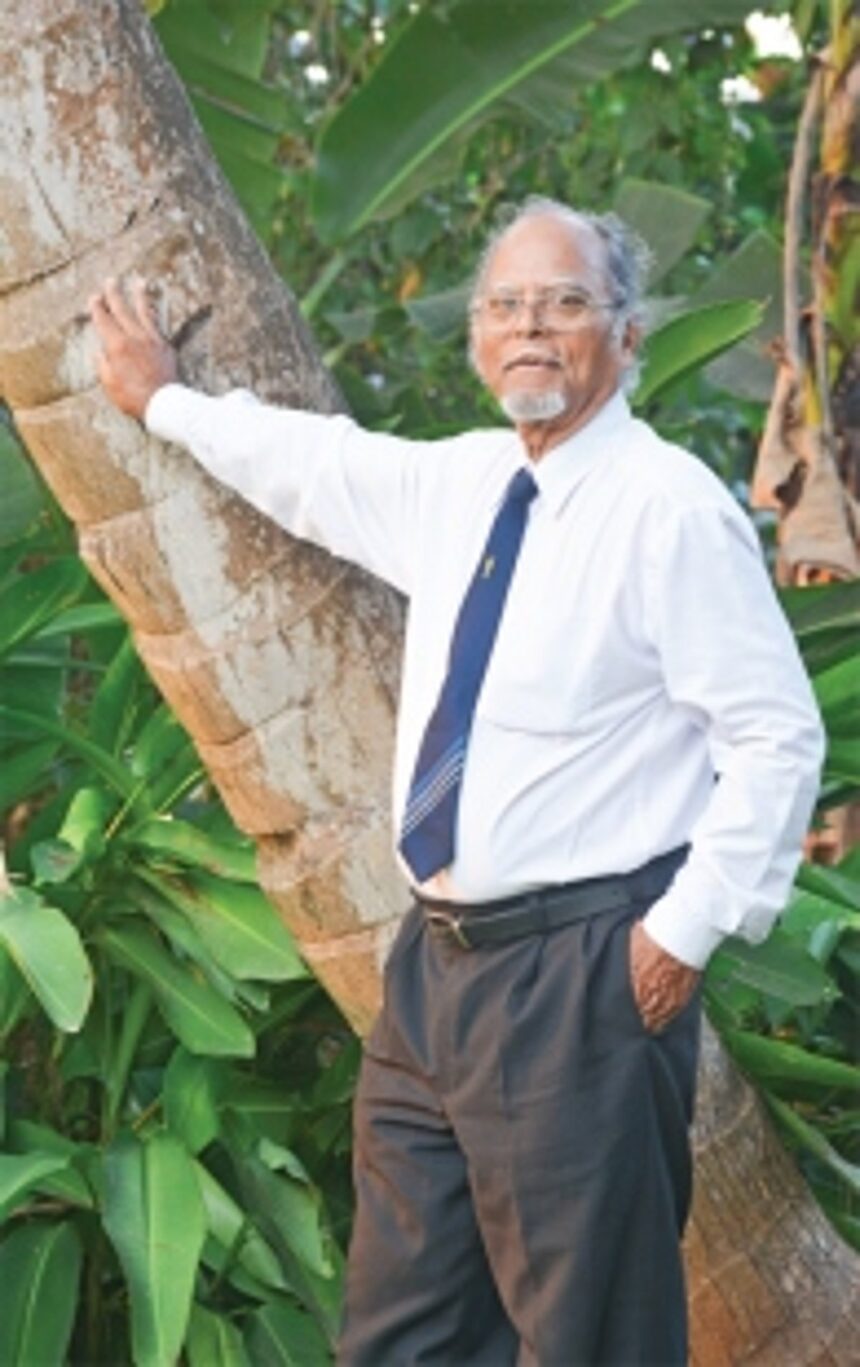
Joaquim Jose Lourenco Fernandes, popularly known as Lourenco, hails from Porvorim and was born on November 22, 1938. His father, late Arcanio Fernandes from Benaulim, was a tiatrist and a good singer. His close friend, Filipino Rodrigues, father of late Rosario Rodrigues, was a musician who belonged to the same ward. “Village feasts were incomplete without a tiatr,” informs Lourenco, “and every tiatr that my father would pen songs for, had music set by Filipino.”
He continues, “Tiatrs at that time were running in heavy losses so my father decided to move to Panjim. As some of the residents in Panjim were originally either from Benaulim or Curtorim, but mostly from Salcete, they would seek help from my father with regard to staging of tiatrs.”
Lourenco’s father informed him that the tiatrists did not earn much from tiatrs, and hence requested him to extend his full support to them. After completion of ‘Kurs de Electricidade’ successfully, followed by a supervisory course in order to obtain a licence, Lourenco took the initiative of eliminating the traditional ‘petromax’, which was widely used for tiatrs in the villages, and with the help of an inverter and six batteries, he introduced light and sound on stage in 1968.
This contribution of Lourenco was free of cost to all the tiatrists of yesteryears and contractor Carvalho would often hire him for light and sound. His tryst with special scenes and light effects came in for Kid Boxer’s tiatr ‘Kidachem Sopon’ wherein he introduced innovations to portray thunder, lightning, heaven, hell and fire on stage.
His next project was late Rosario Rodrigues’s tiatr wherein a mechanism was used to depict a moving snake. “It would not merely crawl on stage, but also climb,” he reveals. In Prem Kumar’s tiatr ‘Vauraddi’, Lourenco tried his skill at depicting a huge field on stage.
In one of late Fr Freddy da Costa’s tiatrs, Lourenco had the opportunity to work on artificial thunder and lightning, besides the river and waves. “Knowledge of electricity helped me to be more creative on stage and this was of use to the directors who worked on innovations and novelty,” he informs.
For the annual feast of Mary Help of Christians at Don Bosco shrine, Panjim, the oratory boys would put up a Konkani tiatr and Lourenco would always have a role to play. In tiatr ‘Satvo Sakrament’ by late Peter Gomes, he enacted the role of a priest, besides portraying the same role in one of the tiatrs presented by Hilariano Costa from St Estevam.
In 1975, when Fr Soares, the then chaplain of the chapel of Candelaria, Porvorim, requested Lourenco to pen a tiatr for the chapel feast, he staged the tiatr ‘Motlobi Put’ and enacted the role of a landlord (bhatkar), besides rendering Portuguese songs, with music by mestro Agostinho of ‘Merry Makers’.
In John Claro’s tiatr ‘Portugez Kolvont’, Lourenco was invited to render Portuguese folk songs. “During that period, cantos would be rendered by singers from backstage as artistes on stage were not quite confident in singing and I was instrumental in rendering them confidently,” he reveals.
One Lenten season, when Fr Nascimento Mascarenhas, the then assistant parish priest of Immaculate Conception Church, Panjim, penned a show ‘Jezuche Bhognar’, Lourenco was part of the troupe and enacted the role of a soldier. When tiatrist Domingo Joao would stage his tiatrs at Boca de Vaca, he would assist him with stage curtains, light and sound.
For the feast of Immaculate Conception in Panjim, when noted photographer Gilbert Goes from Alto de Gimarias would stage a tiatr, he would seek assistance from Lourenco to sing songs, besides light and sound. He also rendered songs of noted singer Diogin de Melo at Cine Nacional for musical show ‘Jogos Florias de Goa’.
Lourenco is still the proud owner of certain rare costumes of the king and judge, besides animals like cows, goats made of papier-mâché and will not hesitate to provide to those tiatr directors who are in need of them.
When Lourenco became the Deputy Director of the Government Printing Press, he could not devote much time for the tiatr stage as permission from the authorities was a rarity. Since then, he shifted from the tiatr stage to folk art and made immense contributions towards the Goan mando and dulpods.
In 1966, when the Goa Cultural and Social Centre organised its first Mando Festival, Lourenco’s troupe ‘Tuna Sparkx’ won the first prize for two consecutive years. And for the past 50 years, he has been part of the festival, by involving children and teenagers, besides the seniors.
For the past nine years, Lourenco has been organising mando festivals at Porvorim under the banner ‘Goan Folk Art Group’. He also assists children in schools who are keen in learning the Goan mando and Goan folk dances.
A while ago, the Goa Cultural and Social Centre presented Lourenco with an award for his commitment towards the mando, dulpods and Goan folk art. For his immense contribution towards tiatr, the 125 years Tiatr Celebration Committee along with Tiatr Academy of Goa felicitated him with the Lifetime Achievement Award at Mapusa.