A taxi driver by night and garage owner by day, Viraj Vengurlekar is the simple, grounded, hard working Goan supporting his family. On many of his trips, ferrying tourists across the state, he would notice at least one cow lying injured on the road each day. Says Viraj, “The sight would depress me no end. Even when I passed the route few days later, I’d notice the cow still lying there with no human help to ensure treatment for that injured animal. The look of an injured, helpless animal can be haunting.” This haunting feeling made Viraj research on solutions that led him to the idea of reflective belts for cows. Though not new in India, this idea hadn’t been mooted in Goa as yet.
With google as his guide, Viraj procured these reflector belts from Mumbai and his wife Pooja stitched the first stock of material to size. Viraj happily states, “With few people backing us, we’ve been able to buy better quality waterproof material.” Explaining the modus operandi of how these belts are put around the cow’s neck, Viraj explains, “We usually set out post 11 p.m. This has to be done in the night when cows are generally resting. We wait around them and let them get familiar with us. We gently pat them and when we know the cow is comfortable, we tie this belt around it’s neck. Sometimes they can get aggressive; in which case we leave them and come around later a second time. We try and minimize risks.”
Working along the highway in Siolim, Taleigao, Succorro, Assagao and Calangute, in this operation, for once black is given priority over white. With a chuckle Viraj adds, “We give importance to target black cows first for obvious reasons since they are difficult to see at night.” With a team of 10 individuals who volunteer their time, they work in groups and in shifts to cover more areas.”
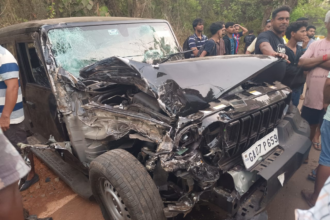
While stray cattle is a menace that needs to be tackled more seriously, this interim solution at least helps limit accidents. Talking about the impact that this relatively homegrown solution has made, Viraj states, “Stray cattle has always been a problem in Goa leading to many fatal road accidents. From our estimates, around 1000 cows were hit per month. These belts can prevent at least 60-70% of accidents especially not attributed to drunk driving.”
With appreciation and aid coming from few lay people, usually foreigners, Viraj got the NGO registered recently. Newfound confidence after seeing the success of his intervention has made him and his team ready to target the tourism belt of Sinquerim to Arambol, Airport to Calangute road on the highway and especially within Arpora and Calangute. Viraj is hopeful that MLAs from different constituencies will see merit in his work. Adds a hopeful Viraj, “I hope Michael Lobo’s constituency will reach out to us. We will be extremely happy to be of service to them considering that stretch is a busy tourist hub. Recently a member from the Keri panchayat wanted to use these belts in his ward and bought these belts from us. We can deploy more teams in North Goa and also enlist volunteers from South Goa if the MLAs there want it.”
Seeing these belts, many others have tried to make their own. However Viraj cautions on the safety aspects first, “We may put a belt around a calf’s neck but as it grows, it will tighten and choke the calf. Backed by his first hand knowledge, Viraj has also designed the belt keeping safety of these animals in mind. He explains, “I have designed this belt using buckles which cannot be tightened but only loosens so it is self adjustable as the calf grows. A cut in the buckle also ensures easy snapping, enabling the cow to free itself should it be invariably stuck.”
Viraj is now keen to make these reflector belts available to stray dogs as well. “I could provide these belts to the NGOs working with stray dogs. On a sterilisation drive, they could easily slip on the reflector belt as well.”
While their efforts have been met with a lot of appreciation and general bonhomie, little funding has come their way. Shares Viraj, “I’ve been using a lot of my personal funds but going forward, to even make this feasible for the team, working at night, we look forward to local panchayats and MLAs support.”
Commenting on GAAPS, Atul Sarin (Founder, Welfare for Animals in Goa) says, “This is a good initiative and it is commendable that someone has addressed this issue. However, in the long run, we must have stricter norms to ensure that no cattle is found on the streets. In cities and towns, we shouldn’t have stray cattle on the streets at all. There should be stricter rules for cattle owners and they should be responsible for keeping them in shelters and the Panchayat leaders should have the will to impound stray cattle.”
Setting the trend for citizen action and initiative, Viraj has a long way to go but in the interim, he can be rest assured of ‘mooing’ gratitude for his noble deed.
Contact: Goa Accident Prevention Society (9561224785)